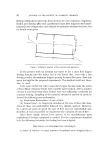
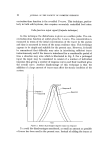
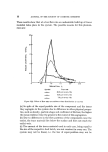
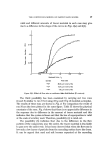
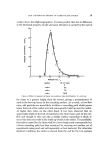
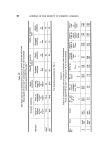
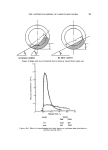
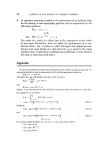
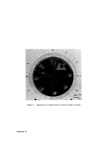
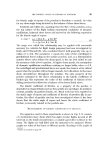
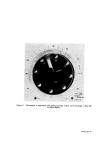
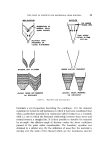
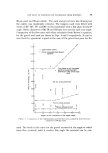
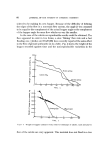
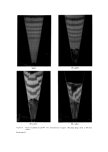
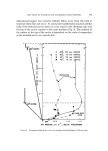
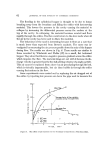
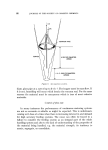
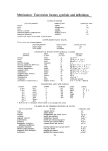
Figure •. Apparatus for measurement of kinetic angle of repose. Facing page 39

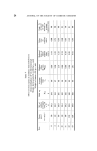
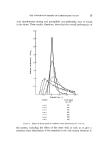
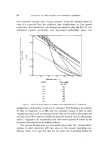
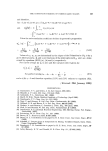
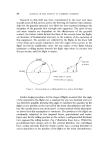
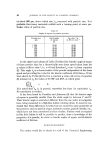
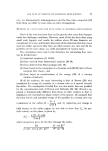
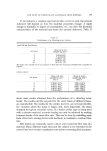
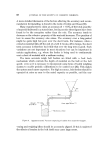
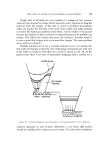
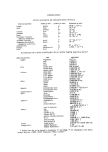
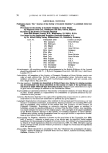
THE KINETIC ANGLE OF REPOSE OF POWDERS the kinetic angle of repose of the powders is therefore a variable, its value for any drum angle being dictated by the balance of these three forces. Schofield and Glikin (1), assuming that the flow of the powders across the top surface of the flight holdup represented conditions of dynamic equilibrium, balanced these forces and arrived at the following expression for the kinetic angle of repose: )•=tan-1 !•+ u (Cos 0 -- • Sin 0)* ................ (i) 1--u {• Cos 0 q-Sin 0) The range over which this relationship may be applied with reasonable accuracy (i.e. suitable for flight design purposes) has been investigated by Kelly and O'Donnell (2), who concluded that it held generally true up to values of u=0.4. The parameter u equals the ratio of the centrifugal to gravitational forces acting on the surface powders, and, as a dimensionless number whose value defines the drum speed, is the one best suited to rate the accuracy of the above equation. At higher drum speeds, the assumption of dynamic equilibrium conditions existing no longer holds when u= 1.0, the centrifugal and gravitational forces are equal, the drum is at its critical speed when the powders will no longer cascade, but will adhere to the inner drum circumference throughout the rotation. The only property of the powder contained in the above relationship is the kinetic coefficient of friction (•) this represents the value of the coefficient of friction of the sliding powders that allows for a balance of the forces listed above. The kinetic coefficient of friction, as a property of the powder, is dependent on characteristics such as the particle size and shape, its moisture content, possibly its particle density, etc. Much work has been reported on the static angle of repose and coefficient of friction of powders (3) in par- ticular, the effect of particle size has been investigated where it has been shown that the static angle of repose and hence the static coefficient of friction, is inversely related to the particle size. MEASUREMENT OF KINETIC COEFFICIENT OF FRICTION The apparatus used in these experiments is shown in Fig. 2. It consists of a horizontal rotary drum which has eight circular flights located at 45 ø intervals on the inside circumference a variable speed drive is fitted to the drum. The flights are half filled with the material to be analysed. Photo- graphs are taken of the drum at different speeds. Readings of the angles of * Table of symbols in page 47.
Purchased for the exclusive use of nofirst nolast (unknown)
From: SCC Media Library & Resource Center (library.scconline.org)