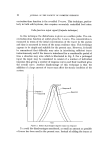
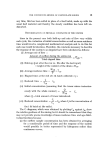
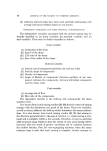
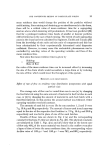
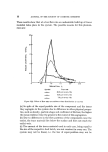
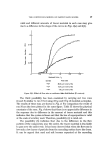
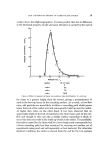
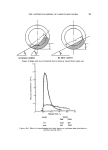
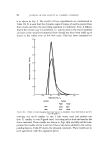
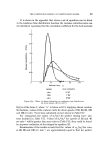
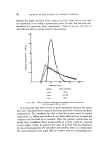
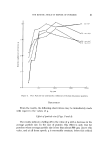
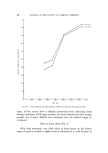
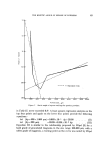
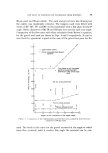
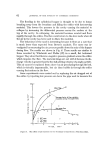
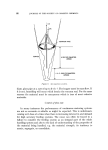
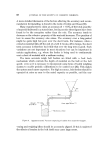
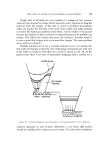
THE FLOW OF PARTICULATE MATERIALS FROM HOPPERS pressure profile, the end of the pipe being positioned at the point of maxi- mum negative pressure. As expected, the flow rates increased in the mass flow regime to values expected from Brown's analysis (Fig. 7). Air in- jection had no visible effect on the flow rate of the gravel. From the above discussions it appears that when the flow of cohesive or fine granular materials is being considered it is important that the effects caused by the interstitial fluid be taken into account. Recently an attempt has been made by Shook (28) to consider the effects of drag on the flow of material from a hopper, and to formulate a general flow equation. He was not able to solve this equation, but was able to show that it reduces to Brown's, {1) if interparticle force and viscous effects are ignored, (2) if free fall of the granules from the orifice is assumed, (3) if the material is assumed to be sufficiently porous for the pressure gradients associated with flow through it, to be negligible, and {4) if porosity changes in the orifice region are small. It has been shown by experiment that these assumptions appear to be reasonably justified provided that the particle size of the material is greater than 200 •m. CONTROL OF THE FLOW RATE Hopper design has been discussed and its importance cannot be over- emphasized. However, in many instances, there are good reasons why the ideal design cannot be used. For instance, some cohesive materials can support large arches and so require large orifices for spontaneous discharge under gravity. If small amounts of material are to be stored or if the hopper is to be discharged into small scale process equipment, the use of large orifices is precluded. In such circumstances the first requirement before flow control can be attempted is to make the material flow out of a smaller orifice than it would normally do. Free flowing materials will not be con- sidered, for acute problems do not normally arise with these materials. MEANS OF ASSISTING THE FLOW OF FINE MATERIALS Aeration when a container is filled with a cohesive material the air trapped in it as a result of being poured, is often sufficient to reduce the strength of the

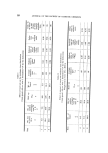
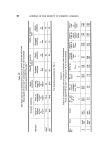
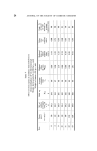
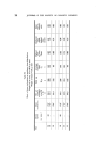
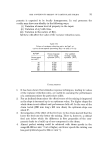
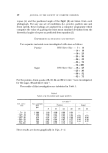
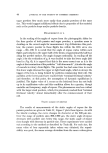
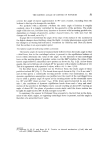
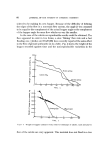
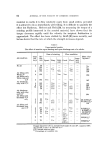
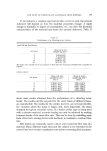
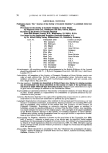
64 JOURNAL OF THE SOCIETY OF COSMETIC CHEMISTS material to enable it to flow relatively easily from small orifices provided it is allowed to do so immediately after filling. It is difficult to quantify the effect but Matheson, Herbert and Holt (29), by measuring the torque of a rotating paddle immersed in the aerated material, have shown that the torque decreases rapidly until the velocity for incipient fluidization is approached. The effect has been studied by Bruff {30) more recently, and he has shown that the rate at which the strength increases depends Table I Experimental results. The effect of aeration upon starting and upon discharge rate of a calcite. Ease of starting Flow condition Time Ori- Mean flow Air condition left, fice Inter- kg min' days mm Spont. Easy Diffi- Const. Fluct. mir- cult tent No air {r 76 ...... No 152 ...... No 304 -- Yes -- -- Yes --- 240 .• 152 -- -- Yes -- Yes -- 187 Air filling only With C/P 4 152 ..... Yes Yes -- -- 236 Air filling only With ring and C/P 2 152 Yes -- -- -- Yes -- 347 Air discharge only with C/P .• 152 -- Yes -- Yes -- -- 222 {r 152 --- Yes -- Yes -- -- 224 1.t:z 38 --- I Yes -- __ Yes -- , 16.4 76 -- , Yes • -- Yes -- 92.0 Air discharge I only with ring and C/P 152 Yes I .... Yes -- 394 Air filling and discharge C/P only I -} 38 Yes ..... Yes 23.1 ( 1 O0 •) * 2 152 -- Yes -- -- Yes -- 148 Air filling and discharge ring I and C/P • 152 Yes .... Yes -- 317(95 •)* i • 38 -- Yes I -- Yes I -- -- 8.33(85•o)* {r 76 Yes -- ---- • Yes -•- 33.2(90 •0) * ..} 76 Yes --- -- Yes ..... 440(95 •o)* (so • 76 I ___ Yes -- Yes i .... 325(90%)* 2 76 -- ' Yes ..... Yes .... 306{83•)* (120s) Hopper diameter 0.61 m, included half angle of cone 20 ø, capacity 1001. Air rate 40 1 min-1 at 13.8 kN m-2 C/P: central aeration pipe i Percentage at constant rate
Purchased for the exclusive use of nofirst nolast (unknown)
From: SCC Media Library & Resource Center (library.scconline.org)