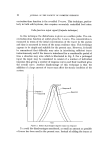
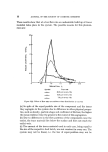
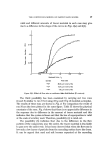
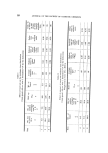
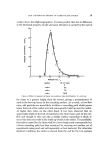
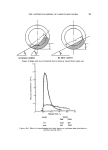
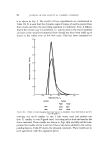
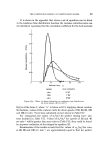
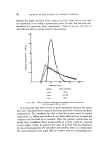
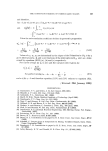
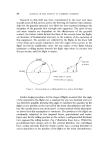
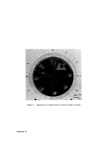
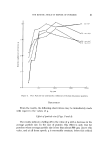
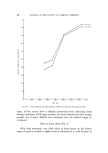
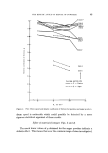
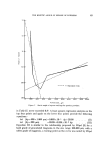
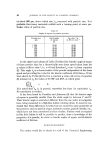
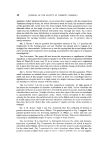
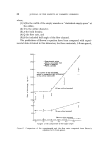
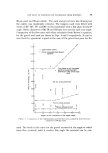
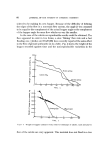
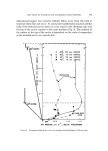
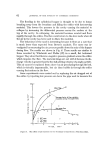
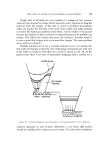
THE KINETIC ANGLE OF REPOSE OF POWDERS cement the angle of repose approximates to 90 ø and a tunnel, extending from the bottom to the top of a storage silo, can form. For particles with a diameter 0.Sram the static angle of friction is roughly constant, since it is largely controlled by the geometry of the particles. The static angle of friction can, for these sizes, increase or decrease with increasing particle size, depending on changes of geometry, surface characteristics, etc. with size but the changes will be small, as in Fig. 7. In page 44 it is stated that the angie of the slope of the surface of the material in the flights changes about halfway along the flight. A similar phenomenon occurs with the change in a rotating ball mill and a treatment by Sullivan and Rose (7) shows that the surface is an equi-angular spiral. The lecturer made the following written comments: The kinetic angle of repose is fundamentally different from the static angie in that a third force, due to the centrifugal action, is present in the equilibrium balance of forces which determine the value of the angle. As the direction of this centrifugal force on the moving plane of powders varies over the 360 ø rotation, the value of the kinetic angle follows a sinusoidal curve pattern as shown in Fig. 1 (2). At low drum speeds, this curve flattens out at about 45 ø for powders with a kinetic coefficient of 1.0. This is in agreement with equation I where, with l)-•0, •, =tan- • (1.0). On the other hand, as pointed out by Professor Rose, the static angle of these particles is about 30 ø (Fig. 7). The lowest drum speed shown in Fig. 5 is 8 rev rain-1 and at this speed, a continually moving powder surface was maintained, i.e. the dyna,nic equilibrium assumption was justified and the result of the centrifugal force was to yield a greater angle of repose at the turning points on the sinusoidal curve (i.e. 90 ø and 270 ø where [t=tan-• •.}•). If the drum speed is lowered to, say, 2 rev rain-•, the conditions of dynamic equilibrium break down and a 'stop and start' motion of the powder in the flights result, cascade starting at about 55 ø, leaving an angie of about 35 ø , the plane of powders remain static until the drum motion has brought its angle back to 55 ø . It still averages out at 45 ø . In summary, the answer to Professor Rose amounts to the fact that in the form- ation of the static angles, no opposing centrifugal force is present, and the angle is therefore of a somewhat lower value. (7) Sullivan, R. M. E. and Rose, H. E. Treatise on internal mechanisms of ball, tube and rod mills (1958) Constable, London.

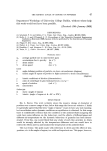
J. Soc. Cosmetic Chemists 21 53-72 (1970) ¸ 1970 Society of Cosmetic Chemists of Great Britttin Some aspects of the flow of particulate materials from hoppers j. E. P. MILES* Presented at the symposium on "Powders", organised by the Pharmaceutical Society of Ireland and the Society of Cosmetic Chemists of Great Britain, at Dublin, on 17th April 1969. $y!lOl•.q.q--Some of the problems that are likely to be encountered in the design of STORAGE systems for particulate materials are outlined together with some methods of overcoming them. A brief description of the JENIKE theoretical treat•nent of material failure in a HOPPER and its use in the design of mass flow hoppers is given together with a discussion of the advantages of using such hoppers. The distinction is drawn between design for a certain type of f•ilure and subsequent flow. METHODS of calculating FLOX•V RATES of GRANULAR materials from hopper ORIFICES under free fall conditions in which drag effects are neglig- ible, are discussed. The effects of drag on the flow of fine materials has been demonstrated by reference to experimental data obtained from full scale and model hoppers. The practical problems that arise for mass flow hopper design are considered together with the problems involved in designing accurate FEEDING SYSTEMS. Some methods and DEVICES for overcoming these problems are mentioned together with the principles of operation and likely range of application. INTRODUCTION Millions of tons of bulk materials are handled in industry annually. At some time most of these materials are stored in some sort of hopper or bin from which they are removed by gravity. In these days of increasing automation a most important requirement is that the material should dis- charge smoothly and continuously when the orifice is opened. The problems involved in the storage of particulate materials can be divided into those associated, *Warren Spring Laboratory, Ministry of Technology, Stevenage, Herts. 53
Purchased for the exclusive use of nofirst nolast (unknown)
From: SCC Media Library & Resource Center (library.scconline.org)