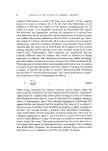
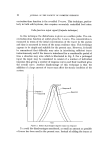
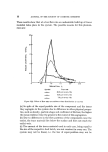
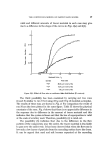
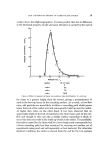
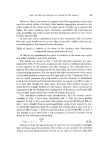
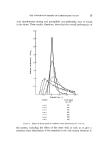
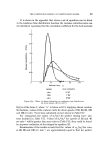
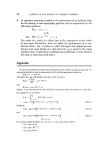
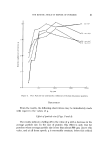
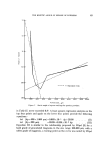
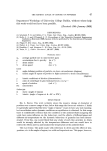
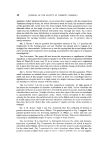
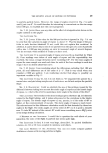
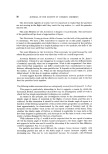
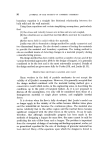
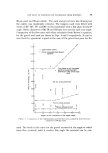
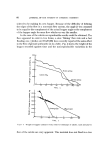
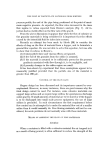
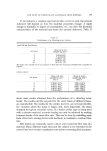
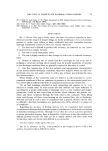
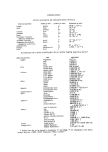
THE KINETIC ANGLE OF REPOSE OF POWDERS 45 33'5 F 32.5 30,! 29.• 28'5 0 ..,...."'•" / = Regression lines 200 400 soo eoo •000 •200 •400 •600 •eoo 2000 Particle size, •m Figure 7. Static angle of repose readings for pumice powders. in Table II, never exceeded 0.5 ø. A least squares regression analysis on the top four points and again on the lower four points provide the following equations:- kst (dp500 1 800 pm)=0.903X 10⁻³ dp+29.00 (II) kst (dp500 pm) =33.29--0.925x10⁻² dp (III) Equation Ill is similar to the relationship proposed by Pilpel (3) for a hard grade of granulated magnesia in the size range 100-800 gm with a softer grade of magnesia, a turning point on the curve was noted by Pilpel

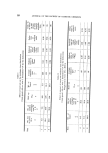
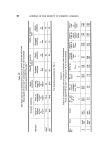
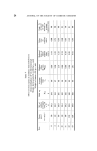
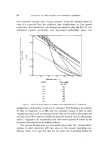
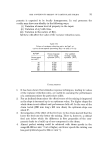
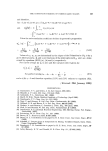
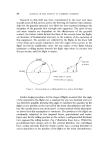
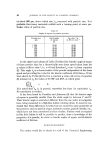
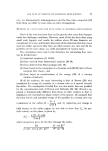
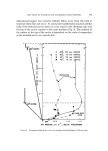
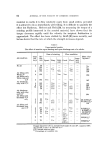
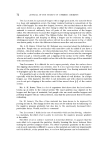
JOURNAL OF THE SOCIETY OF COSMETIC CHEMISTS at about 800 pm, above which size, •t increased with particle size. It is probable that many materials exhibit such a turning point at some par- ticular value of particle size. Table II Angles of repose for pumice powders . Powder size Static angle •k----tan - pm of repose at 32 rev min- 1 800 30.50 43.20 1 025 30.10 45.25 725 29.95 43.85 510 29.10 43.50 360 29.36 37.50 255 30.06 37.50 180 32.58 32.20 In the right hand column of Table II is listed the 'kinetic' angle of repose of these powder sizes for a theoretically zero drum speed taken from the p values at 32 rev min-1 i.e. u----0 and therefore •k-----tan-1 I• from equation {I). This angle •k is a characteristic of the powder independent of the drum speed and providing the value for the kinetic coefficient of friction p. It has been shown by Porter {4) that for a constant I• value, all curves of equation {I) intersect at •k for values of 0 =00 ø and 270 ø, at which point It is noted that •t is, in general, somewhat less than its equivalent •k' No correlation is evident. It has been found by Franklin and Johanson (51 that the kinetic angle of repose is generally smaller than the static angle by between 1 ø and 5 ø. Their kinetic angle is somewhat different from the one under investigation here, being measured in a flightless hollow rotating drum. It must be con- cluded that these differences in behaviour are caused by some properties of the powders, such as particle shape, moisture content, particle density, etc., which have not been considered in these studies. Further work is required in this field before it will be possible to predict, from a knowledge of the properties of a powder, its static or kinetic angles of repose and its kinetic coefficient of friction. ACKNOWLEDGEMENT The author •vould like to thank lhe staff o[ the Chemical Engineering
Purchased for the exclusive use of nofirst nolast (unknown)
From: SCC Media Library & Resource Center (library.scconline.org)