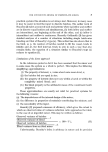
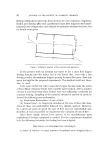
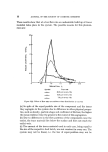
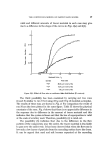
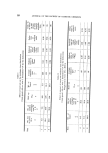
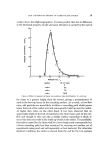
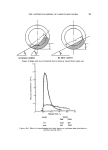
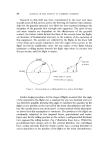
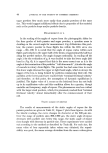
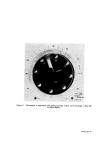
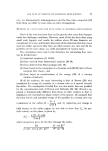
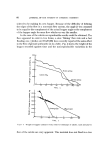
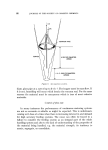
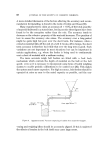
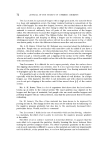
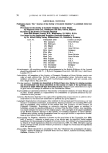
THE CONTINUOUS MIXING OF PARTICULATE SOLIDS Mixtures of bulk solids and their quality The "point" has been defined as an elemental volume which is small compared with the whole system, and even small compared with the scale of segregation, but includes many molecules. At the first sight these con- cepts appear to be applicable to bulk solid systems provided a single molecule is considered to be equivalent to one single solid particle. Un- fortunately, in many cases, particularly in bulk solid systems, it is difficult to meet the two conditions in the definition of points and, therefore, it is not possible to design satisfactory experiments to obtain information about the quality of mixing by using this concept. For this reason, in spite of repeated proposals for the use of serial correlation coefficients as an index of mixing (12, 13) this method has been avoided. Recently Schofield (14) made such an attempt and has shown the difficulty and limitation of this approach. It is, therefore, felt that the approaches (15-22) proposed to describe the quality of mixing in batch mixing may be followed. In many cases this would prove to be uneconomic. In most industrial cases the long term variance is of prime importance. In cases where it is necessary to determine the degree of mixing for other scales of scrutiny, experiments should be performed using that scale. APPARATUS The present investigation is intended to characterize the performance of a simple rotating cylindrical drum as a continuous mixer. A drum having a length of 200 mm and a diameter of 100 mm was obtained from a standard mild steel pipe. Two steel plates having circular openings were fixed with counter-sunk screw at the two ends. The inlet and outlet opening were 20 mm and 60 mm diameter respectively (Fig. 1). The drum was placed on rollers rotated by a variable speed motor. The whole assembly was mounted on a steel frame having a device to give the desired tilt to the drum. The feeding of bulk solids at a constant rate is a major problem. Lee (23) described a number of feeders available, with a list of manufacturers, but these feeders are mostly on the industrial scale. Recently Hickerson (24) has put forward a theory of vibratory feeding. This author, by analysing the mode of operation of a feeder, has shown the specific applicability of different kinds of feeders. In their experiments Poole et al (25) used a Sinex feeder model C.W.F.1. and a Metler feeder model D.W.A.10 coupled with automatic recording devices to show the amount of material

JOURNAL OF THE SOCIETY OF COSMETIC CHEMISTS flowing within given intervals these devices are very expensive. Sugimoto, Endok and Tanaka (2t3) used a partitioned mass flow hopper to feed simul- taneously two components, and claimed to maintain constant feed rate, but no details were given. --200mm- Figure I Schematic diagram of the experimental apparatus In the present work an attempt was made to use a mass flow hopper feeding directly into the mixer, but it was found that, even with a free flowing powder, the minimum hopper opening for mass flow gave a flow rate much too high for the proposed experiments. This method could not, there- fore, be used. Tests were carried out with a mass flow hopper having under the outlet a Sinex Minor vibratory feeder with variable speed control. After a number of tests it was found that these feeders were not sufficiently consistent for constant feeding. Sampling of the material stream for periods of about lh showed the following non-uniformities: (a) Short-term fluctuations of rate of flow. (b) Linear trend--i.e. long-term variation of the rate of flow with time. None of these non-uniformities followed any definite pattern. Moreover, for a given set point of speed the rate of flow was not reproducible and, therefore, it was not possible to characterise the variation of rate of flow. Since these simple devices have proved to be unsatisfactory more sophisticated feeding equipment is needed. For the experiments described here the following technique for feeding has been adopted. DISCUSSION OF EXPERIMENTAL TECHNIQUE A series of batches of equal amount of material were weighed into a
Purchased for the exclusive use of nofirst nolast (unknown)
From: SCC Media Library & Resource Center (library.scconline.org)