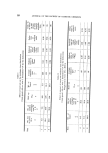
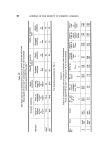
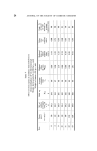
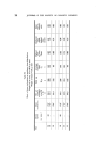
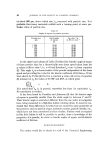
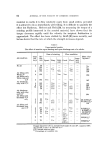
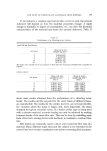
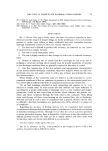
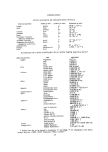
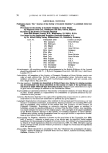
THE FLOW OF PARTICULATE MATERIALS FROM HOPPERS !37 If, for instance, a constant speed device like a screw is used, the amount delivered will depend on how the material properties change. A slight change in humidity or degree of consolidation, etc., can alter the frictional characteristics of the material and hence the amount delivered. Table II Table II Performance of a vibrating screw feeders. Sand 1,50 Ilm free flowing Set point 2 4 6 8 10 Mean for } min samples kg min-! 3.$8__+ o.s yo 7.44__0.9% 11.24_+1.1% 14.69_+ 1.5• 18.11 ñl.l• The tests were carried out over a period of days and the means are obtained for a number of repeats. Calcite cohesive Set point 2 4 6 8 10 Mean of • min samples kg min- Run 1 2.49+2.41% 4.65 + 1.80 % $.65 + 1.94 % 6.36+ 1.99% 7.55 + 5.86 % Mean of •t min samples kg min-1 Run 2 2.35+1.41% 4.63 _ 1.40 % 6.34 + 1.20 % 7.82 + 1.54 ,%0 8.72 + 1.55 % shows some results obtained from the performance of a vibrating screw feeder. The results and the set point for the sand, taken at different times, are reproducible. The results for the calcite, however, are not reproducible, the variation about the mean is larger, and, more important, the mean obtained for a given set point varies. If a feeder of this type is being used with a cohesive material, accurate feeding can only be achieved by making frequent checks of the mean flow rate. This can be done by installing some form of feed rate sensing device with feedback, to maintain a constant flow rate. Belt feeders are commonly used to detect and control the flow rate of a material. Many different types exist and the subject is too extensive to be entered into here except to emphasize some points concerning their accuracy.

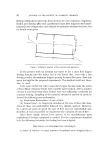
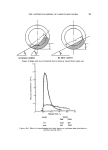
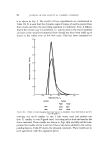
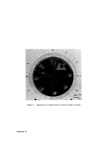
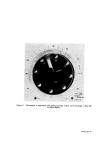
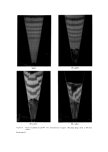
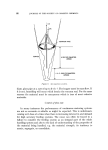
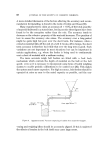
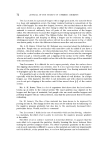
68 JOURNAL OF THE SOCIETY OF COSMETIC CHEMISTS A more detailed discussion of the factors affecting the accuracy and recom- mendation for installing, is found in the work of Colijn and Chase (31). Many manufacturers claim an accuracy of + 0.5% of the total quantity of material delivered in a stated time, but in practice these figures have been found to be the exception rather than the rule. The accuracy tends to decrease as the cohesive property of the material increases. The question of how to assess the accuracy also arises. The accuracy over a long period might be quite high but poor over the short term. For instance, when a cohesive material falls off the end of a belt it breaks off in lumps, the short term accuracy is therefore bad while that over the long term is good. Such variations are not important in most situations but can be important in certain applications, e.g. where the feeder is being used to continuously coat a sheet of material with a uniform coating. The more accurate weigh belt feeders are fitted with a feed back mechanism which controls the depth of material on the belt or the belt speed even so it is necessary to incorporate some form of batch weighing system to enable periodic calibrations to be carried out (32). This makes the system much more expensive. For high accuracy, belt feeders should be operated at rates as near to the rated capacity as possible, and the con- Figure 9, Apparatus used. Vacuum emptying of calcite from mass flow hopper. veying and weighing idlers should be accurately aligned. If this is neglected the effects of tension in the belt itself may cause large errors.
Purchased for the exclusive use of nofirst nolast (unknown)
From: SCC Media Library & Resource Center (library.scconline.org)