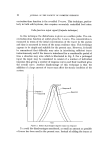
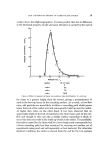
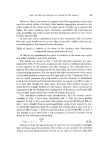
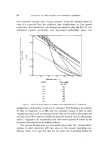
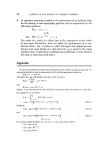
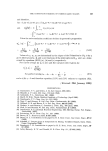
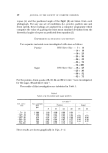
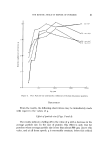
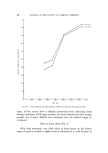
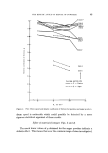
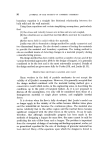
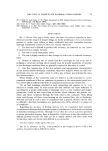
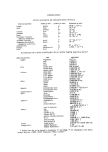
THE CONTINUOUS MIXING OF PARTICULATE SOLIDS 33 and therefore, I(r)-:I l(r)+I2(r)+i 3(r)--« (tl lcte-q ! r+q2 •e-q2r +q 3ye-q3 r) and c•lc•i 2-- 2 f o• I (r) R(r) dr r:o • (•ae-•r •2•e-•2 r + •3Te-•3r) R(r) dr o When the autocorrelation coefficient declines in geometric progression: o o / G] = •ae-•r + •2Be-•2r + •37e-B3r erløse a dr o -- • l_1ogea + 2_1ogea + 3_1o•a ...... (XIV) Values of • l, • 2, q 3 are determined by the slopes of the F-function in Fig. 8 for a given interval and a, •, and 7 are functions of the intercepts and •10 and are deter- mined by equations (XIII) (a), (b) and (c) respectively. For curves of type (a) • 1 is zero and the variance ratio is given by: o/ Gi q 2-1ogea 1 v For perfect mixing q l •- q 2 --q 3 .... (XV) t•o V ' ' and u+ • + •: 1 and therefore equation (XIV) and (XV) reduces to equation (XI). (Received: 29th January 1969j REFERENCES (1) Danckwerts, P. V. and Sellers, S. M. Ind. Chemist, 395 (1951). (2) Beaudry, J.P. Chem. Met. Eng., 112 (July 1948). (3) Goldsmith, P. L. Statistician, 16 1 (1966). (4) Sharif, M. M.Sc. Thesis, Bradford Institute of Technology (April 1966). (5) Danckwerts, P. V. Chem. Eng. Sci., 2 1 (1953). (6) Naor, P. and Shinnar, R. Ind. Eng. Chem. Fundamentals, 2 4 (1963). (7) Gilliland, E. R. and Mason, E. A. Ind. Eng. Chem., 44 218 {1952}. (8) Cholette, A. and Cloutier, L. Canadian J. Chem. Eng., 105 {June, 1959). (9) Wolf, D. and Resnick, W. Ind. Eng. Chem. Fundamentals, 2 4 {1963). (10) Danckwerts, P. V. Chemical Reaction Engineering, 12th Meeting, Europ. Fed. Engng., Amsterdam (1957). (11) Zxvietering, Th. N. Chem. Eng. Sci., 11 1 {1959). (12) Brown, R. L. Research London, 6 355 (1953). (13) Brown, R. L. Contribution to the paper by H. E. Rose: Trans. Inst. Chem. Engrs., 87 62 (1959). (14) Schofield, C. Lecture given at Symposium on Mixing, Yorkshire Branch, Instn. Chem. Engrs. {September 1968). (15) Bosanquet, C. H. Contribution to paper by H. E. Rose, Trans. Inst. Chem. Engrs., 87 62 (1959). (1(3) Carley-Macauly, K. V• r. and Donald, M. B. Chem. Eng. Sci., 17 493 (1962).

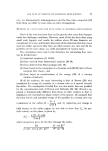
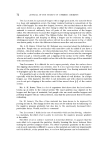
34 JOURNAL OF THE SOCIETY OF COSMETIC CHEMISTS (17) Bourne, J. R. Chem. Engrs., No. 191, CE.198 (1965). (18) Bourne, J. R. Chem. Eng. Sci., 22 693 (1967). (19) Bourne, ]. R. Brit. Chem. Eng., 111 8.34 (305) (1968). (20) Williams, ]. C. Powder Technol., 2 13 (1968). (21) Ashton, M.D. and Valentin, F. H. H. Trans. Inst. Chem. lz'ngrs., 44 T166 (1966). (22) More de Chazal, L. E. and Hung, Yen Chi. A.I. Ch. E. J., 14 1069 (1968). (23) Chesman, A. Lee. Chem. Eng., 17 119 (Feb. 1964). (24) Hickerson, W. L. Brit. Chem. Eng., 111 (351) 995 (1968). (25) Poole, K. R., Taylor, F. R. and Wall, G. P. Trans. Inst. Chem. Engrs., 48 T261 (1965). (26) Sugimoto, M., Endoh, K. and Tanaka, T. Kagaku Kogaku, Ill 145 (1967). (27) Cumins, ]. D. Convention "Advance in Automatic Control" Sponsored by the Inst. Mech. Engrs., Nottingham (5-9 April, 1965). (28) Hammond, P. H. and Barber, D. L. A. Trans. Soc. Instr. Technot,. 17 59 (1965). (29) Coulson, J. M. and Maitra, N. K. J. J. Imp Coll. Chem. Eng. Soc., 4 135 (1948). (30) Roseman, B. and Donald, M. B. Brit. Chem. Eng., 7 P.749, 823 and 922 (1962). (31) Widenbaum, S.S. and Bonilla, C. F. Chem. Eng. Progress, 51 275 (1955). (32) Sugimoto, M., Endoh, H. and Tanaka, T. Kagaku Kogaku, 4 348 (1066). DISCUSSION MR. C. PUGH: In mixing one often seeks to incorporate an active material into another in such a way that the amount in each subunit, such as a 300 mg tablet for example, has an acceptably low variability. Can one determine this variability from the characteristic you measure, the variance ratio or should one carry out [urther determinations for this? Mu. WXLLXAUS: It is not possible by any statistical method to know the proportion o[ active ingredient in each tablet. You can, however, determine the proportion of tablets that will fall outside certain specified limits. If the mean composition and the standard deviation are known, the proportion of tablets lying outside the specification can be determined. In making this calculation it is assumed the tablet compositions are normally distributed about the mean. Whether or not this assumption is justified can be verified by examing analysis data which are probably already available. Another point to be borne in mind is that the value obtained for the standard deviation of the composition of samples taken from a given mixture depends on the size of the samples. To obtain information about the variation between tablets, the size of sample examined should be the same as the amount of material used to form a tablet. Mu. L. BXT•S: The subject of continuous mixing poses initial problems of classi- fication because within the general definition of "continuous mixing" lie various techniques for securing feed input conditions and "stream" activating mechanisms. You have outlined some of the difficulties in describing the performance of a con- tinuous mixing system, particularly as in practice it is not usual to secure a completely even feed of the various constituents. Would you consider any merit in viewing the characteristics of a system to comprise two separate functions. (1) Attenuation of feed perturbations by means of convective redistribution transverse to the cross section of each unit length of stream. (2) Local mixing of the prefed ratios of constituents taking account of the mixing mechanism and the degree of energy required per unit mass to attain the particular results wanted.
Purchased for the exclusive use of nofirst nolast (unknown)
From: SCC Media Library & Resource Center (library.scconline.org)