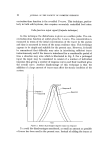
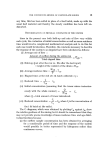
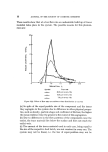
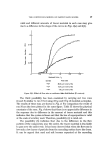
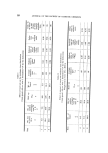
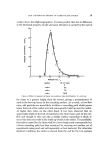
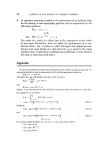
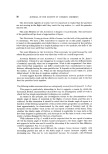
THE CONTINUOUS MIXING OF PARTICULATE SOLIDS 7 The quantity f(t) and Danckwert's Edt are comparable. The quantity analogous to Idt is given by g(t)-- F*(t) ...... (Viil/ El(t) where Ef (t) is the mean of the distribution of f(t) and is given by El(t) = t f(t)dt: F*(t) dt .... (IX) o o The variance is the second moment of the distribution and given by Vf(t) = t--El(t) f(t) dt= Ef(t)--Ef (t) .. (X) o Variance reduction ratio from the residence time distribution Danckwerts (5) showed that the variance reduction ratio of a system having an arbitrary residence time distribution can be obtained by the following expression: 002 / = 2føø• oø E(t) dr. (-XI) Gi2 '.
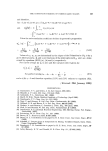
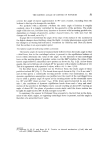
E(t+r)R(r)at. t=0 r=0 where E(t) is the age distribution function, that is the age distribution of all the particles in the exit stream. For perfect mixing E(t) = v v • 'e-vt and, therefore, equation (XI) reduces to equation (I). When the auto-correlation coefficient declines with distance in geometric progression (3) according to the rule R(r) =a r, where o a 1, the solution of equation (I) becomes 002/ • .... (XII) -- V - ß ß oi2 1 - V log a With any residence time distribution other than perfect mixing it has been proposed (5) that a polynomial may conveniently be fitted to describe F(t), the residence time distributing function, as a function of t, which on differentiating gives the function E(t) this can be utilized in equation (XI). Similarly, when the auto-correlation coefficient does not decline in exact geometric progression it may be possible (3) to obtain an approximate value of "a" which fits R(r) reasonably well for small values of r, and can be used to evaluate the integral in equation (XI). The coefficients for larger values of r have less effect on o o 2. Residence time distribution and the quality of mixing It is seen that a knowledge of the residence time distribution provides

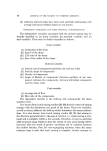
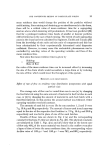
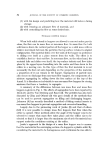
8 JOURNAL OF THE SOCIETY OF COSMETIC CHEMISTS sufficient information to predict the long term variance of the outgoing stream but there is evidence {5, 7, 8, 11) that this information is not sufficient to describe the quality of the mixture unambiguously for all scales of scrutiny. Two quantities introduced by Danckwerts {5), namely the hold-back and segregation, indicate the departure of a system from ideal behaviour but do not provide such information as to describe the mix or to indicate the exact performance of the system. An attempt was, there- fore, made by Chollete and Cloutier (8) to take account of by-passing the mixing zone, using the technique of negative step demand. These authors assumed that the mixer can be divided into three regions in which perfect mixing, plug flow and by-passing occur they obtained equations for some typical cases. Unfortunately, their equations are complicated and not basically different from the solution that would be obtained by fitting equations to residence time distribution functions for similar situations. Recently similar equations have been put forward by Wolf and Resnick Their approach provides further understanding of the behaviour of a system but does not provide information about the quality of mixing. On another occasion, to describe the quality of mixture, Danckwerts (10) introduced the concepts of "concentration at a point" and "age of molecules at a point" and proposed an index of segregation as follows: Var tt P ...... (XIII) J = Var a ' ' Where Var% represents the variance between various points within the mixer and Var a represents the total variance for all molecules. Danckwerts argued that for a system that shows perfect mixing in terms of residence time distribution the value of J may lie between 0 for complete mixing in terms of homogeneity and 1 for complete segregation. Zweitering {11) argued further and showed that for plug flow the value of J is always 1 this is because according to the definition of plug flow it offers no degree of freedom. For systems having a residence time distribution indicating a stage intermediate between plug flow and ideal mixing the value of J for complete segregation is again 1 J can not have a value of 0 because there must be some difference of ages of molecules or particles between different points within the vessel. This analysis showed that the lower limit of J is not unique and cannot be determined from a knowledge of the residence time distribution. Therefore, the information obtained from residence time distributions is not sufficient to describe the quality of mixing.
Purchased for the exclusive use of nofirst nolast (unknown)
From: SCC Media Library & Resource Center (library.scconline.org)