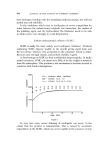
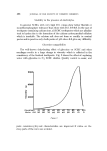
JOURNAL OF THE SOCIETY OF COSMETIC CHEMISTS to measure these values by means of spheres that are retained by the structure of the gel. They correlate the weight of the sphere with a yield value. A second method, which we have tried without much success so far, is to use different spheres of the same diameter, but of different densities to again find to what level the density of the sphere is balanced by the structure of the gel. Obviously all these methods will give different values. I wonder from a practical point of view whether anyone has any experience of yield value by rates of sedimentation of spheres. DR. G. W. SCOTT-BLAre: I feel that the use of failing spheres to determine yield values could be dangerous. Mardies (1t3) has shown that with some greases and paints a falhng sphere will gradually slow down because "greater energy is required to displace the system at greater depths". Presumably the material shear-thickens. MRs. J. V. BoYD: You say that your static yield stresses depended on the rate of application of this yield stress. Would it not be possible, using a much lower shear rate, to get an absolute value that depends only on the material? In your shear stress you go up to 1 500 reciprocal seconds and back in two minutes. This is a high rate of application. I have applied a low constant shear rate and watched the point at which a gel forms. This does not depend on the rate of application but seems to be a constant for the material. PROF. CARLESS: I would consider this to be an arbitrary way of looking at the problem. We have not tried low rates of shear, but these would in general be expected to give larger values. The rate of shear we chose gave reproducible values and was used for comparative purposes. DR. G. J. •)• LEEuw: The explanation for the effect of glycerine on the rigidity of gelatin-gels, as presented in the discussion part of your paper, is not very satisfac- tory. As long as the gelatin dissolves in a water/glycerine mixture, which is true for all your test conditions, the term "a decrease in solubility" is meaningless. As far as I know, spiral formation is not so much associated with coacervation, but with the gelation process itself. DR. lXT•xo•: As the proportion of glycerin in the gel increases the amount of gelatin which can be dissolved will fall. We believe that under these conditions there will be a tendency for the gelatin molecule to exhibit a tighter spiral formation. This spiral formation of the molecule can be associated with coacervation as we believe that a prerequisite of the separation of gelatin coacervate from a system is the adop- tion of a fairly tight spiral formation of the gelatin molecule. DR. B. S. lXTEU•A•: I would just like to refer to the very first question on the rate of swelling. The use of nearly boiling water does in fact speed up the swelliLig of Laponite. (16) Mardles, E. W. J. Nature 158 199 (194(i)

J. Soc. Cosmet. Chem. gl 441-457 (1970) (•) 1970 Society of Cosmetic Chemists of Great Britain New reactions of alginate propylene glycol R. H. McDOWELL* Presented at the Symposium on "Gums and Thickeners", organised by the Society of Cosmetic Chemists of Great Britain, at Oxford, on 14th October 1969. Synop$i$--In mildly alkaline aqueous solutions, PROPYLENE GLYCOL ALGINATE can react with compounds containing amino or hydroxyl groups. If the compounds concerned have a suitable chain length, RHEOLOGICAL changes take place which suggest that CROSS LINKING has taken place. The reactions with GELATINE, POLYVINYL ALCOHOL and STARCH have potential uses in COSMETICS and PHARMACEUTICAL products. INTRODUCTION Propylene glycol alginate (referred to hereafter as PGA) is a water soluble polymer used for thickening and stabilising acidic products. It is prepared by the reaction of partially neutralized alginic acid with propylene oxide {1). Esterification of carboxyl groups takes place and in the course of the reaction the free acidity drops. It is not practicable to bring about complete esterification and in commercial products up to 10% of the carboxyl groups remain as free acid, while between 10% and 30% are neutralized with sodium or calcium. On treatment of the dilute aqueous solution with sodium hydroxide the expected ester saponification takes place, propylene glycol being split off. The alginate can be recovered in part as sodium alginate, but a side reaction involving [I-elimination brings about some degradation of the alginate chain. Some alginate is lost, and the part that can be recovered is of a lower degree of polymerization, so *Alginate Industries Ltd., London, W.C.2. 441
Purchased for the exclusive use of nofirst nolast (unknown)
From: SCC Media Library & Resource Center (library.scconline.org)