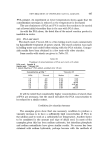
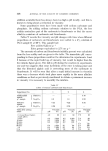
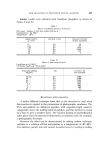
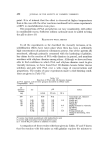
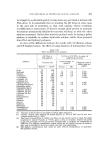
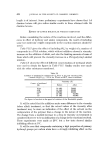
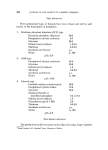
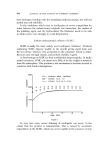
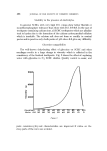
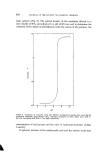
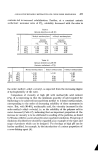
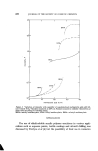
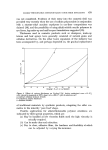
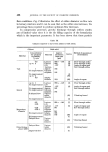
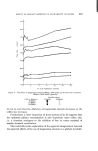
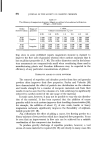
454 JOURNAL OF THE SOCIETY OF COSMETIC CHEMISTS be acetylated by treatment with vinyl acetate in somewhat similar condi- tions. (7), It is suggested that the cross linking reaction is only one of several competing reactions which are taking place simultaneously. With high molecular weight polyfunctional compounds only a very small propurtion of the potentially reactive groups need enter into cross linking reactions to give marked changes in physical properties. It is understandable therefore that a transesterification or amidation reaction in which only very few of the ester groups of the PGA take part could form enough cross links to produce the physical changes that have been noted. From the examples given it will be seen that the conditions for breakdown of the links are not greatly different from those for their formation, so that to get the viscosity increases and gel formation a narrow range of conditions has to be found where the rate of formation is greater than the rate of destruction. In view of the effect of calcium and other divalent metals in forming insoluble salts with alginates, it might be suggested that, for example, the 1:6 diamino hexane forms an insoluble salt with alginic acid formed by hydrolysis of the PGA. This has been shown not to be the case by preparing the 1:6 diamino hexane salt of alginic acid which is fully soluble in water. Furthermore the addition of the hydrochloride of 1:6 diamino hexane to a sodium alginate solution produces no appreciable change in viscosity. USES Possible uses for the effects described fall into two groups. (a) Those depending on the formation of an insoluble product. (b) Those depending on high viscosity and semi gel formation, e.g. suspension of solids. The best established application is the modification of gelatine films to allow photographic processing to be carried out at higher temperatures than is possible with unmodified gelatine. Films modified in this way have the advantage in processing of being more water absorbent than those of formalin hardened gelatine. A possible use of the same gelatine modifying process is in the manufacture of hard gelatine capsules as the product, although insoluble in water, is broken down by digestive enzymes. PGA, either alone or in combination with other polymers, can be used to provide water resistant binders for pellets or granules. From the cost point of view it is an advantage to keep the proportion of PGA as low as it is technically

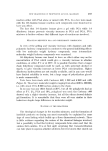
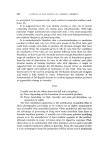
NEW REACTIONS OF PROPYLENE GLYCOL ALGINATE 455 possible, and mixtures with PVA or starch appear the most promising. Although insoluble, these reaction products swell in water and allow the passage of water vapour. Furthermore the PGA-starch product is broken down by enzymes and is therefore likely to be quite acceptable in food products. The thickening and suspending effects have not yet found commercial use, but the wide range of composition that can be used and of the consis- tencies that can be obtained suggest that the effect could provide a solution to a problem in formulation in some industrial field, possibly in cosmetics. (Received: 1st August 19691 REFERENCES (1) Steiner, A. B. and McNeely, \¾. H. Organic esters of alginic acid. Ind. Eng. Chem. 43 2 053 (1959). (2) Weissbach, A. and Hurwitz, J. The formation of 2-keto-3-deoxyheptonic acid in extracts of Escherichia coli B. J. Biol. Chern. 234 705 (1959). (3) Brit. Pat. 768 309: Process for the production of amides of alginic acid. (4) Brit. Pat. 962 483: Water insoluble film forming nitrogenous products. (5) Brit. Pat. 987 797: Improved method of hardening photographic silver halide material. (6) Brit. Pat. 1 135 856: A method of modifying alkylene glycol alginates. (7) Brit. Pat. 890 083: Acylation of hydroxy compounds with vinyl esters. DISCUSSION M•. G. A. GR•N•: Can you speculate on the nature of the chemical reaction occurring? We have discussed this matter several times and it is difficult to find out exactly what is happening chemically - the effects are so strange you would not expect them at all. T•F• L•cxuR•: From the nature of the products obtained, I think there must be some cross-linking. We must remember that in most cases the product obtained is broken down if the mixture remains alkaline, which suggests that it may be an ester. Various transesterification reactions have been described but they are normally done in anhydrous conditions, generally with an acid catalyst and it seems rather extraordinary that it could happen in dilute aqueous solutions or with an alkali. Not long ago I had my attention drawn to some patents on the acetylation of starch where vinyl acetate toohomer is reacted with starch which is suspended in sodium carbonate solution, and I wonder whether something similar could be happening here. I think there are a number of quite independent reactions going on. They probably all have different energies of activation, hence different temperature co- efficients. The beta degradation leading to the chain breakdown is very sensitive. At high temperatures it is quite important - at low temperatures it becomes very much less. The straight ester hydrolysis perhaps has an intermediate temperature co• efficient and the reaction leading to viscosity increases (perhaps transesterification) must have a lower energy of activation because it does not speed up so much as the others if the temperature is raised.
Purchased for the exclusive use of nofirst nolast (unknown)
From: SCC Media Library & Resource Center (library.scconline.org)