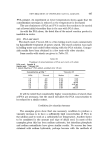
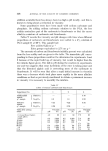
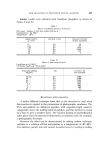
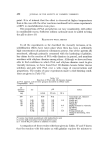
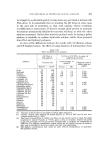
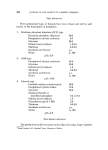
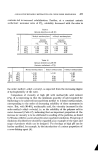
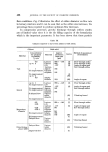
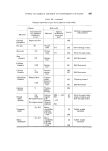
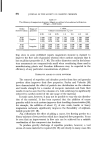
459. JOURNAL OF THE SOCIETY OF COSMETIC CHEMISTS length is of interest. Some preliminary experiments have shown that 1:4 diamino butane will give rather similar results to those obtained with 1:t3 diamino hexane. EFFECT OF LOWER MOLECULAR WEIGHT COMPOUNDS Before considering the nature of the reactions involved, and the differ- ences in effect of hydroxy and amino compounds, the result of including some low molecular weight compounds in the reaction mixtures should be noted. Table VIII gives the effect of including 8% by weight of a number of compounds in a PGA solution, which without additives showed a viscosity increase on the addition of alkali, and also the limiting amounts of some of them which will prevent the viscosity increase in a PGA/polyvinyl alcohol mixture. Table IX shows the effect of different concentrations of methanol which were used to obtain the figures in Table VIII. Similar studies were made with the other substances mentioned. Table IX Addition of methanol to mixture of 1% PGA q- 2 % low viscosity PVA. 1 mmole Na2CO3 g -1 PGA for 15 min at 20øC, then re-acidified. Concn. of methanol (M) None 0.25 0.375 0.5 1.0 Viscosity (P) Before 1.6 (60) 1.6 (60) 1.25(60) 1.6 (60) 1.7 (60) After 730(6) 220(6) 820(3) 0.7(60) 0.S(60) The figure in brackets is the speed of rotation of the Brookfield spindle. It will be noted that the additives make some difference to the viscosity before alkali treatment, so that the actual values of the viscosity after treatment may be more an indication of the effect of the solvent on the configuration of the polymer than a change in the nature of the reaction. The change from a marked increase to a drop in viscosity on treatment is considered however to be an indication of a change in the reactions involved. These experiments were made at 20øC but a few tests showed similar inhibiting effects at 5 øC. It will be seen that compounds containing a high proportion of primary hydroxyl groups per carbon atom have a strongly inhibiting effect on the

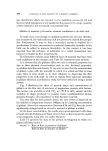
NEW REACTIONS OF PROPYLENE GLYCOL ALGINATE 453 reaction either with PGA alone or mixed with PVA. In a fexv tests made with the 1:13 diamino hexane reaction such compounds were found not to have any effect. The fact that 1:4 diamino butane gives a gel with PGA while 1:4 dihydroxy butane prevents viscosity increases in PGA and PGA, PVA mixtures is further evidence that different types of reaction are involved. l{EACTION BETX¾EEN PGA AND I)IHYDROXY COMPOUNDS In view of the gelling and viscosity increases with diamines and with polymeric hydroxy compounds in contrast to the general inhibiting effects with low molecular weight hydroxy compounds, some intermediate molecular weight hydroxy compounds were examined. 1:13 dihydroxy hexane was found to have no effect either way on the concentration of PGA which would give a viscosity increase in alkaline conditions, at either 5øC or at 20øC. It is possible therefore that a longer chain dihydroxy compound could be used, as with polyvinyl alcohol or starch, to give viscosity increases at lower PGA concentrations. Higher dihydroxy hydrocarbons are not readily available, and in any case would have limited solubility in water, but a large range of polyethylene glycols is made commercially. Tests have been made with Carbowax 400, 1 000 and 6 000 and with Polyox &5. These have molecular weights ranging from about 400 to 100 000, i.e. with about 13 to 8 000 carbon atoms in the chain. In no case was any effect found at 20øC, but all the polyglycols had an effect at 5øC. 2% PGA and 10% polyglycol was used: the Carbowac 400 showed only a slight viscosity increase, but all the others showed definite gel formation. It is remarkable that they were all very similar in their behaviour despite large differences in molecular weight. NATURE OF THE REACTIONS The rheological changes in the reaction mixtures, and the formation of insoluble products on drying can most reasonably be explained by some type of cross linking which builds up a three dimensional network. There is little evidence regarding the nature of the chemical linkages involved, but a possibility is that the hydroxy compounds form esters and that the amines form amides. It is at first sight surprising that transesterification can take place in aqueous alkaline solutions but it is known that starch can
Purchased for the exclusive use of nofirst nolast (unknown)
From: SCC Media Library & Resource Center (library.scconline.org)