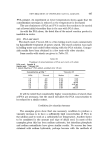
J. Soc. Cosmet. Chem. 9,1 471-482 (1970) ¸ 197o Society of Cosmetic Chemists of Great Britain A group of alkali-thickenable methacrylate copolymer emulsions E. V. GULBEKIAN* Presented at the Symposium on "Gums and Thickeners", organised by the Society of Cosmetic Chemists of Great Britain, at Oxford, on 15th October 1969. $yn0p$i•The alkali-thickening of a group of alkyl methacrylate-methacryli½ acid COPOLYMER EMULSIONS has been examined. The VISCOSITY achieved at high pH is shown to depend on the quantity of copolymerized acid and the nature of the ALKYL group of [the methacrylate ester. The use of such ALKALI-THICKENABLE polymer emulsions is discussed. INTRODUCTION The introduction of synthetic colloids to replace or complement natural products has increased the variety of thickening agents available to various industries and enabled materials to be designed for specific applications. Alkali-thickenable polymers are an example of a family of products which can be tailor-made to give a wide range of properties such as hardness, flexibility and solution viscosity. Alkali-thickenable and alkali-soluble polymers are essentially high molecular weight materials containing pendant carboxyl groups in the polymer chain, the salts of which swell or dissolve in water. Properties may be varied by adjusting the polymer composition and the number and dis- tribution of --COOH groups in the chain. Emulsions of such polymers have the unique advantage of being thickenable in situ, and can thus be stored and handled as low viscosity fluids until such time as their thickening *Vinyl Products Ltd., Carshalton, Surrey. 471

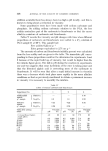
472 JOURNAL OF THE SOCIETY OF COSMETIC CHEMISTS property is to be utilized. They have found application, for example, in emulsion paints and latex compounds for carpet sizing. Resins of this type can be prepared by copolymerizing vinyl acetate with maleic anhydride (1), a monoalkyl ester of maleic acid (2) or crotonic acid (3). Such copolymers are useful in certain adhesive and other appli- cations where removability by aqueous alkali is required (4) and, in the non-aqueous state, as hair spray compositions (5). A possible disadvantage of vinyl acetate-crotonic acid copolymers, which are otherwise particularly suitable, is that they are generally of low molecular weight, due to the chain transfer property of crotonic acid in free-radical polymerization addition- ally, most vinyl acetate copolymers are readily hydrolyzed by aqueous alkali (6). If long term storage of alkali-soluble copolymers in aqueous systems at higher pH is required, acrylic and especially methacrylic ester copolymers are more suitable. In the present paper, the alkali-thickening of a group of alkyl metha- crylate-methacrylic acid copolymer emulsions is described. Methacrylic acid was used in preference to acrylic acid because of its good copoly- merization with methacrylate esters in aqueous emulsion systems. With methyl methacrylate, for example, 97% of the methacrylic acid introduced has been found to have copolymerized (7). EXPERIMENTAL The polymer emulsions were prepared to the following basic formula: Monomers Dodecyl mercaptan Polyoxyethylene (4-5) monolaurate Sodium dodecyl sulfate Sodium bicarbonate Sodium sulfate Ferric chloride (to 5 ppmFe on monomer wt) Sodium persulfate Sodium metabisulfite Parts by weight 100.00 0.20 1.00 1.00-3.00 0.12 0.50 0.24 0.24 Materials The monomers were commercial grades of high purity (99%) and were used as received the inhibitor contents were as follows:
Purchased for the exclusive use of nofirst nolast (unknown)
From: SCC Media Library & Resource Center (library.scconline.org)