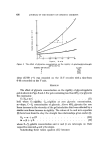
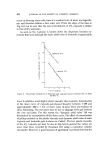
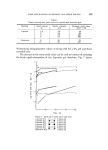
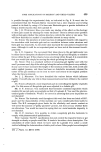
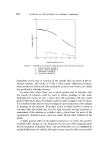
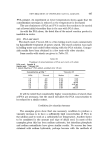
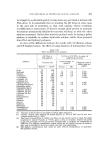
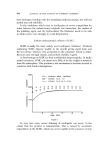
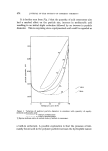
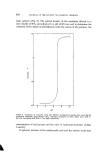
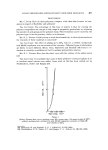
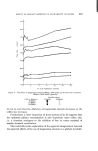
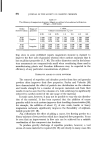
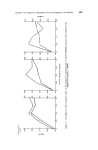
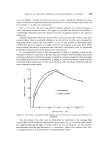
ALKALI-THICKENABLE METHACRYLATE COPOLYMER EMULSIONS 481 DISCUSSION MR. C. PUGH: HOW do these polymers compare with other film formers in hair- sprays in respect of flexibility and adhesion? THE LECTURER: The advantage of this type of system is that by varying the polymer composition one can get a wide range of properties, particularly by adjusting the number of acid groups in the polymer chain. Film formation can be varied by the polymer type it can be powdery, sticky or in between. MR. R. L. DAW•S: Could you say a word about sensitivity to electrolytes insofar as the viscosity of these materials is concerned? TH• LEC'rUR•R: The effect of adding up to 20•o NaC1 to a n-BMA: methacrylic acid (60:40) copolymer was an increase of the viscosity. Different types of electrolytes are likely to have different effects. Thus, Markovitz and Kimball (18) found a re- duction in viscosity on addition of NaCI to sodium polyacrylate solution. MR. R. L. DAWES: How does the effect vary with the valency of the added metal ion? TH• LECTURER: It is possible that some of these products would precipitate if di- or trivalent metal cations were added. Some work on this has been carried out by Proshliakova, Zubov and Kargin (19). I I o •ooo 2ooo 3ooo Shear stress, N m -2 Figure $ Shirley-Ferranti flow curve (medium cone 60 s sweep time X5 range factor) at 25øC. n-Butyl methacrylate: methacrylic acid (60:40) copolymer emulsion at high pH non-volatile = 7.52 •o. (18) Markovitz, H. and Kimball, G. E. f. Colloid Sci., 5 115 (1950). (19) Proshliakova, N. F., Zubov, P. I. and Kargin, V. A. Kolloid. Zh., 9•0 199 (1958).

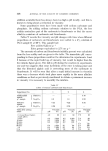
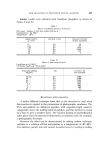
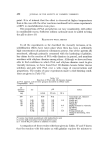
482 JOURNAL OF THE SOCIETY OF COSMETIC CHEMISTS DR. B. S. NEUMANN: You refer to viscosity of the system. Do we take it that these materials are Newtontan or do they have a yield value? I see that you use the Ferranti portable viscometer with which one can take readings at various rates of shear. Do you have any flow curves available? THE LECTURER: A Shirley-Ferranti curve is given in _Fig. 5. Shirley-Ferranti curves of Cycloryl NA thickened with an acrylic thickener were Newtontan. MR. C. PUGH: IS the process of thickening reversible or irreversible? How little can you get away with? THE LECTURER: According to the work of Muroi (20), thickening is only partly reversible rheologically in that you do not end up exactly with what you started with if you reverse the pH, but it will be something similar. The second question is difficult to answer in general terms, but the quantity required could be 0.2--2.0% of the total formulation. The thickening will depend also on the size of the cation (21). DR. J. W. B. SAaUEL: Can you tell me if by using a hydrophilic and a hydro- phobic monomer you can balance them so that you end up with a gel which is inter- mediate, presumably, between a water-soluble and a water-insoluble polymer? T•E LECTURER: Gels from methyl methacrylate-methacrylic acid copolymers have been studied (19). MR. R. S. McKEE: You suggest that in using these polymers for hair sprays you might be able to polymerise in a solvent other than water. Have you actually done this in, say, some of the alcohols? T•E LECTURER: It is possible to polymerise in ethyl or isopropyl alcohol, although solubility difficulties may arise with the lower levels of methacrylic acid. MR. J. B. W•LI•so•: You refer to the use of these materials as thickeners in typical shampoo type systems, and this type of material (not your own I think) has been in use in this field for many years, particularly on the Continent. I wonder if you could give me your own view on the particular advantage of using this type of thickener in the typically thickened shampoo system over some of the other equally well known ones some of them perhaps a little less expensive. THE LECTURER: It would be rash of me to make recommendations in a field which is not my own, but there is one point I can make. In principle, these are very versatile systems and it is therefore possible to build in almost any desired group of properties. (20) Muroi, S. J. Appl. Polymer Sci., 10 713 (1966). (21) Gregor, H. P., Gold, D. H. and Frederick M. J. Polymer Sci., 9,8 467 (1957).
Purchased for the exclusive use of nofirst nolast (unknown)
From: SCC Media Library & Resource Center (library.scconline.org)