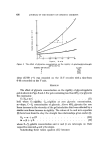
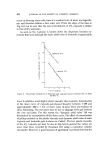
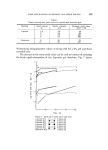
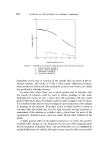
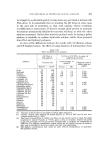
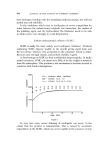
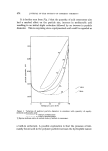
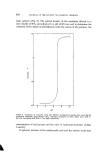
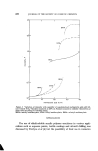
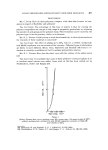
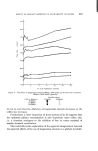
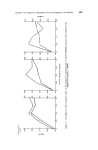
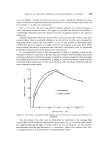
ALKALI-THICKENABLE METHACRYLATE COPOLYMER EMULSIONS 479 was not considered. Evidence of their entry into the cosmetic field was provided very recently when the use of sodium polyacrylate in conjunction with a styrene-ethyl acrylate copolymer in eye-liner compositions was claimed (14), and the possibility of using alkali-soluble acrylic polymers in eye-liners, leg make-up and nail lacquer formulations suggested (15). Thickeners used in cosmetic products such as shampoos, make-up lotions and hair sprays have generally consisted of natural gums and cellulose derivatives. On the other hand, expansion of the industry has been accompanied by, and perhaps depended on, the gradual replacement 3O 20' 0 2 4 6 8 10 12 14 16 18 20 thickener (ø/0 wt on surfactant) Figure 4 Effect of various thickeners on ½ycloryl NA. Active surfactant conc.-- 11.2 % w/w viscosity measured at 25øC, shear rate----403 s-1 pH of solutions ca 7. a=methyl cellulose (½elacol M.450) b----polymeric acrylic thickener c----sodium chloride. of traditional materials by synthetic products, relegating the older cos- metics to the minority 'pure food' shops. Possible applications for alkali-thickenable polymer emulsions are indicated by their special properties, which are: (a) May be handled as low viscosity fluids until the high viscosity is actually required. (b) Can be made clear and colourless. (c) Dry to clear, adhesive films, the hardness and flexibility of which can be adjusted by varying the monomer.

480 JOURNAL OF THE SOCIETY OF COSMETIC CHEMISTS (d) Have a protective colloid and surfactant effect. (e) Water-susceptibility can be controlled. Acrylic thickeners could be of interest, for instance, in shampoos. The effect of a commercial acrylic thickener on an aqueous sodium poly- oxyethylene lauryl sulfate solution (Cycloryl NA), suggested as a base for shampoos, is compared in Fig. 4 with methyl cellulose and sodium chloride. Cosmetic products in which synthetic resins have made most progress appear to be hair sprays, in which materials such as vinyl pyrrolidone- vinyl acetate copolymers have distinct advantages over shellac (16). Vinyl acetate-crotonic acid and methyl vinyl ether-ethyl hydrogen maleate copolymers have also been suggested (17). These products are normally alkali-soluble and could be considered as thickeners in other contexts, but in hair sprays they are useful for their cognate property of removability with mild aqueous alkali. The methacrylate copolymer types described above would fit in naturally for this type of application except for the fact that large quantities of water cannot, it appears, be tolerated in hair sprays. It would, therefore, be a prerequisite either to convert the emulsion polymer into a dry form or prepare it directly in a suitable solvent. ACKNOWLEDGEMENTS Most of the experimental work was carried out by I. D. Lewis and S. F. Rickaby, to whom grateful thanks are due. (Received: 17th July 1969) REFERENCES (1) German Pat. 540 101 (2) US Pat. 2 643 245/6. (3) US Pat. 2 263 598. (4) Fordyce, D. B., Dupre, J. and Toy, W. Off. Dig., 31 284 (1959). (5) Brit. Pat. 856 403. (6) Davies, R. F. B. and Reynolds, G. E. J. J. Appl. Polymer Sci., 19, 47 (1968). (7) King, A. P. and Naidus, H. J. Polymer Sci. C., No. 27 311 (1969). (8) Atherton E. and Peters, R. H. J. Soc. Leather Trades Chemists, 38 22 (1954). (9) Issacs, P. K. and Edelhauser, H. A. J. Appl. Polymer Sci., 10 171 (1966). (10) Gulbekian, E. V. and Sweetingham, M. J. Proc. Vth Intern. Congr. Surface Activity, 9, 965 (Barcelona 1968). (11) Muroi, S., Hosoi K. and Ishikawa, T. J. Appl. Polymer Sci., 11 1963 (1967). (12) Wesslau, H. Makrotool. Chem., 69 220 (1963). (13) Stone-Masui J. and warilion, A. J. Colloid Interf. Sci., 28 187 (1968). (14) Canad. Pat. 807 127. (15) Chemical Week, 154 (21st June, 1969). (16) Root, M. J. Am. Perfumer, 75 43 (10, 1960) (17) Root, M. J. and Bohac, S. Soap Che•n. Specialties, 41 95 (2, 1965).
Purchased for the exclusive use of nofirst nolast (unknown)
From: SCC Media Library & Resource Center (library.scconline.org)