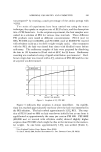
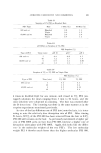
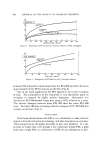
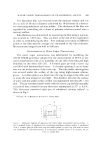
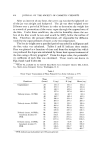
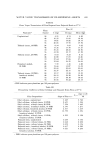
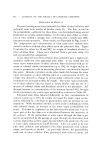
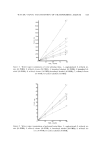
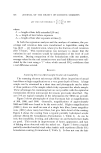
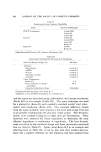
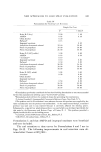
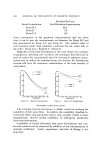
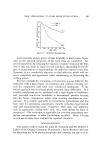
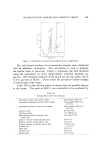
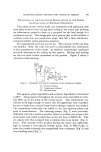
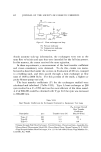
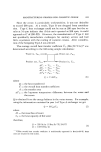
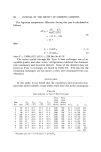
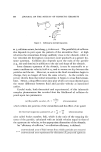
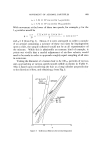
602 JOURNAL OF THE SOCIETY OF COSMETIC CHEMISTS I PERCENT PEI 6ø I I % REMOVED PEI 6 REMOVED PEI 600E PEI 600 0 100 200 300 400 500 600 700 800 OOO 1000 DESORPTION TIME - MINUTES Figure 6. Desorption of PEI from hair into 5% solution of PEI (untagged) I 10% SHAMPOO • • o•1 I I I I I I o 5o '•oo 15o 200 250 :•oo •o RINSE TIME -- MINUTES Figure 7. De•rption of PEI 600 into 10• shamp• •lufion 4OO Initially PEI 6 desorbs 4 times faster than the PEI 600 and after 24 hours approximately 0.3% PEI 6 remains on the hair (Fig. 6). One of the main applications for PEI appears to be in the treatment of hair. The permanence of the treatment is very dependent upon its resistance to removal by highly anionic shampoos. Desorption was checked on PEI 600-treated virgin hair using a 10% solution as a rinse. The ani•onic shampoo removes more PEI 600 than the water PEI 600 rinse. But after 360 min of rinsing with the shampoo, 0.8% PEI 600 still remains on the hair. (Fig. 7). CONCLUSION It has been clearly shown that PEI is very substantive to hair, that the degree is directly related to hair damage, and that desorption is very slow. These properties are all highly desirable in hair care products. It is im- portant to realize that even though a low molecular weight PEI, a high molecular weight PEI, or a derivative of PEI all are substantive to hair,

AZIR1DINE CHEMISTRY AND COSMETICS 603 it is the application and the end results desired which determine the PEI to use. For example, in hair shampoos, where the PEI is being utilized to improve combability and manageability, higher molecular weight PEI's appear to be more effective. This may be due to the other components in the formulation, the effect of long PEI chains versus short PEI chains, or the higher molecular weight's faster sorption rate and slower desorp- tion rate. In hair coloring, the lower molecular weights show most utility. All PEI's are substantive to hair but the desired end result de- termines which PEI to use. (Received January 14, 1972) REFERENCES (1) Dick, C. R., and Ham, G. E., Characterization of polyethylenimine, J. Macrotool. Sci., Chem., A4 (6), 1301-14 (1970). (2) Derruer, O. C., and Ham, G. E., Ethylenimine and Other Aziridines, Chemistry and Ap- plications, Academic Press, New York, N.Y., 1969. (3) Procter 8c Gamble, U.S. Patent 3,400,198 (September 3, 1968). (4) Dow Chemical Co., U.S. Patent 3,546,336 (December 8, 1970). (5) Procter & Gamble, U.S. Patent 3,489,686 (January 13, 1970).
Purchased for the exclusive use of nofirst nolast (unknown)
From: SCC Media Library & Resource Center (library.scconline.org)