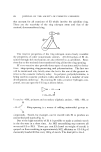
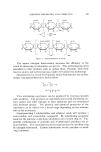
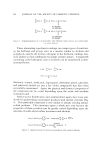
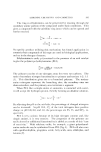
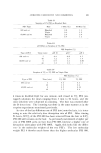
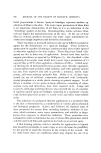
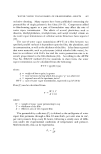
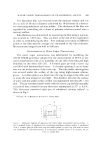
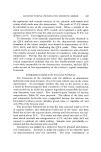
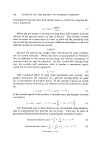
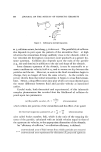
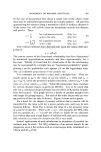
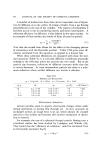
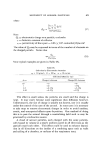
WATER VAPOR TRANSMISSION OF FILM-FORMING AGENTS 607 occlusive dressing. Many reports have been published concerning the permeability of single polymeric free films (10-13). Components added to film-forming agents as a part of formulation may affect the rate of water vapor transmission. The effects of several plasticizers such as diacetin, diethylphthalate, triethylcitrate, and acetyl triethyl citrate on the water vapor transmission of cellulose acetate films have been reported The rate of water vapor transmission (WVT) of a film between two specified parallel surfaces is dependent upon the film, the plasticizer, and its concentration, as well as the thickness of the film. It has been reported that some materials, such as polystyrene (which adsorbs little water), be- have in accordance with Fick's law and the water permeation rate is in- versely proportional to the film thickness (14). According to the ASTM Test No. E96-53T method (15) for materials in sheet form, the water vapor transmission can be calculated from the following: where: WVT = (g) (24/0 (a) g = weight of loss or gain, in grams t = time in hours during which loss or gain "g" was observed a = exposed area of the specimen, in in. 2 WVT -- rate of water vapor transmission, expressed in g/in2/24 hr Flux (F) can be calculated from WXT F- AX0.1 where: W = weight of water vapor permeating in mg T = thickness of the film A = effective area of the exposed film The permeability coefficient (P0 is defined as the milligrams of water vapor that permeate through a film 0.1-mm thick, per unit area in cm =, per unit pressure drop every 24 hours, following a steady state of diffu- sion under the experimental conditions of temperature and pressure. Mathematically, this can be expressed as F R e --

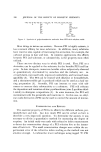
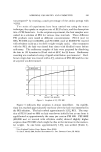
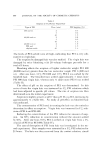
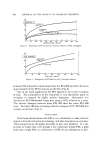
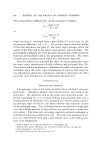
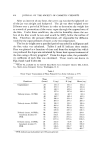
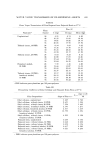
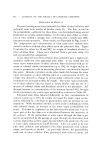
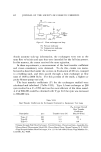
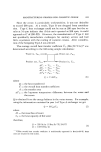
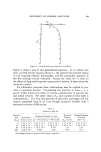
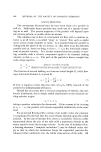
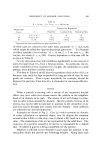
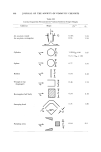
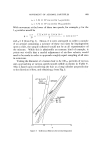
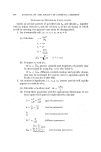
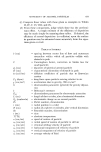
608 JOURNAL OF THE SOCIETY OF COSMETIC CHEMISTS The permeability coefficient (Pc) can be calculated as follows' or PC • slope X 24 Px -- P• slope X 24 Pc -- where the slope is calculated from a plot of flux (F) versus time (t) the pressure difference (zxP -- P• -- P2) of water vapor below the surface o[ the film and above the film Px, the water vapor pressure below the surface of the film and P2, the water vapor pressure above the film. The permeability coefficient (Pc) then becomes characteristic o[ the polymeric materials and modifiers used in the preparation of the film. The above is based upon a combination of both Fick's and Henry's laws (16). Previous studies have reported the effect of certain plasticizers upon the water vapor transmission of ethyl cellulose and polyamid film (16). The present study is an attempt to determine the effect of plasticizer con- centration upon the water vapor transmission of the free film from the selected polymer-plasticizer combination and also to determine the effect upon this value through use of a combination of plasticizers. EXPERIMENTAL Materials and Methods The polymers used in this study included ethyl cellulose* and poly- amid resin.* Hexadecyl alcohol* and tributyl citrate• were used as the plasticizers. All chemicals used in this study were analytical grade. So- hitions containing 5% w/w of ethyl cellulose and polyamid resin with a varying amount of plasticizer were prepared in a solvent system contain- ing absolute ethyl alcohol for the ethyl cellulose and isopropyl alcohol for the polyamid resin. The resulting solution was filtered through glass wool and a 20-ml quanti,ty of this solution was poured onto a clean mer- cury surlace. The films were cast using a mercury substrate technique as indicated in a previous publication (16). The rate of evaporation of sol- vent was controlled by inverting a glass fiInnel over a petri dish at am- bient room temperature. * Ethyl C•11ulose--N-10, Hercules Powder Co., Wilmington, Del. ? Polymid 1155, Lawlet Chemicals, Inc., Krumbhaar Resin Divisi,on, Chicago, Ill. •: Enjay Chemical Co., New York, N.Y. õ Citrofiex-4, Pfizer and Go., Inc., New York, N.Y.
Purchased for the exclusive use of nofirst nolast (unknown)
From: SCC Media Library & Resource Center (library.scconline.org)