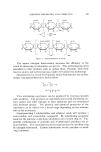
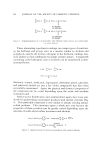
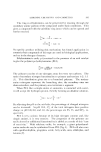
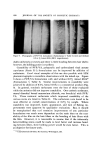
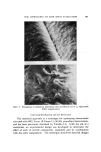
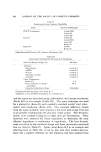
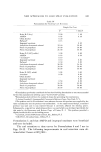
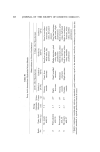
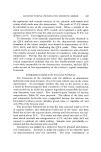
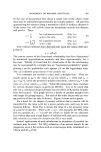
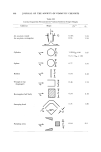
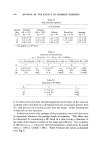
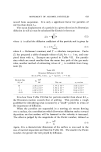
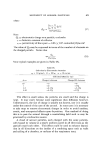
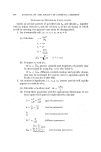
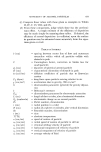
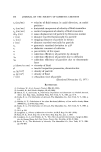
MOVEMENT OF AEROSOL PARTICLES 659 mass of particle X acceleration of particle = sum of all forces acting upon particle as applied to an individual particle. Out of this analysis a series of pa- rameters is obtained, each of which is characteristic of one type of be- havior. By a relatively simple calculation of each parameter and inspec- tion of its magxfitude a good idea may be obtained of the relative impor- tance of each of the several forces how this may be done is illustrated by a number of examples. IMPLICATIONS FOR APPLICATIONS Certain useful conclusions may be drawn from a knowledge of the forces governing aerosol motion in a given case. In a specific situation, a quick survey is first made to determine which forces (or modes of deposi- tion) are most important. This is readily done by calculating certain parameters which are developed below: G, •p, Re, dr/D, Pe -•, K•u and comparing the values obtained with those given in the examples. Usually one of these will be much greater than all of the others, thus identifying the predominant force. As soon as the relative importance of the several forces is known, a judgment may be made on how to pre- vent, or how to foster deposition, whichever may be desired. This will be done mainly by adjusting values of the independent variables: par- ticle density or, particle size d•,, air stream velocity v0, size of deposition surface D (also R and L), and possibly electrical charge on particle Qv. The most important property of the material of the aerosol is its den- sity. This, of course, is determined by its composition, which may be rather fixed by the nature of the material for a particular application. All of the illustrative calculations given below have been based upon a particle density of 1 g/cm a. For other values of density, the results given may easily be corrected according to the way in which p enters into each parameter or equation. The effect will be significant whenever gravity (•', us, G) or inertia (a,) is involved, but does not enter into diffusional phenomena (Pe, :o ). The particle size is perhaps the most important variable which is within the control of the user of the aerosol. Some guidelines may be deduced from the theory of movement and summarized as follows: If it is desired to maintain an aerosol suspended in a free space, the particles should be less than 50 t* in diameter to minimize settling

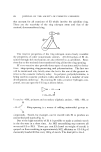
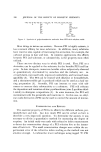
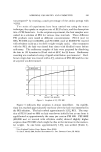
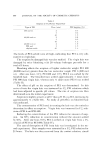
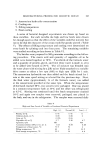
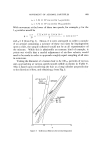
660 JOURNAL OF THE SOCIETY OF COSMETIC CHEMISTS If it is desired to deposit an aerosol upon a free surface by impinge- ment, the particles should be less than 50 • in diameter, but larger than about 10 t,, in order to take advantage ot5 inertial effects Deposition upon small surfaces, such as a human hair, will be aided by direct interception if the aerosol particle is of the same order of mag- nitude as the surface dimension There is no advantage to using very fine particles, less than say 1 • in diameter, unless it is desired to have an aerosol penetrate deeply into the respiratory tract for medicinal purposes (see below) 1t5 it is desired to protect against an aerosol entering the respiratory tract, it will help to maintain particle size greater than 10 • in order to utilize the removal mechanisms (inertia, gravity) in the nasal system. These statements apply to a material having a density of 1 g/cm a. If the value of p is much different from this, the statements should be modi- fied accordingly. In all cases where it is desired to minimize gravitational effects and/or to promote inertial effects it will be desirable to use as large an air stream velocity as possible. This should be at least of the order ot5 100 cm/sec. Such a speed will also minimize diffusional effects, even for very small particles. Deposition in the respiratory and nasal system is ot5 special impor- tance and has been the subject ot5 detailed study. Formalized schematic representatations ot5 the respiratory tract have been devised by Findeisen (1) and by Landahl (2). These represent the tract by a series of straight and curved tubes, having branching intersections and finally terminating in small spheres. Typical average length and diameter dimensions are assigned to each different part, as well as a number count ot5 each. Then, from a knowledge ot5 typical breathing rates, air speed velocity may be calculated. Using this scheme, calculations may be made using the theory outlined above to estimate deposition, or penetration, ot5 particles ot5 various sizes by the various mechanisms in the several por- tions of the system. The broad results ot5 such theoretical calculations have been sub- stantiated by experimental tests. General conclusions have been sum- inarized by Hatch and Gross (g), and may be paraphrased as follows: 1. Particles greater than 10 • are essentially all removed in the nasal chamber (inertia, sedimentation) and do not penetrate into the lungs. 2. Particles less than 1 • are essentially not removed at all in the upper respiratory tract.
Purchased for the exclusive use of nofirst nolast (unknown)
From: SCC Media Library & Resource Center (library.scconline.org)