J. Soc. Cosmet. Chem., 23, 657-678 (September 14, 1972) The Movement of Aerosol Particles WILLIAM LICHT, Ph.D.* Presented December 13, 1971, New York City Synopsis--The MOVEMENT of an AEROSOL PARTICLE, subsequent to the initial VE- LOCITY imparted by its source, is governed primarily by the influence of GRAVITY, DRAG, INERTIA, DIFFUSION, and ELECTROSTATIC CHARGES. The combined effect of these forces determines the path a particle follows. If this path brings it sufficiently near to a surface, it may collide with that surface and be deposited thereon. Of special interest here is the possible deposition upon surfaces of the body, the hair, and the respira- tory tract. Each of these forces may be characterized by a dimensionless parameter which is readily defined and calculated. From an examination of the numerical values of these parameters, the relative importance of each factor may be judged for a given case. The likelihood of a particle being deposited upon a given surface may also be estimated. The critical variables which control the movement are found to be the size and density of the individual particle, its initial velocity, and the velocity of the surrounding air. These may be adjusted, within limits, so as to tend to promote desired deposition of the particles, or to prevent an unwanted deposition. GENERAL CONCEPTS The widespread use of aerosol dispensers for a variety of cosmetic, pharmaceutical, and related products creates a need for an understand- ing of how aerosol particles move and what determines where they finally come to rest. Such a particle issues from the atomizer as a spherical drop- let of fixed size and density, traveling with a certain initial speed and di- rection. Depending upon the intended purpose of the product, the user may wish the particles to behave in one of several possible ways: * Department of Chemical and Nuclear Engineering, University of Cincinnati, Cincinnati, Ohio 45221. 657

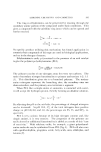
658 JOURNAL OF THE SOCIETY OF COSMETIC CHEMISTS (a) to remain suspended as long as possible in a confined space, in or- der, for example, to produce a disinfecting or deodorizing effect upon the air (b) to collide with, and be retained with maximum efficiency upon a particular surface, as, for example, surfaces of the body both exter- nal (skin, hair, eyes) and internal (respiratory tract, throat) in order to provide cosmetic or therapeutic effects, e.g., perfume, hair spray, deodorant, nasal decongestant, throat spray, etc. (c) conversely, to avoid collision with surfaces of the body as in the case of an insecticide which might cause skin irritation (d) to become impacted on the surfaces of instruments which are de- signed for the sampling and analysis of aerosols, e.g., microscope slides, impactor stages. A study of the principles which govern the movement of aerosol particles should be of value in helping to achieve any one of these objectives. The path followed by an aerosol particle, subsequent to its generation and re'_ease, depends not only upon its initial velocity and upon the ve- locity of the air stream in which it rides, but also upon the action of cer- tain external forces. These may be listed as: (a) drag, the resistance to motion offered by the air surrounding the particle (b) gravity (opposed by a negligible amount of buoyancy) (c) inertia, the resistance offered by the particle to an attempted change in speed or direction (d) diffusion, due to bombardment by air molecules or to turbulence in the air (e) electrostatic, if the particle acquires a charge. Whether the particle remains suspended in still or moving air, settles out, or impinges upon some neighboring surface depends upon its path or trajectory, as determined by the net effect of whichever of these forces may be acting. After collision upon a neighboring surface, the particle may rebound or it may remain deposited upon that surface. To predict the probability of deposition of a particle upon a surface requires an un- derstanding of how each of these forces affect its path. Each of the above forces is reviewed briefly below, in order to indicate what is known about its effect upon aerosol motion, and to indicate how the relative importance of each force may be judged in a given set of cir- cumstances. This is done basically by analyzing the equation of New- ton's Law of Motion:
Purchased for the exclusive use of nofirst nolast (unknown)
From: SCC Media Library & Resource Center (library.scconline.org)