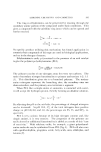
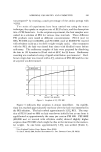
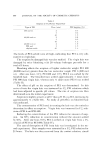
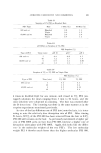
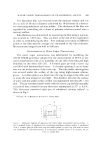
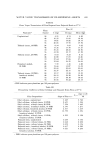
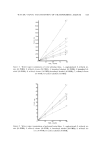
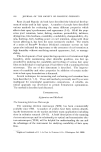
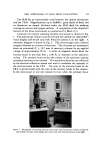
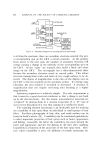
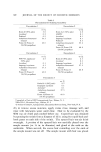
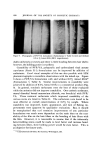
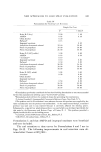
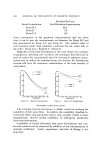
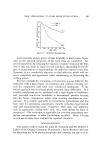
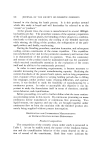
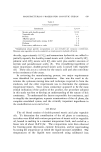
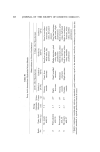
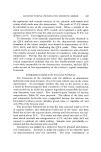
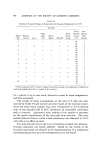
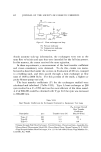
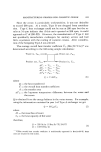
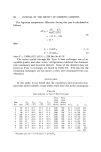
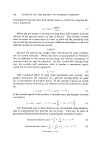
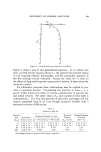
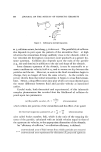
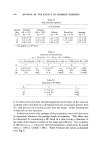
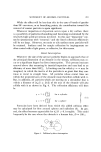
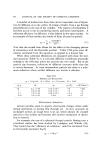
MOVEMENT OF AEROSOL PARTICLES 663 0 •) X/x s o5 tQ 9 Figure 1. General trajectory of particle in still air Figure 1 shows a plot of this generalized trajectory. It is evident that after a period of time equal to about 5 •, the particle has traveled almost its full stopping distance horizontally, and has practically attained its full free settling velocity vertically. Clearly the value of ß is basic to the effects of drag and/or gravity upon particle motion. It determines the values of xs and us. For illustrative purposes these relationships may be applied to par- ticles of practical interest. Considering the material to have p = 1 g/cm a, Table I shows the effect of various combinations of particle size and initial velocity. For other values of p, each number in the table is multiplied by •. It is clear that particles of about 50 t* and larger will not remain suspended long in air even though proiected initially with a horizontal velocity of 100 cm/sec. Table I Motion in Still Air Particle Stopping Distance (x,, cm) Terminal Vertical Distance Size Relaxation Velocity Traveled (d•, t•) Time (r, sec) u0 = 10 cm/sec u0 = 100 cm/sec (u, cm/sec) after 1 sec 1 ø 3.54 X 10-0 3.54 X 10 -s 3.54 X 10 -4 3.47 X 10 -a 3.47 X 10 -a 10 3.08 X 10 -4 3.08 X 10 -a 3.08 X 10 -2 3.02 X 10 -• 3.02 X 10 -• 50 7.70 X 10 -a 7.70 X 10 -20.770 7.55 7.55 100 3.08 X 10 -20.308 3.08 30.0 29.1 Cunningham factor is required (see footnote, page 661 ).

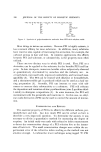
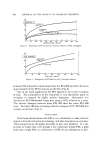
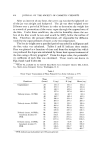
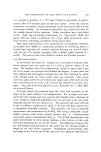
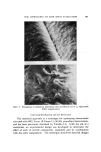
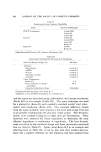
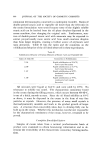
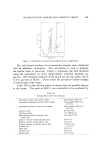
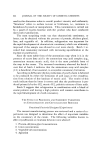
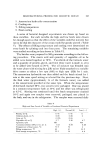
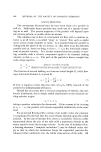
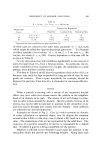
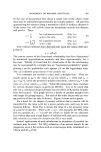
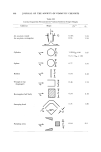
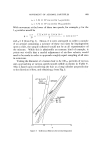
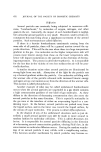
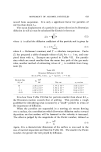
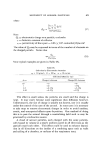
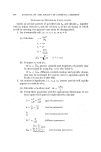
664 JOURNAL OF THE SOCIETY OF COSMETIC CHEMISTS Gravity Deposition The movements discussed thus far have been those of a particle in still air. Sufficiently heavy particles may settle out of a stream of mov- ing air as well. The precise trajectory of the particle will depend upon the velocity pattern, or profile, of the air stream. The simplest case is that of a horizontal air flow with a uniform ve- locity v0 at all levels, a so-called "plug" or "piston" flow such as might occur across a large chamber or room. It is assumed that the particle is riding with the speed of the air stream, i.e., that there is no slip between particle and air, hence no drag, so that ux --- v0 is the horizontal compo- nent of particle velocity. It is further assumed that the particle is mov- ing vertically with a velocity component equal to its terminal settling velocity, so that uv = u•. The path of the particle is then a straight line with a slope equal to: u v u8 distance traveled vertically ux v0 distance traveled horizontally, in same period of time The fraction of aerosol settling out from an ini,tial height R, while flow- ing a horizontal distance L, is given by u8 L grL V - voR - voR - G (7) If R/L is equal to or less than the ratio of u•/vo, 100% removal of the particles by sedimentation will occur. Should the air stream have a vertical component of velocity, also uni- formly distributed, this is simply added algebraically to the terminal set- tling velocity, to give u•=us+v• (8) taking a positive velocity to be downward. If the current of air is rising at v v = --u•, the particle will remain suspended indefinitely at the same level. For an aerosol flowing with a stream of air inside a tube, the situation is complicated by the fact that the axial velocity depends upon the radial position. In the case of laminar flow, there is a parabolic velocity profile symmetrical about the axis of the tube with a maximum velocity-at the center equal to twice the average velocity. In the case of turbulent flow, a limiting situation ("complete turbulence") may be defined rather sim- ply as that in which the turbulence keeps the suspended particles dis- tributed rather uniformly over the whole cross section of the tube. All
Purchased for the exclusive use of nofirst nolast (unknown)
From: SCC Media Library & Resource Center (library.scconline.org)