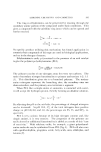
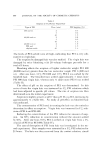
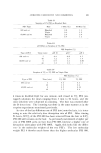
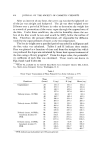
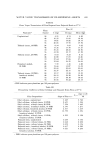
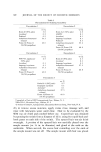
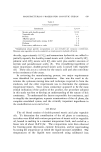
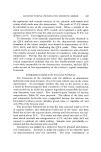
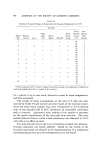
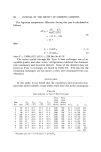
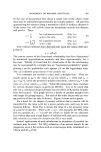
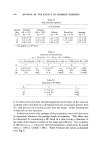
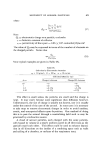
MOVEMENT OF AEROSOL PARTICLES 675 where (•- 1) (,• q- 1) QP2C = 2%z)2dv0 (17) Here 0• = electrostatic charge on a particle, coulombs •t -• dielectric constant of collector •0 -- permittivity of free space = 8.85 X 10²' coulombs2/dY ne.cm• The value of Qe may be expressed in terms of the number of electrons on the charged particle. Notice that QP va-- (18) Dx/d•vo Some typical examples are given in Table IX. Table IX Collection by Electrostatic Attraction 1.0 g/cma D = 100 t• v0 = 10 cm/sec Collection Efficiency (Va) Charge-6 electrons Charge-300 electrons 10 •0 --•0 • ,--o •% 0.• •0.•% ,--,3.s% 0.0• •0.2% •% The effect is small unless the particles are small and the charge is large. It may easily become more significant than diffusion however. Unfortunately, the size of charge is usually not known, nor is it usually under the control of the user of the aerosol. In some cases it is necessary to take steps to remove electrostatic charges in order to avoid random, erratic, and unexpected effects upon deposition. One method of doing this is to pass the aerosol through a neutralizing field such as may be generated by a radioactive source. A cloud of aerosol particles, each charged with the same polarity, will expand in volume at a nearly uniform speed in all directions as the particles repel each other. This effect could be used to enhance deposi- tion in all directions on the insides of a confining space such as walls and ceiling of a chamber, or surfaces of the respiratory tract.

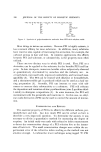
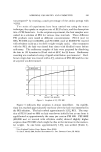
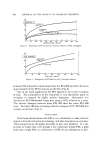
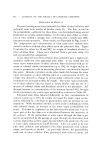
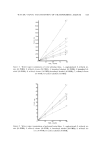
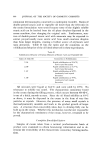
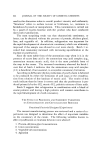
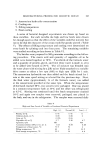
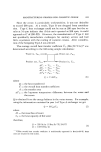
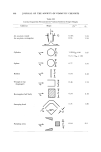
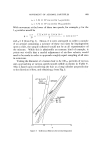
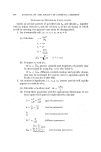
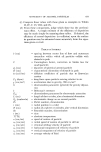
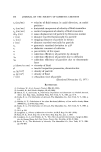
676 JOURNAL•OF THE SOCIETY OF COSMETIC CHEMISTS SUMMARY OF METHOD OF CALCULATION Given an aerosol particle of specified size dr, and density o, together with its initial velocity u0 and the velocity v0 of the air stream in which it will be moving, two general cases must be distinguished. 1. Air is essentially still, i.e., v0 u0, or v0 = 0. ppdp 2 (a) Calculate r- 18/1 X s • HoT Us = gr k TC 3•-gd v •a = i-•X)t (t = 1 sec) _ (b) Compare u• with zxXB If u• zxxB, gravity controls and trajectory o[ particle may be determined by using Fig. 1 (see also Table I). -- I[ u• zxx• diffusion controls motion and particle deposi- tion may be estimated [or various cases by equations given by Fuchs (1 1) (see also Table VII). 2. Air motion is significant, i.e., Vo Uo assume particle will rapidly acquire air velocity of v0. (a) Calculate r (as above) and Rd - vøDps •'- (b) Using-these quantities and the appropriate dimensions of sur- faces upon which particle might deposit, calculate ' usL grL G - voR- voR (gravity parameter) Xs •b = • = -• (inertia parameter) dp (interception parameter) rod (diffusion parameter) Os - 1) Ku = 12•FeoDS•dvv ø .(electrostati c parameter)
Purchased for the exclusive use of nofirst nolast (unknown)
From: SCC Media Library & Resource Center (library.scconline.org)