J. •5'oc. Cosmet. Chem., 23, 637-655 (September 14, 1972) The Design of a Continuous Manu- facturing Process for an Oil-in-Water Cosmetic Cream N. PHILIP REDMOND, B.S., and PAUL W. HALTENBERGER, B.S.* Presented December 13, 1971, New York City Synopsis--An important factor in the decision to consider the CONTINUOUS MANU- FACTURE of a COSMETIC CREAM is product volume or demand. The particular cos- roetic cream which is the subject of this discussion meets this requirement. In arriving at a final PROCESS DE•CIGN and selection of EQUIPMENT, emphasis is placed upon: (a) the determination of the basic chemistry responsible for the stability and characteristic con- sistency identified with the product under study, and (b) the determination of the relative importance of process and ingredient variations. Calorimetry and fractional factorial de- signed experiments conducted to study emulsification and crystallization behavior are de- scribed. Results lead to the conclusion that the fatty acid soap and fatty acid complexes present in the emulsion play an important role in determining product consistency and stability while moderate variations in other components have little or no effect. The types of equipment and process designs considered for the continuous process study are dis- cussed, including results of actual pilot-scale experiments. INTRODUCTION Cosmetic creams such as hand creams, facial creams, skin creams, and others have traditionally been manufactured by the "batch" pro- cess. The most popular creams produced by this metohd today are emul- sions of the oil-in-water type (O/W) and will generally be found to con- tain emulsifying agents either of the anionic or nonionic types, or pos- sibly both. This study was concerned with a cosmetic cream of the O/W type containing an anionic surface active agent (1), specifically, an ammonium soap of a straight chain fatty acid. Further, this soap is * Noxell Corp., 11050 York Road, Baltimore, Md. 21203. 637

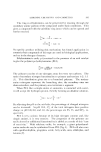
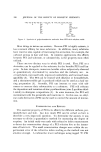
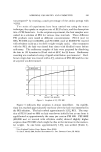
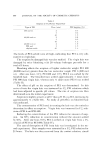
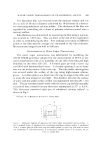
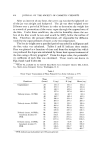
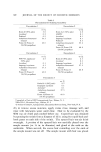
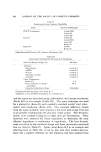
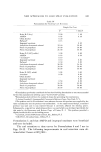
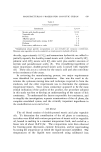
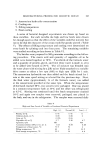
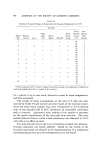
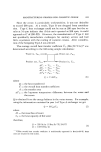
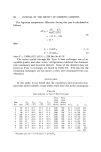
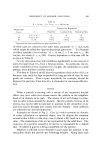
638 JOURNAL OF THE SOCIETY OF COSMETIC CHEMISTS formed in situ during the batch process. It is this product around which this study is keyed and will hereinafter be referred to as the "cream" or "product." At the present time, the cream is manufactured in several 1000-gal- lon batches per day. The procedure consists of the separate preparation of the oil and aqueous phases, the blending of these phases in a combina- tion kettle to form an emulsion, the cooling of the blended materials while stirring, the filling of the product, the refrigeration of the pack- aged product, and, finally, warehousing. During the blending procedure, emulsion formation, and subsequent cooling, certain constituents of the cream crystallize. This crystalliza- tion is believed to be vital for the particular consistency and texture .that is so characteristic of the product in question. Thus, the consistency and texture of the product must be maintained and was the parameter which received considerable attention in the evaluation of the cream itself and its ability to be continuously processed. In order to meet marketing requirements, it became necessary to consider increasing the present manufacturing capacity. Realizing the current drawbacks of the present batch system, such as long preparation time, exposure of hot product to varying holding periods due to filling line stoppages, undue product waste, cleaning difficulties, and operator errors, it was decided to study the feasibility of manufacturing by a continuous process. In order to accomplish this objective it was im- portant to study the formulation itself in terms of chemistry, emulsifi- cation behavior, and crystallization. Before proceeding, it is well to further define what the term continu- ous processing means in this report. By continuous processing we mean continuous in-line manufacture or continuous flow processing. Two liquid streams, one aqueous and one oily, are brought together under continuous flow to form the emulsion with the finished product ulti- matdy being supplied without process interruption. OBSERVATION AND CALORIMETRY MEASUREMENTS OF CRITICAL CRYSTALLIZATION PHENOMENA Product Composition The composition of the cosmetic cream under study is presented in Table I. As can be readily noted, the nature of the emulsion forma- tion and the crystallization behavior of the cream depend on the ac- tion of several of the constituents. Both lime water (calcium hy-
Purchased for the exclusive use of nofirst nolast (unknown)
From: SCC Media Library & Resource Center (library.scconline.org)