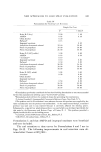
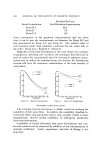
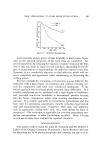
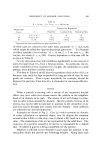
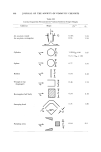
Notes Properties and Vocabulary of Aggregated States B. ECANOW, Ph.D.,* R. BALAGOT, M.D.,* B. GOLD, Ph.D.,* and C. ECANOW, B.S.** It is a legitimate concern and necessity for the scientific community to help clarify the vocabulary used in discussing heterogenous systems. In this effort we have extended to heterogenous systems the conceptual clari- fications and vocabulary which were developed in our laboratories for the coagulated and the flocculated suspension states (1, 2). The aggregated states of heterogenous systems are the ones which give ditficulty in relat- ing vocabulary to properties. The flocculated state is one in which the particles are aggregated in a network structure with entrapped bulk media. The particles have a rela- tively fixed spacial relationship (geometry) to each other. The particles with their adsorbed surfactant films are not in contact. If one particle moves and the bridges hold, then the whole group moves in that direction (2). The coagulated state is one in which the particles are aggregated in a structure which consists of surface-to-surface contact. The surface con- sists frequently of adsorbed surfactant or adsorbed colloidal material sur- rounding the particles. The adsorbed films form a matrix with little or no entrapped free bulk medium. The matrix of surfactant and water and oil molecules (in oil/water emulsions) can form a structural phase having the properties of a micellar film or liquid crystals or coacervate, etc. Thus, the film matrix in a coagulated system probably incorporates * University of Illinois, 853 S. Wood St., Chicago, Ill. 60612, and Hines V.A. Hospital, Hines, Ill. * Ecanow and Assoc. Consultants, Chicago, Ill. 679

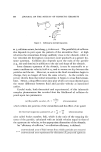
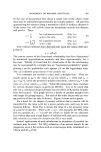
680 JOURNAL OF THE SOCIETY OF COSMETIC CHEMISTS and "locks in" flavors or scents in many formulations. In a similar man- her, to explain the action of anesthetic drugs, Ecanow et al. have pro- posed that membranes which also consist of micellar films or liquid crys- tals or coacervate structures can adsorb or "lock in" nonpolar anesthetic gas molecules. The coacervate (membrane) is then stabilized by the non- polar molecules. One effect of stabilizing the coacervate structure is that diffusion across the matrix or membrane by polar molecules or ions such as potassium or sodium is minimized and the anesthetic state results (3). A defined term in the vocabulary used to discuss hererogenous systems should incorporate within its limits all the characteristics common to all the systems. Thus, the terms coagulation and fiocculation describe two different types of aggregated states which can be present in any hereroge- nous system. These aggregated states occur in cosmetic, pharmaceutical, or biological beterogenous systems. REFERENCES (1) Ecanow, B., and Wilson, R., Powdered particle interactions: suspension flocculation and caking, II, ]. Pharnt. Sci., 52, 1031-8 (1963). (2) Ecanow, B., Gold, B., Ecanow, C., Newer aspects of suspension theory, Arner. Perrum. Cosntet., 84, 27-30 (1969). (3) Ecanow, B., and Gold, B., Application of physical-chemical principles to the study of anxiety and depression, J. Psychotherapy Psychosom. Med., 21, 125-7 (1972).
Purchased for the exclusive use of nofirst nolast (unknown)
From: SCC Media Library & Resource Center (library.scconline.org)