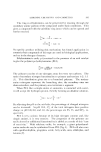
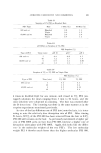
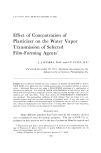
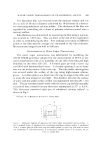
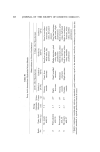
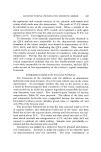
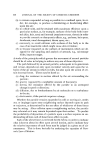
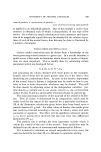
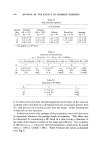
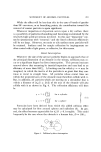
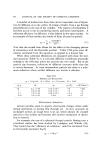
MOVEMENT OF AEROSOL PARTICLES 661 3. The efficiency of particle removal is essentially 100% in the pul- monary air spaces, for particles down to about 2 v. 4. As particle size decreases from 2 v to about 0.5 v, removal in pul- monary air spaces decreases, but increases again for sizes below 0.5 v due to deposition by diffusion.* 5. Deposition in the upper respiratory tract is increased with faster breathing frequency, due to increased rate of air flow. 6. Deposition deep in the lungs increases with slow, deep breathing, as a large fraction of the tidal air gets in and there is a longer time of transit in and out of the lungs. DETAILED ANALYSIS The list of forces which may act upon an aerosol particle will next be reviewed in detail in order to show how to calculate the important quantities associated with each. This in turn leads to the ability to judge which force (or forces) may be controlling the particle behavior in a given case. Throughout the following it will be assumed that the aerosol par- ticles are spherical in shape having a diameter of less than roughly 100 v, and are moving in dry air at 20øC and 1 atm pressure, viscosity • • 1.81 X 10 -4 poises, density p/: 1.20 X 10 -a g/cm •. Drag Under the conditions assumed, the force of frictional resistance (drag) offered by still air, is given by Stokes law* FD = 3•'d•,u• For horizontal motion in still air in the absence of all other forces, Newton's law leads to the quantity r: pvdv"/18v which is a basic property of the particle-air system called the relaxation time. Eventually, the drag effect reduces the speed of the particle to zero. The distance traveled *• Particles of 0.I v remaining in an alveolar sac of 0.03-cm diameter for 1.2 sec (as assumed by Findeisen) would deposit to the extent of 60%, according to the diffusional equation cited above. Particles of 0.01 t• would be completely deposited. t For very small particles Fv must be corrected by dividing by the Curmingham factor C, which is approximately 1 + 0.16/dr in air at 20øC and 1 a•tm, where dvis in microns. For particles generally larger than 100-t• diameter, Stokes law must be replaced by the use of a drag coefficient relationship to express the drag force, but such larger particles are not of interest here.

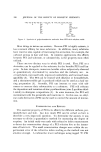
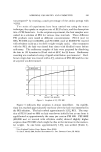
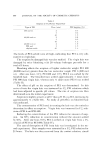
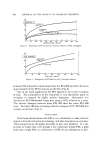
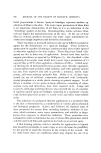
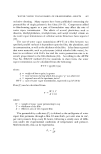
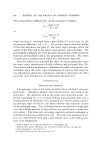
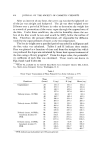
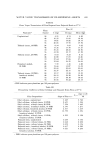
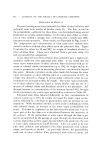
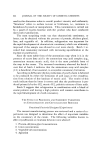
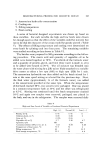
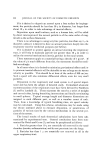
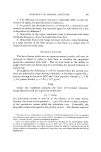
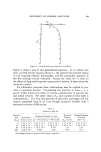
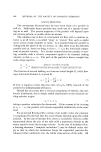
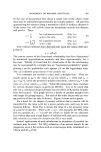
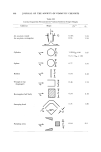
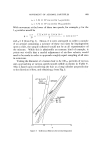
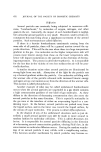
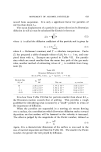
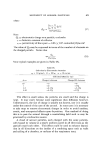
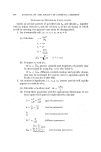
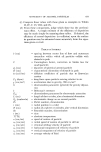
662 JOURNAL OF THE SOCIETY OF COSMETIC CHEMISTS horizontally from the start with initial speed Uo, called the stopping dis- tance, is given by pvdv2uo x8 = •u0 .... (1) 18/• When the air stream is moving, the drag force will depend upon the velocity of the particle relative to that of the air. This relative velocity must be taken in a vector sense in order to allow for the possibility that the air and the particle may be moving in different directions as well as at different speeds, at a particular instant. Gravity Because the particle has weight, there will always be some tendency for it to move vertically. When this force is incorporated in Newton's law, in addition to the always present drag, the vertical component of motion in still air may be obtained. In free vertical fall starting from rest, the particle will accelerate until it reaches a maximum speed, called the terminal velocity, given by us = g• (2) The combined effect of drag (both horizontal and vertical) and gravity determines the trajectory of a particle moving freely in quiet air, in the absence of all other forces. If the particle is given an initial horizontal velocity at speed u0, the distance traveled horizontally is given by x = xs(• - e -t/•) = u0•(1 - e-t/•) (3) If the vertical speed of the particle is initially zero, the distance traveled vertically is y =ust--usr(1--e -t/•) = usa-f --(1--e-t/•)] (4) The horizontal and vertical distances are determined independently, and in combination they describe the tra,:•ectory. This may be done in generalized dimensionless form by expressing the variables in ratios: horizontal distance ratio x x X s I•OT vertical distance ratio - y y t us• g•2 • 1 - •-t/, (5) (1 - e -t/v) (6) time ratio = t/•'
Purchased for the exclusive use of nofirst nolast (unknown)
From: SCC Media Library & Resource Center (library.scconline.org)