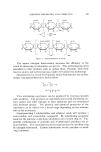
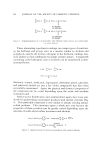
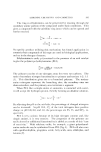
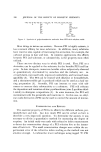
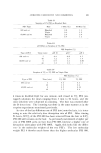
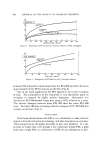
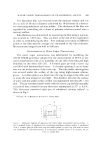
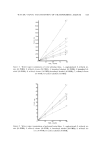
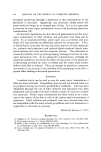
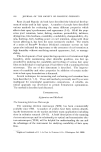
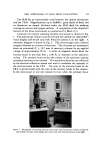
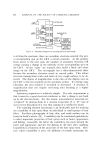
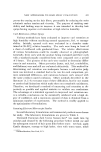
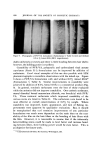
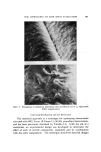
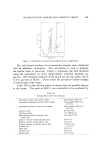
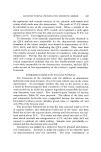
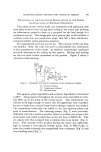
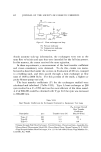
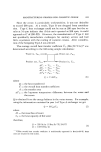
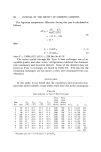
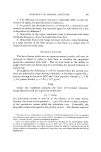
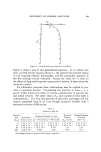
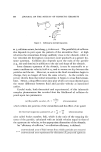
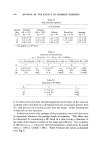
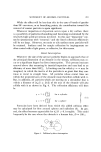
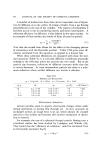
MOVEMENT OF AEROSOL PARTICLES 671 While the effect will be less than this in the case of bends of gentler than 90ø-curvature, or at branching points, the contribution toward the removal of coarser particles is again significant. Whenever impaction or deposition occurs upon a dry surface, there is a possibility of particles rebounding and becoming re-entrained by the relatively high speed air streams involved. In this case "impaction" can- not be synonymous with "removal," and the listed collection efficiencies will be too large. However, on moist or oily surfaces most particles will be retained. Surfaces used for sample collection by impingement are often coated with a light grease, or adhesive, for this reason. Direct In tercep tion Whenever the size of the aerosol particles begins to approach that of the principal dimension of an obstacle in the stream, collisions may oc- cur to a significant degree by direct interception. This process increases removal above that occurring by inertial impaction and may lead to an efficiency of more than 100%. A limiting case for which f -- oo may be imagined, in which the inertia of the particles is so great that they con- tinue to travel in straight lines. All particles whose center lines are within the projected area of the obstacle must therefore collide with it. But, in addition, all particles which are moving on a streamline that is within a distance of (dp/2 -+- D/2) of the axis of the obstacle will also collide with it as shown in Fig. 4. The collection efficiency will then be r/ = 1 d- (•) for a cylinder r/ = 1 d- for a sphere (1t) Formulas have been derived from which this added collision effect may be calculated for flow around spheres and cylinders (6). In gen- eral, the effect becomes appreciable for dp/D 0.1 roughly. This could frequently be the case where the obstacle is a human hair, D • 100 •. Figure 4. Collision by direct interception

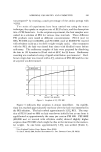
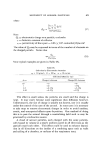
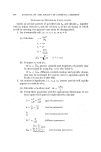
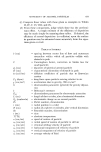
672 JOURNAL OF THE SOCIETY OF COSMETIC CHEMISTS Diffusion Aerosol particles are constantly being subjected to numerous colli- sions, "bombardment," by molecules of oxygen, nitrogen, and other gases in the air. Generally, the impact of such bombardment is negligi- ble unless the aerosol particle is very small. However, under certain cir- cumstances this may bring about a significant movement of the aerosol particles. Such movements are called diffusion. If there is a heavier bombardment consisten.tly coming from the same side of all particles, there will be a general motion toward the op- posite direction. This will be the case when there is a large temperature gradient in the gas. Gas molecules on the higher temperature side will possess more kinetic energy than those on the lower temperature side, hence will impart momentum to the particle in the direction of decreas- ing temperature. The process is called thermophoresis. It is responsible for the fact that in the vicinity of very hot surfaces the air will be prac- tically dust-free. A similar situation exists when aerosol particles are illuminated by strong light from one side. Absorption of the light by the particle sets up a thermal gradient within the particle. Gas molecules colliding with the warmer side of the particle rebound with increased kinetic energy and again set up a net motion away from the direction of the warmer side. This motion is called photophoresis. Another example of what may be called unbalanced bombardment occurs when the aerosol particles are suspended in a gas which contains a high concentration gradient of one kind of gas molecules. As these diffuse in the direction of decreasing concentration they also move the aerosol particles in the same direction. This is especially noticeable in the gas zone at the interface of either an evaporating liquid or a con- densing vapor. In the former, aerosol particles are pushed away from the liquid surface, and in the latter case toward the liquid surface, by the stream of vapor molecules. The process is called dil•usiophoresis. In the absence of any of the unbalanced situations such as just de- scribed, a small aerosol particle may still be made to move around in random fashion by molecular collisions. This is called Brownian di[- [usion. It is responsible for aerosol particles diffusing in the direction of a decreasing aerosol concentration gradient, obeying Fick's law, in the same manner as molecular diffusion occurs. During the random wander- ings of an aerosol particle it may collide with a neighboring surface. This becomes another mechanism by which particles may become re-
Purchased for the exclusive use of nofirst nolast (unknown)
From: SCC Media Library & Resource Center (library.scconline.org)