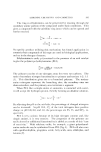
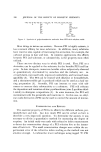
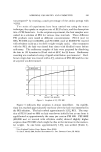
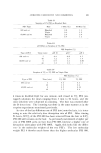
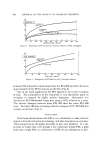
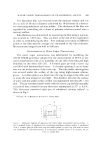
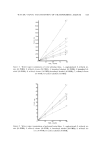
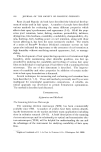
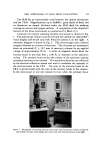
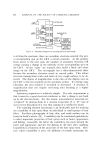
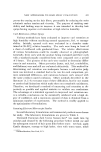
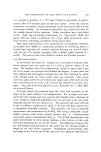
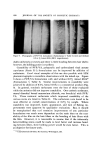
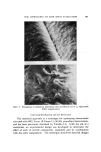
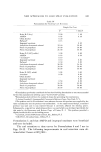
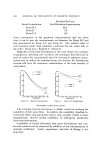
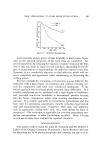
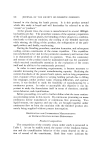
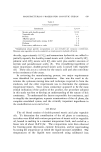
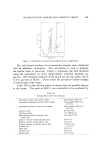
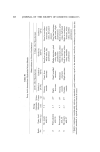
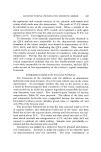
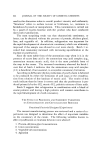
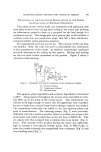
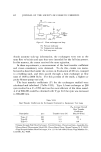
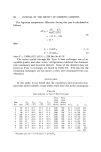
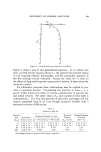
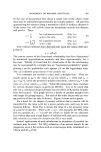
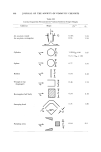
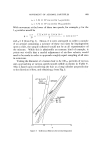
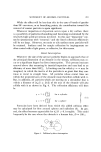
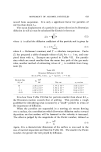
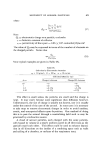
MOVEMENT OF AEROSOL PARTICLES 669 v0 = 1.24 X 10⁷ crn/sec for 1-• particles v0 = 5.72 X 10 • cm/sec for 50-• particles With movement at the lower of these two speeds, for example, q, for the 1-v particles would be vo.r 5.72 X 103 X 3.54 X 10 -6 • - D - 2 = 1.01 X 10 -• and v • 0 (from Fig. 3). Hence, if it were attempted to collect a sample of an aerosol containing a mixture of these two sizes by impingement upon a slide, the sample collected would not be at all representative of the mixture. While this is admittedly an extreme kind of example, it points out vividly that a careful adjustment of air flow velocity would need to be made in order to approach roughly equal sampling of all sizes in a mixture. Taking the diameter of a human hair to be 100 v, particles of various sizes approaching at various speeds would collide as shown in Table V. This is based upon considering the hair as a long cylinder perpendicular to the direction of flow, and obtaining q, from Fig. 3. JET ON PLATE Round CYLINDERS I00 Re = I0 Re= 0.2 0.1 a/2 1 10 ,1, Figure 3. Collection efficiency by inertial impaction

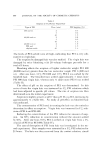
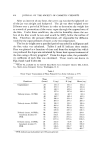
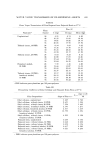
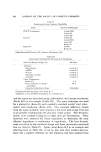
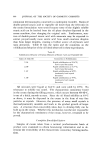
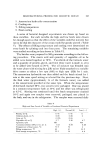
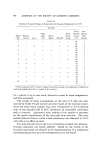
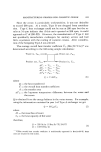
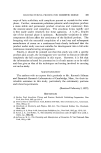
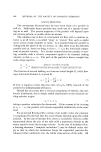
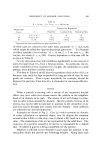
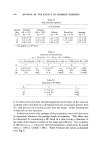
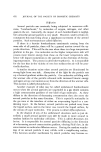
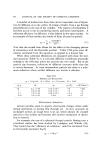
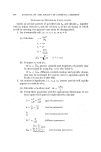
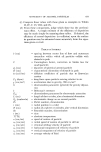
67O JOURNAL OF THE SOCIETY OF COSMETIC CHEMISTS Table IV 99% Inertial Impaction voiD, Seconds Particle Cylinder Cylinder Size (Re = 0.2) (Re = 100) ø Ribbon Round Jet Impinger (d•,, ix) •b99 = 16 •bg• = 9 •b• = 22 •b•9 = 0.36 •p• = 9 1 4.52 X 10⁶ 2.54 X 10⁶ 6.21 X 10⁶ 1.02 X 10⁵ 1.13 X 10 10 5.19 X 10⁴ 2.92 X 10⁴ 7.14 X 10⁴ 1.17 X 10 s 1.30 X 10 50 2.08 X 10 a 1.17 X 10 a 2.86 X 10 a 46.7 5.19 X 10 Also applies to a 90 ø bend. Table V Impaction on Human Hair p• = 1.0g/cma D = 100n Re = 0.0662v0 v0 = 10 cm/sec Re = 0.66 v0 = 100 cm/secRe = 6.62 v0 = 1000 cm/sec Re = 66.2 1 l0 5O 3.54 X 10 -a ,'-•0 3.54 X 10 -• ,-¾0 3.54 X 3.08 X 10-' 5% 3.08 •-•80% 30.8 •-•100% 7.70 90% 77.0 •-dO0 % 770 •-d O0 % Table VI Impaction in 90ø-Bend 1 1.77 X 10 -a 10 1.54 X 10 -• -•18% 50 3.85 •96% It is evident from this how inertial impaction on the hairs in the nose, for example, will contribute to a substantial removal of particles greater than 10 t, and prevent their being carried into the lungs. Other mechanisms of removal are also operative. Further removal in the passages of the respiratory tract will also occur by impaction whenever the passage bends or branches. This effect may be illustrated by considering a 90ø-bend in a tube having a diameter of the order of the smaller bronchi of the lungs (say 0.20 cm). For a velocity of 100 cm/sec, pp -- 1.0 g/cm a, inertial impactions would occur in accord with q• z (100 X •-/0.20) • 500 •-. Table VI shows the values as obtained from Fig. 3.
Purchased for the exclusive use of nofirst nolast (unknown)
From: SCC Media Library & Resource Center (library.scconline.org)