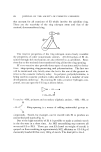
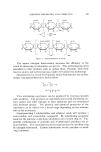
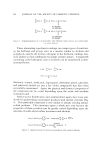
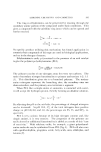
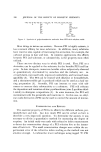
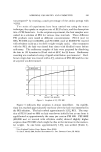
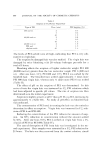
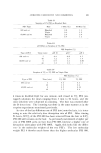
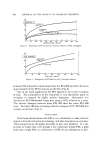
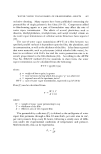
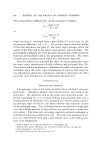
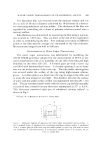
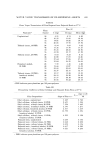
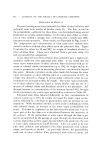
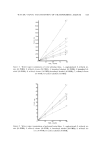
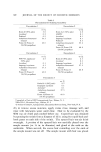
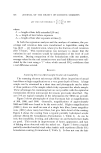
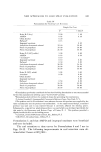
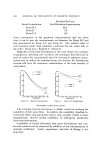
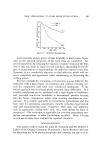
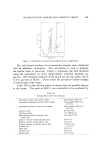
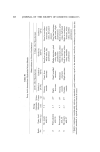
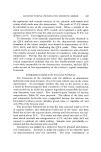
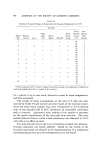
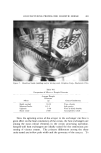
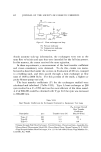
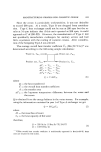
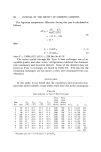
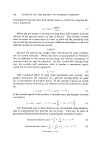
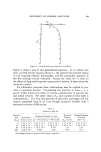
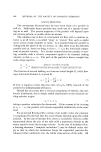
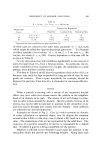
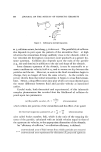
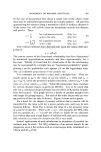
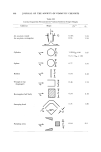
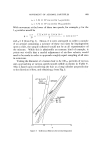
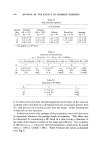
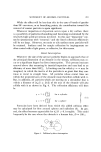
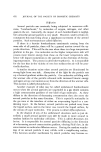
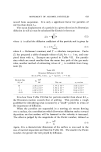
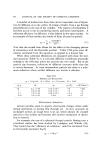
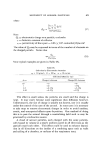
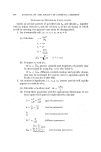
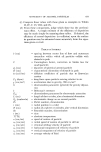
MOVEMENT OF AEROSOL PARTICLES 667 In the case of symmetrical flow about a center line ot5 the object, these areas may be represented geometrically in a simple manner. All particles approaching the obstacle along a streamline which is within a distance b of the center line will collide those on streamlines outside this distance will pass by. Thus: b for a cylindrical obstacle, (Fig. 2,a) v - D or for a flat strip (Fig. 2,b) (9) (•)2 for a spherical obstacle, (Fig. 2,a) • = or for a disk (Fig. 2,b) (10) The evidence indicates that ,• depends only upon the values of _Re and ½, that is: • = •q(Re,•) The precise nature of this functional relationship has been determined by numerical approximation methods, and also experimentally, for a few cases. Whitby (5) found that for a fixed value of _Re, the relationship may be represented by a straight line on "log-normal probability" graph, __ plotting ,• on the probability scale against X/q• on the logarithmic scale. _ The X/½ is directly proportional to the particle size. Two constants are needed to place such a straight line. They are -- usually given as •ul/2, the value of X/q• for which ,• -- 0.50, and • -- (•841/2/•ul/•), called the geometric standard deviation, wherein •841/• is the value ol• X/• for which 't -- 0.84. Table III summarizes these numbers for various obstacle shapes, as given by Whitby. It is to be noted that only for a cylindrical shaped obstacle has the effect of Reynolds number been determined: The graph will be a family of parallel straight lines with larger Re giving larger ,•. For each of the other shapes only an aver- age position of the line may be drawn. Figure $ shows such a graph. For a fixed Re, the degree of particle collision due to inertia will be controlled by the ratio void for a given particle size, and may be esti- mated as follows. From Fig. $, obtain the value of ½ for whatever value of • may be of interest. Then vo/D -- q,/r. For example, for 99% colli- sion by particles of p _-• 1 g/cm a the values in Table IV are obtained. It is evident that such a high degree of collision will only occur at reason- able velocities (v0) when the obstacle size (D) is very small. Several applications of such calculations to situations of practical im- portance may be cited. For 99% collection of an aerosol sample by im- pingement ur)on a flat surface such as a microscope slide, considered as a ribbon with D __-- 2 cm:

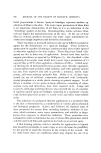
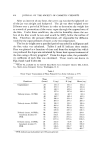
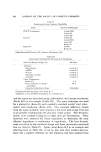
668• JOURNAL OF THE SOCIETY OF COSMETIC CHEMISTS Table III Inertial Impaction Parameters for Various Collector Target Shapes Collector Shape ½•t 1/2as Jet on plate, round 0. 373 Jet on plate, rectangular 0.55 Cylinder ¾---•-•,- O• ½ 1 . 253N/•-0.1.65150NR, 0.2 •- 0.77 Sphere ¾o Ribbon • /9 0.54 Vo Trough or cup I • 0.46 (impinger) ¾o = ,, • •,.•-- /9 O. 54 Rectangular half body ¾o t Sweeping bend • 0.71 Focusing away =_ • tQ 0.14 ¾o T 1.24 1.24 1.91 2.22 1.91 2.32 1.80 2.9
Purchased for the exclusive use of nofirst nolast (unknown)
From: SCC Media Library & Resource Center (library.scconline.org)