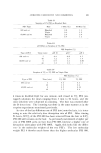
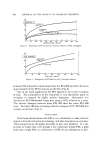
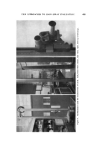
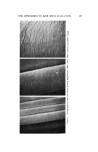
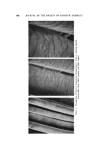
NEW APPROACHES TO HAIR SPRAY EVALUATION 635 Curl retention of hair sprays at high humidity is much more depen- dent on the physical properties of the resin than on coatability. Im- proved coatability, by reducing the viscosity or surface tension of the film, may or may not result in improved curl retention, depending on the de~ g•ee of plasticization or hygroscopicity the additives impart to the film. However, it is a worthwhile objective to find additives which will im- prove coatability and appearance while maintaining or improving the holding power. Previous methods for evaluating curl retention among different for- mulations with a high degree of confidence and without running con- trols for comparison each time were considered inadequate. A sta- tistical approach was developed which overcame these difficulties. It is reliable, conclusions can be validated with a high degree of confidence and, provided run-to-run variability is determined, permits keeping data for futhre comparisons rather than running simultaneous com- parisons. :It::is readily applicable to formulation optimization and has been used for optimizing concentrates, thereby reducing experimental time and manufacturing costs. Properties other than curl retention such as appearance, drying time, tack, etc., must always be kept in perspective. The technique is applicable for selecting propellants, pro- pellant concentrations, or other formulation variables. Work is being carried out in these areas and will be reported elsewhere. ACKNOWLEDGMENT The authors wish to thank Dr. John H. Fassnacht and Mr. Robert S. I,uksic of the Organic Chemicals Department's Freon Products Division for obtaining the SEM photomicrographs and carrying out the curl re-

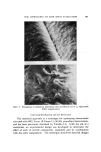
636 JOURNAL OF THE SOCIETY OF COSMETIC CHEMISTS tention measurements, Dr. Ronald D. Snee of the Engineering Depart- ment's Engineering Service Division for consultation on the statistical design of the curl retention experiments and the statistical analysis of the results, and Mr. Chester E. Shatrat of the Organic Chemicals De- partment's Jackson Laboratory for discussions concerning the operation of the scanning electron microscope. (Received April 10, 1972) REFERENCES (1) Root, M. J., Hair spray--future?, Amer. Per/urn. Cosmet., 86 (10), 39-41 (1971). (2) Shansky, A., Polymeric substances in hair spray film-forming compositions, Ibid., 83 (5), 31-5 (1968). (3) Eriemann, G. A., Objective and subjective methods for the evaluation of hairsprays, J. Soc. Cosmet. Chem., 22• 287-302 (1971). (4) Micchelli, A. L., and Koehler, F. T., Polymer properties influencing curl retention at high humidity, Ibid., 19, 863-80 (1968). (5) Root, M. J., and Bohac, S., Hygroscopicity and hardness of hair spray resins at varying humidities, Ibid., 17, 595-605 (1966). (6) Brookins, M. G., The action of hair sprays on hair, Ibid., 16• 309-15 (1965). (7) Reed, A. B., Jr., and Bronfein, I., Curl retention with hair sprays, Drug Cosmet. Ind., 94, 178 (1964). (8) Performance testing of aerosol hair sprays, Aerosol Age, 7, 26 (1962). (9) Grande, J., New Concepts in Hair Products and Evaluation Procedures (Humidity Stability and Hair Characteristics), General Anilene and Films Co. Brochure, New York, N.Y. (10) Princen, L. H., and Baker, F. L., New tool for coatings study, Paint Varn. Prod., 61, 21-9 (1971). (11) Black, J. T., SEM: scanning electron microscope, photographic applications in science, Technol. Med., 4 (16), 29 (1970). (12) Swift, J. A., New developments in electron microscopy, ]. Soc. Cosmet. Chem., 22, 477-86 (1971). (13) Johari, O., The scanning electron microscope--its operation and use, Metat Progr., 94, 147-50 (1968). (14) Takada, S., Possibilities of improving the quality of hair spray, Aerosol Rep., II, 12-25 (1972).
Purchased for the exclusive use of nofirst nolast (unknown)
From: SCC Media Library & Resource Center (library.scconline.org)