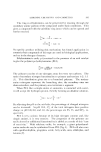
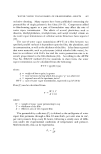
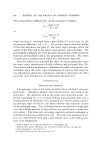
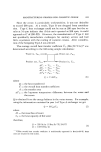
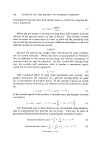
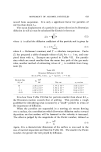
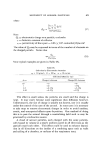
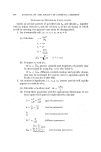
608 JOURNAL OF THE SOCIETY OF COSMETIC CHEMISTS The permeability coefficient (Pc) can be calculated as follows' or PC • slope X 24 Px -- P• slope X 24 Pc -- where the slope is calculated from a plot of flux (F) versus time (t) the pressure difference (zxP -- P• -- P2) of water vapor below the surface o[ the film and above the film Px, the water vapor pressure below the surface of the film and P2, the water vapor pressure above the film. The permeability coefficient (Pc) then becomes characteristic o[ the polymeric materials and modifiers used in the preparation of the film. The above is based upon a combination of both Fick's and Henry's laws (16). Previous studies have reported the effect of certain plasticizers upon the water vapor transmission of ethyl cellulose and polyamid film (16). The present study is an attempt to determine the effect of plasticizer con- centration upon the water vapor transmission of the free film from the selected polymer-plasticizer combination and also to determine the effect upon this value through use of a combination of plasticizers. EXPERIMENTAL Materials and Methods The polymers used in this study included ethyl cellulose* and poly- amid resin.* Hexadecyl alcohol* and tributyl citrate• were used as the plasticizers. All chemicals used in this study were analytical grade. So- hitions containing 5% w/w of ethyl cellulose and polyamid resin with a varying amount of plasticizer were prepared in a solvent system contain- ing absolute ethyl alcohol for the ethyl cellulose and isopropyl alcohol for the polyamid resin. The resulting solution was filtered through glass wool and a 20-ml quanti,ty of this solution was poured onto a clean mer- cury surlace. The films were cast using a mercury substrate technique as indicated in a previous publication (16). The rate of evaporation of sol- vent was controlled by inverting a glass fiInnel over a petri dish at am- bient room temperature. * Ethyl C•11ulose--N-10, Hercules Powder Co., Wilmington, Del. ? Polymid 1155, Lawlet Chemicals, Inc., Krumbhaar Resin Divisi,on, Chicago, Ill. •: Enjay Chemical Co., New York, N.Y. õ Citrofiex-4, Pfizer and Go., Inc., New York, N.Y.

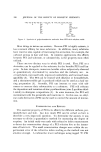
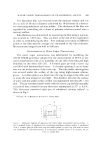
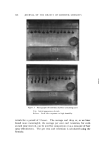
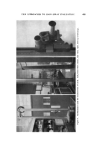
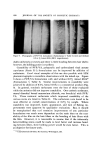
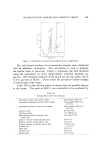
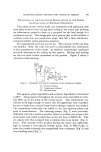
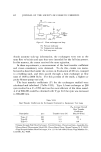
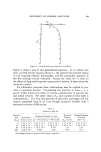
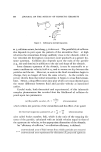
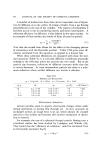
WATER VAPOR TRANSMISSION OF FILM-FORMING AGENTS 609 The deposited film was removed from the mercury surface and cut into a circle ot 10 cm in diaIneter and dried for 18-24 hours in a desicca- tot containing anhydrous calcium sulfate. The thickness of the fihn was regulated by controlling the wfimne of polymer solution poured onto a mercury surface. Film thickness was determined by measuring the film using a microin- eter accurate to ñ0.01 min. This was done at the end of the experiment in order to avoid defacing the film. Five readings were taken at different points of the film and the average was calculated as the film thickness. Measurements ranged frown 0.05 to 0.06 min. Determination of Water Vapor Transmissio•z The water vapor transmission was determined by •nodifying the ASTM E96-66 procedure adopted for the measurement of WVT at ele- vated temperatures with a low humidity on one side of the film and high humidity on the other side (15). A 4-ounce glass jar with a screw cap was filled with demineralized water. A circular opening 2 cm in diam- eter was cut in the center of the screw cap. The film under investigation was secured under the surface o[ the cap using high-vacuum silico.ne grease. A rubber gasket was fitted into the cap to support the film and to make the unit leakproof and tight. The distance between the surface of water and the under surface of film was maintained between 20 ñ 0.5 min. The jar was then fitted loosely with the screw cap and the assembly was placed into a heated vacuum desiccator maintained at 37 ø ñ 0.5øC. This desiccator contained eight .jars o[ anhydrous calcium sulfate * as shown in Fig. 1. ß Ihierite, W. A. Hammond I)rierite Co., Xenia, Ohio. 11 6 5 lo 4 Figure 1. Schematic diagram of apparatus for water vapor transmission determination. I, lid 2, jacketed heater 3, perforated jar containing anhydrous calcium sulfate 4, perforated shelf 5, 4-ounce glass jar with screw cap and rubber gasket 6, screw cap with hole in cente• and model film 7, dial the•nmmeter 8, temperature variable screw 9, to vacuum 10, air inM 1 l, model film
Purchased for the exclusive use of nofirst nolast (unknown)
From: SCC Media Library & Resource Center (library.scconline.org)