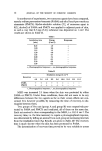
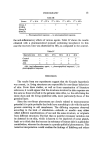
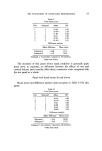
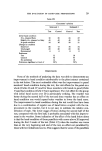
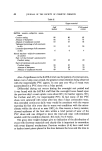
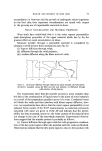
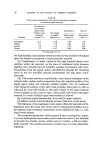
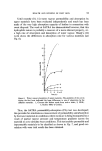
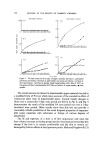
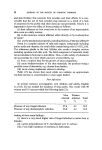
PHOREOGRAPHY Table III 13 Screen T ø -e 18 h T ø + 27 h T ø + 39 h T ø + 42 h T ø + 48 h Group A - - + + + (PABA) Group B ..... (PMCX) +, Phoreographical response -, no phoreographical response. the anti-inflammatory effects of various agents. Table IV shows the results obtained with a pharmaceutical pomade containing tocopherol. In this case the recovery time was shortened by 50•o as compared to the control. Table IV Recovery time 21 h 24 h 27 h 30 h 41 h 48 h Control .... + + PABA .... + + AIA + + + + + + AIA, Anti-inflammatory agent +, phoreographical response -, no phoreographical response. DISCUSSION The results from our experiments suggest that the Kryspin hypothesis was correct, i.e. living structures are responsible for non-linear behaviour of skin. From these studies, as well as from examination of literature references, it would appear that the structures involved in skin response are the same as those involved in the galvanic skin reflex, i.e. the cells lining the sweat ducts and the living epidermal cells, more particularly those of the germinal layer. Since the non-linear phenomena are closely related to transcutaneous potential it is quite probable that both have something to do with the active process occurring in cell membranes. The differing responses observed according to the kind of stimulation--cathodic or anodic•may either reflect different manifestations of one and the same structure, or originate from different structures. The fact that no positive resistance variation can be detected in rat skin, which is known to be deprived of sweat glands, leads us to think that the increase in resistance of human skin is a glandular contribution, whereas the decrease is a purely epithelial phenomenon. This tentative interpretation would confirm the findings of Edelberg and others

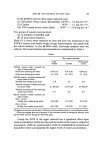
14 JOURNAL OF THE SOCIETY OF COSMETIC CHEMISTS with respect to the diphasic wave of the galvanic skin reflex, but as yet, it is only a plausible hypothesis. Whatever the mechanism may be, it appears that phoreographical determination can be very helpful in assessing skin conditions. However, the method is very sensitive to physiological and psychological factors (general condition of the subject, state of waking or sleeping, attentiveness, stress etc.). When measuring the absolute threshold value on human beings, the subject should be comfortably settled in pleasant surroundings too much surrounding activity and noise should be avoided. Even in such quiet conditions, variations are bound to occur since the physiological conditions of the subject will vary from day to day and in the course of a single day. It is nonetheless possible to break away from these requirements if only a relative measurement is needed. The latter is expressed as the ratio of the values measured at two different locations. The effect of a chemical or cosmetic product on skin can be measured in this manner, the product being applied in a given location where the threshold variations are measured with reference to an untreated control area. This differential method is a slight modification of the technique described above and requires two measuring electrodes connected in parallel and one indifferent electrode common to both circuits. It is possible to get rid of these inconveniences by working on a slightly anaesthetized animal in the in vitro determination. Of course there is no reason to think that skin of human beings would behave like that of an animal in a given situation and from this point of view, direct determinations cannot be replaced. But, in some circumstances such as determination of uv screen effect the in vitro technique allows com- parisons to be made in a very sensitive manner. Indeed, to study a particular problem, elucidate a mechanism or evaluate the effectiveness of a cosmetic agent all kinds of information are welcome and it can be very useful to collect those coming from animals and human subjects as well. At any rate, as Kryspin predicted, non-linear phenomena, in so far as they originate from living structures, have a very important significance and phoreogra- phical determinations prove to be a suitable method to assess skin condition. (Received: 4th January 1972) REFERENCES (1) Kryspin, J. The phoreographical determination of the electrical properties of human skin. J. Invest. Dermatol. 44 227 (1965). (2) Edelberg, R. Electrical properties of skin. In Elden, Harry R. Biophysical properties of the skin (1971) (Wiley Interscience, London).
Purchased for the exclusive use of nofirst nolast (unknown)
From: SCC Media Library & Resource Center (library.scconline.org)