J. Soc. Cosmet. Chem. 24 3-14 (1973) ¸ 1973 Society of Cosmetic Chemists of Great Britain Phoreography, a new method of determining the effect of uv radiation on skin M. CAMBRAI and H. DO-LINH* Presented on the loth April 1972 in Oxford, at the Symposium on 'Skin--Environmental responses and protection', organized by the Society of Cosmetic Chemists of Great Britain. Synopsis---PHOKEOGRAPHY is a method to study the electrical properties of human SKIN. Non-linear behaviour of skin can be attributed to some living structures of the skin and phoreo- graphical determination can be very helpful to assess skin conditions. The paper indicates that non-linearity of skin is a response of living cells of SWEAT GLANDS and of living cells of EPIDERMIS. On the other hand, phoreography proved to be quite suitable to determine the effect of UV RADIATIONS. Using laboratory rats one can determine a minimal erythema dose (MED), i.e. the uv energy leading to a disappearance of phoreographical response. It is also possible to evaluate the time of recovery and to assess the screen effects of various agents. INTRODUCTION When a current is applied on it, skin does not behave as an ohmic resistor over the whole range of intensity. In other words, beyond a certain threshold of intensity the skin response departs from linearity. In 1965, Jan Kryspin suggested that non-linear phenomena could be related to some living structures of the skin (1). At this date, and as far as we know, Kryspin did not make any comments about the specific nature of these structures involved, according to him, in the non-linear responses. Nonetheless, he pointed out that the distinction between linear and non- linear properties of epidermis is of important significance and described a * Unilever Research Laboratory, La Plaine Saint-Denis, 8 Impasse de la Montjoie, 93-France.

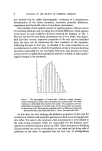
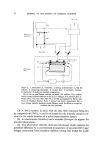
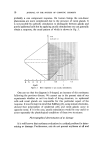
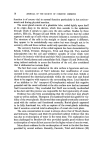
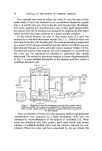
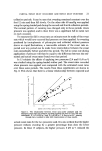
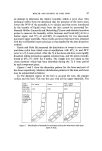
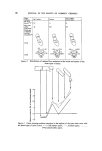
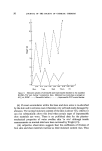
4 JOURNAL OF THE SOCIETY OF COSMETIC CHEMISTS new method that he called 'phoreography' consisting of a simultaneous determination of the ohmic resistance, hysteresis, potential differences, capacitance and threshold values of non-linear phenomena. The principle of this method consists in applying pulses of direct current of increasing intensity and recording the potential difference which appears in the tissue. In such conditions Kryspin obtained the diagram of Fig. 1. One can see that the non-linear phenomena are of two kinds: time depen- dent and time variant capacitive properties of the skin can be calculated from the later one by measuring the time constants of the transients. Following Kryspin in that way, we decided to do some researches in our own laboratory in order to check his hypothesis, to know what are the living structures responsible for the non-linear behaviour and, last but not least, to know if the so-called phoreographical method is suitable to detect patho- logical changes in the epidermis. / Figure 1. The phoreogram of human skin. Ordinate: voltage, abscissa: current increasing up to nine units and decreasing in reverse order. The ohmic resistance is determined from the first four pulses. The appearance of time- independent non-linearity at the fifth pulse, of the time-variant non-linearity at the seventh pulse. The hysteresis manifests itself as a difference between the first and the last pulse. Reprinted from J. Invest. Dermatol. 44 (1965). At this time, we were studying the dielectric properties of skin and the variations of resistive and capacitive parameters which occur during galvanic skin reflex. We came to the conclusion that non-linearity is to be related to the same living structures which are responsible for the diphasic trans- cutaneous potential variation known as GSR. These structures as Edelberg (2) has pointed out are the sweat glands on one hand and the living cells of epidermis on the other. It appeared that the best way of distinguishing
Purchased for the exclusive use of nofirst nolast (unknown)
From: SCC Media Library & Resource Center (library.scconline.org)