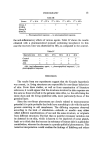
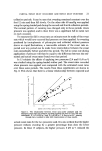
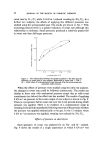
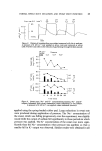
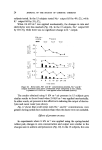
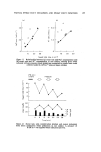
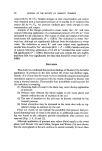
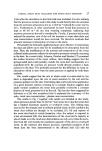
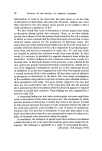
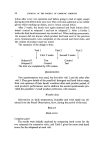
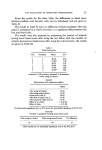
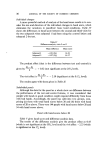
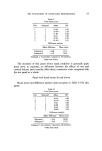
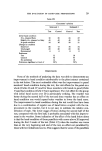
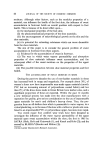
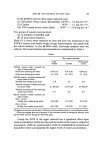
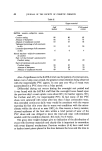
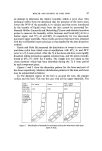
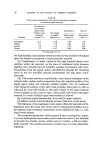
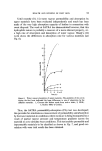
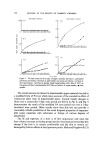
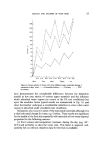
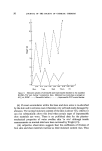
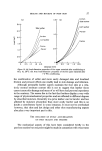
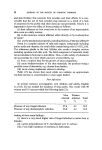
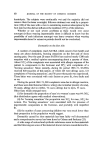
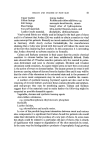
THE EVALUATION OF HAND-CARE PREPARATIONS 39 Table VII Consumers' opinions Subpanel 1 Subpanel 2 Test Control Control Test Initial hand condition Dry, chapped flaky 30 Slightly dry, chapped or flaky 49 In good condition 14 Change in condition Improved 68 Unchanged 25 Deteriorated 0 Preference Test Control No preference Preference significant at level of 29 23 27 48 49 52 16 18 11 73 7O 54 2O 2O 36 0 0 0 32 36 46 43 14 10 20% 50% DISCUSSION None of the methods of analysing the data was able to demonstrate an improvement in hand condition attributable to the plant extract contained in the test lotion. The most noticeable effect was the improvement in panel members' hand condition during the test the visit effects for the panel as a whole (Tables II and IV) and for those members with hands in good (Table V) and bad condition (Table VI) are significant. The visit effect for the group with initial hand scores over 20 is particularly striking. The weather was better during the second half of the test and since weather has an effect on hand condition one would expect better weather to lower the hand score. The improvement in hand condition during the test could thus have been due to a combination of regular use of hand lotion coupled with the im. provement in the weather, but it is not easy to estimate the relative con- tribution of each. The lower usage of lotion during the second half of the test, compared with the first half, is probably associated with this improve- ment in the weather. Some indication of the effect of the hand lotion alone is that the hand condition of those panellists with scores above 20 improved during the first 2 weeks of the test (Table VI) when the weather was worse than at the very beginning and end of the test, an effect not paralleled by those with low initial hand scores. This suggests that for some of the panellists

40 JOURNAL OF THE SOCIETY OF COSMETIC CHEMISTS the hand lotion had a definite beneficial effect. The test was, of course, designed primarily to demonstrate differences in performance, if these existed, between the test and control lotions irrespective of changes in the weather. Since there was no product difference it is useful to be able to separate, for some panellists at least, the effects of product usage from that of weather. The method of hand assessment described above seems to be sufficiently sensitive to be able to detect small changes in hand condition, in spite of the big variation in the panellists' basic hand condition and our inability to control the environment. The complete evaluation of hand-care prepara- tions necessitates not only the assessment of hand condition by an expert observer and by the panellists themselves, but also an assessment of the other attributes of the product which contribute to consumer acceptance. The questionnaires used in the present trial were mainly designed to obtain the panellists' opinions on relative performance of the two lotions, but the data gained on such attributes as colour, perfume, consistency and ease of smoothing into the skin, showed that both lotions were highly acceptable products. ACKNOWLEDGMENT Particular thanks are due to Mr J. R. Herbert for invaluable assistance with the hand scoring technique, to Mrs S. Hall for providing the question- naires and to Mr M. J. Savage for useful statistical discussions. (Received: 19th January 1972) REFERENCES •1) Midd!eton, J,. D. Th9 effect of temperature on extensibility of isolated corneum and its relation to skin ch•pping. Brit. J. Dermatol. 81 717 (1969). (2) Suskind, R. R. and Ishihara, M. The effects of wetting on cutaneous vulnerability. Arch. Environ.' Health. 11 529 (1965). •3) Polano, M.K. The interaction of detergents and the human skin. J. Soc. Cosmet. Chem. 19 3 (19•8). (4) Buettner, K. J. K. The moisture of human skin as affected by water transfer. J. $oc. Cosmet. Chern. 16 133 (1965). (5) Middleton, J. D. The mechanism of water binding in stratum corneum. Brit. J. Derma,tot. 80 437 (1968). (6) Allenby, A. C., Fletcher, J., Schock, C. and Tees, T. F. S,. The effect of heat, pH, and organic solvents on the electrical impedance and permeability of excised human skin. Brit. J. Dermatol. 81 Suppl. 4, 31 (1969). (7) Midd!eton, J. D. The mechanism of action of surfactants on the water binding properties of isolated stratum corne•,um. J. Soc. Cosmet. Chem..20 399 (1969}.
Purchased for the exclusive use of nofirst nolast (unknown)
From: SCC Media Library & Resource Center (library.scconline.org)