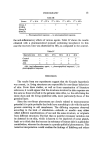
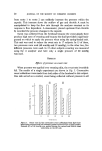
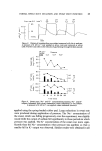
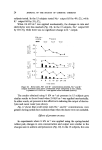
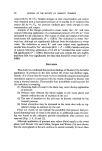
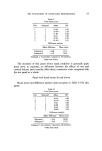
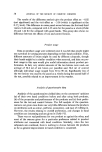
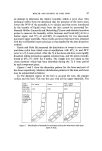
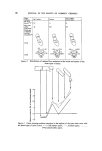
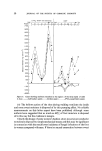
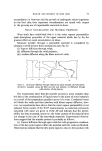
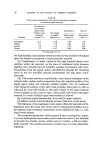
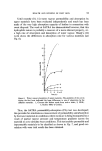
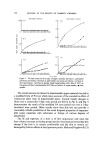
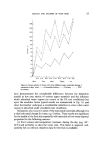
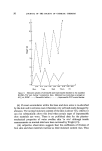
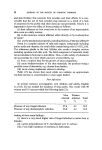
26 JOURNAL OF TIlE SOCIETY OF COSMETIC CHEMISTS output fell by 29_4.3•o. Smaller changes in urea concentration and output were obtained with a mechanical pressure of 18 mmHg. In 15 subjects urea output fell by 93:3•o. Air pressure similarly gave small changes in urea concentration and output. Analysis of the changes produced in sweat water, Na +, K + and urea outputs following application of a mechanical pressure of 8 kN m -2 were calculated for all experiments. The output of sweat and output of all sweat constituents fell significantly (P 0.001). The reductions in sweat Na + were less, although not significantly different from the reductions in sweat water. The reductions in sweat K + and urea output were significantly smaller than found for Na + and water (0.01 P 0.001). Similar analyses of outputs following application of 2.4 kN m -2 revealed that water output fell significantly (P 0.001). Electrolyte and urea outputs fell only slightly and these falls were significantly less than that found for sweat water (P o.ool). DISCUSSION This study has confirmed the previous findings of Shuster (12), that after application of pressure to the skin surface the sweat rate declines signi- ficantly. It is of note that the results we have obtained using pharmacological stimulation appear to correspond with the results obtained by Shuster (12) using a thermal stimulus. Theoretically four possibilities could account for this reduction in sweating. (1) Damming back of sweat in the ducts may occur during application of pressure. (2) Pressure may obstruct the blood supply to the sweat gland and thereby reduce the rate of secretion at the coil. (3) The rate of secretion by the coil may be directly inhibited by the luminal pressure. (4) Sweat absorption may be increased in the sweat duct with no sig- nificant change in secretion by the coil. From our results we can exclude the possibility that pressure had pro- duced damming back of sweat in the ducts as no additional surge of sweat- ing was found in the collection periods immediately after pressure was removed (Figs. 5, 8, 10 and 12). Although application of pressure may reduce blood supply to the sweat gland, both Shuster (12) and Collins, Sargent and Weiner (16) have shown that the sweat glands in the arm continue to secrete normally for more than

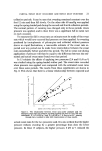
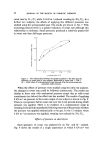
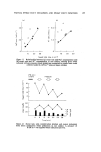
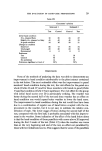
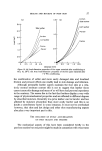
PARTIAL SWEAT DUCT OCCLUSION AND SWEAT DUCT FUNCTION 27 5 min after the circulation to that limb had been occluded. It is also unlikely that the pressures we have used in this study would directly alter the secretion from the coil since pressures as low as 1.2 kN m -2 reduced the sweat rate by 25%. Furthermore, in other experiments we have found that pressures as high as 66 kN m -2 do not stop sweating completely, indicating that secretory pressure at the coil is considerable. Finally, if pressure had merely reduced the secretory rate of the coil the increase in sweat electrolyte and urea concentration would not have occurred. We therefore conclude that pressure increases re-absorption of sweat in the ducts. Presumably the externally applied pressure slows the flow of sweat along the duct and allows more time for its modification by absorption from the duct. Thus, the modification of the amount and composition of the sweat collected under pressure reflects the absorptive processes normally occurring in the duct. In a recent study, Johnson, Dawber and Shuster (17) examined the surface structure of the sweat orifices their finding suggests that the spring-loaded pad could partially occlude the sweat duct mechanically at a superficial level. By contrast, air pressure would directly produce a back pressure in the duct. This probably accounts for the difference in sweat re- absorption which is seen when the same pressure is applied by both these methods. Our results suggest that the rate at which sweat is re-absorbed by the ducts is dependent upon the rate of sweat secretion by the coil and the pressure applied over the skin. The finding that at all sweat rates application of a given pressure reduces sweating by a constant fraction suggests that under normal conditions the sweat duct probably re-absorbs a constant fraction of sweat presented to it by the coil. This has also been suggested by Schwartz et al (8) who considered that it explained the constancy of the ratio, sweat urea concentration: plasma urea concentration. The results in Fig. 7 together with results not included in this study, where pressures greater than 13.2 kN m -• were used, show that the sweat duct has a limited maximum capacity to re-absorb sweat. This finding may account for the changes seen in miliaria (prickly heat). In this condition the sweat duct orifices are thought to be occluded, (18, 19) and rupture of the sweat duct leads to vesicle formation when the subject is exposed to a hot environment (20). Our demonstration of the sweat duct's capacity to absorb leads us to the conclusion that miliaria can only occur when the secre- tion from the coil exceeds the maximum capacity of the duct to re-absorb sweat. In the common skin disease psoriasis, superficial occlusion of the sweat duct has been demonstrated in the affected skin (21) and the
Purchased for the exclusive use of nofirst nolast (unknown)
From: SCC Media Library & Resource Center (library.scconline.org)