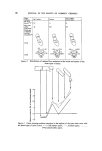
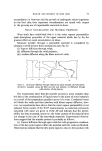
44 JOURNAL OF THE SOCIETY OF COSMETIC CHEMISTS moisture. Although other factors, such as the modulus properties of a material, can influence the health of the foot skin, the influence of sweat accumulation in footwear holds an overall position with respect to foot health. This is because of its direct effect upon- (i) the mechanical properties of the foot skin (ii) the physicomechanical properties of the shoe materials (iii) the encouragement of microbiological growth on the skin and the shoe materials (iv) its potential for extracting substances which can cause dermatitis from the shoe materials. The aim of this paper is to consider the general problem of sweat accumulation in footwear from these aspects. (i) Evidence for the accumulation of sweat in footwear. (ii) The way in which water vapour permeability and absorption properties of shoe materials influence sweat accumulation, and the subsequent effect of the sweat moisture on the properties of the upper materials. (iii) The possible interaction between shoe material properties and foot health. THE ACCUMULATION OF SWEAT MOISTURE IN SHOES During the past two decades the use of non-leather materials in shoes has increased both in range and magnitude. For example about 30•o of women's shoes now have impermeable man-made upper materials (mostly PVC but an increasing amount of polyurethane coated fabric) and less than 9}/0 of the dress shoes made in Great Britain have leather soles, and a significant proportion of these are exported. Within the past 12 months a new technical process has made even the shoe manufacturers with a reputation for quality, give serious consideration to the use of impermeable upper materials for men's and children's lace-up shoes. Thus, the pro- gression from an all-leather shoe which is permeable to water vapour, to a virtual plastic bag, as in the case of the shoe with a rubber or plastic sole com- bined to an impermeable PVC or polyurethane upper, becomes more rapid. Two recent major foot comfort wear trials have been designed to investigate the influence of the water vapour permeability of the upper material upon sweat accumulation within the shoe the first in 1965 by SATRA (Hole, Holt and Grimwade (1), and Keech and Hole (2)), and the second by BLMRA* (Brooks and Mitton (3)). ß British Leather Manufacturers Research Association.

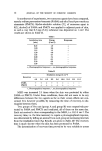
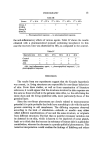
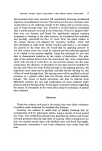
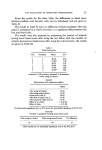
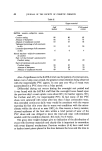
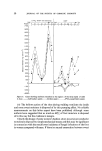
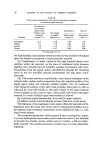
HEALTH AND HYGIENE OF FOOT SKIN 45 In the SATRA trial the three upper materials were: (i) Calf leather. Water vapour permeability (WVP) -- 7.4 mg cm -• h-L (ii) Corfam WVP -- 1.1 mg cm -• h -x. (iii) PVC-coated woven cotton fabric WVP -- 0.05 mg cm -• h -x Two groups of wearers were involved: (a) 21 members of SATRA staff (b) 18 local school teachers. Daily (7« h wear) sweat retention by shoe and hose was measured on the SATRA wearers and weekly weight change measurements were made with the school teachers. In the BLMRA trial, University students were the subjects. The sweat retention measurements are summarized in Table L Table I Shoe upper materials Calf PVC-coated leather Corfam cotton SATRA wearers--dally moisture up- takes of shoes and hose Daily hose uptake (g per sock) Daily shoe uptake (g per shoe) SATRA wearers--moisture uptakes and drying losses of shoes Monday shoe uptake (g per shoe) 'Monday evening to Tuesday morning' loss (g per shoe) 'Monday morning to Friday morning' uptake (g per shoe) School teachers--weekly moisture up- takes of shoes Part 1 of trial Weekly shoe uptake (g per shoe) Part 2 of trial Weekly shoe uptake (g per shoe) 0.30 (1.0) 0.56 (1.9) 0.64 (2.1) 1.S (1.0) 4.8 (2.7) 5.7 (3.2) 2.6 5.8 6.9 2.1 (81%)* 3.3 (57%)* 2.9 (42%)* 2.4 5.8 9.0 4.0 (1.00) 11.6 (2.9) 15.3 (3.8) 2.4 (1.00) 9.2 (3.8) 11.7 (4.9) The figures in brackets are the ratios of the hose and shoe uptakes relative to the calf leather shoes. * These percentages give the proportion of the moisture picked up during the Monday wear period which was lost during the following night. Clearly the WVP of the upper material has a significant effect upon sweat accumulation within the shoe and the results of the wearers' subjective assessments, which are summarized in Table II, established the sensations of discomfort which accompanied the higher levels of sweat accumulation.
Purchased for the exclusive use of nofirst nolast (unknown)
From: SCC Media Library & Resource Center (library.scconline.org)