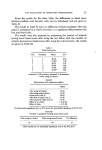
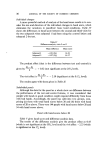
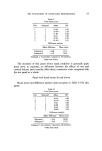
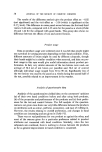
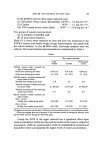
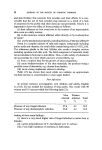
58 JOURNAL OF THE SOCIETY OF COSMETIC CHEMISTS and skin friction this concerns foot powders and their effects. It is con- ceivable that the use of foot powders may increase as a result of a lack of awareness by the public that their shoes are not permeable. Clearly it is important to know the effect of these powders as follows: (i) their influence on foot sweat rate in the context of an impermeable shoe worn in a daily routine (ii) is skin moisture content affected, either directly or by re-absorption of sweat? (iii) are the mechanical properties, including friction, of the skin affected 9. Sweat is a complex mixture of salts and organic compounds including amino acids and vitamins, the total solids content being only 0.3-0.8•o (16). The sebaceous glands in the hair follicles also exude a complex mixture including squalene and oleic acid. The third component of materials which can accumulate in footwear is skin debris. Thus, a wide variety of substances can accumulate in a shoe which can have several effects, e.g. (i) form a nutrient base for the growth of micro-organisms (ii) cause biodeterioration of the shoe materials, the products being a possible cause of dermatitis, e.g. chrome from leather (iii) cause strong unpleasant odours to develop. Pettit (17) has shown that sweat solids can undergo an approximate ten-fold increase in concentration in shoe upper leather. Foot infections In several extensive investigations with children and adults, English et al (18, 21) has studied the incidence of tinea pedis. One result with 98 women and 161 men provided the following data (21): Men Women infected infected Total Presence of any fungal infection 27.6 4.1 19.3 Presence of any dermatophyte infection 23.0 4.1 16.2 leading to three main findings: (i) there is a very much higher rate of fungal infection in males than in females (ii) a great preponderance of T. interdigitale over T. rubrum (iii) a very high incidence of erythema in both sexes.

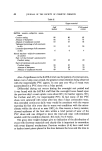
HEALTH AND HYGIENE OF FOOT SKIN 59 Another investigation (18) on school children showed that at 14 years of age 48• of the boys and 33•o of the girls had lesions (a much smaller proportion in both sexes had tinea pedis). Other authors (22) have also demonstrated the higher rate of fungal infections in men than women. Clearly the greater susceptibility of men to fungal infections on the foot skin is significant with respect to footwear. It can be assumed that most if not all of these male subjects wore boots or shoes with permeable leather uppers, thus, the accumulation of sweat moisture would be minimal compared with man-made permeable or impermeable uppers. The prospect of a rapid and pronounced increase in the incidence of foot infections which is likely to accompany the introduction of a much greater number of im- permeable shoes for men and boys is deserving of serious consideration. In this connection the rapid increase in the incidence of T. rubrum (21) in Great Britain should be remembered in view of its relatively greater resistance to therapy. In the children's investigation, English et al (18) found the following incidence of the observed 179 infections-- 84•o Tri&ooehyton mentagrooehytes 7'2•o T. rubrum 3'9}/0 Eoeidermooehyton fioccosum A further observation of interest was the significant increase in lesions in boys between 7 and 8 years, and girls between 13 and 14 years, these ages possibly being the point at which the change from well-ventilated sandals to the conventional lace-up dress shoe takes place: unfortunately the authors did not report on the type of shoes worn by the children. Investigations of foot infections amongst military personnel has con- elusively established the adverse effect of excess moisture in footwear. Lamberg (23) has reported that pitted keratolysis of the plantar surface is quite common in military patients after spending several days in the field. The patients had been wearing 'tropical' boots, i.e. rubber soles and canvas top with air holes for ventilation, and had been in combat for at least 2 weeks. None of them could walk wearing boots and they required 2-3 weeks hospitalization during which a 40•o formalin ointment was con- sidered to be the most effective therapy. Gill and Buckles (24) showed that of a group of 264 marines in comb at in South Vietnam during the monsoon, 50-55•o of them developed pitted
Purchased for the exclusive use of nofirst nolast (unknown)
From: SCC Media Library & Resource Center (library.scconline.org)