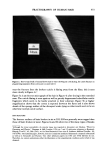
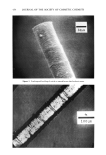
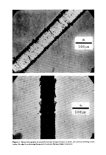
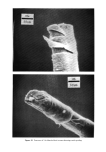
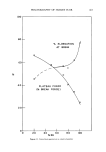
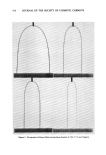
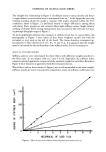
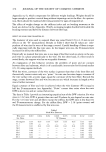
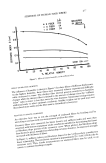
464 JOURNAL OF THE SOCIETY OF COSMETIC CHEMISTS being gradually torn apart circumferentially before the catastrophic failure of the cortex. In air at relative humidities of 80% or less the cortex appears to have split axially into two or more mechanically independent subunits which failed in different radial planes, probably in rapid sequence, yielding a step fracture in this case it appears that the cuticle fails in a pattern largely determined by that of the underlying corticle elements to which it remains firmly attached. At 90% RH in air the cuticle and cortex fracture planes coincide as though the fiber were homogeneous. There is no evidence of prior failure of the cuticle as invariably oc- curs in wet breaks. From these observations we infer that in the wet state the cortex is more extensible than the cuticle as has been reported on the basis of swelling experiments on animal hair (12, 13), but that in air at less than 90% RH the opposite is true dry cortex is less extensible than dry cuticle. At 90% RH the extensibilities appear to be equal. Al- though at 50% RH the cuticle fracture seems to follow that of the cortex, its role may not be entirely passive. The fact that prior wet fracture of the cuticle leads to fiat frac- ture of the cortex at 50% RH indicates that the cuticle is involved in the generation of the compressive or shear forces that crack the cortex axially, producing step fractures. It is known that if hairs are stressed in water to an extension greater than their elonga- tion at break in 50% RH air and allowed to dry under tension, they do not break until more stress is applied. As stated above, when they are then broken, fiat breaks are obtained as though the fracture had occurred in water. On the other hand, if hairs are extended almost to break at 50% RH, then hydrated and broken in water, fiat breaks are also obtained. Apparently the hairs "remember" the pre-stress in water, but not the pre-stress at 50% RH. We interpret this as confirmation of the proposed mechanism, i.e. during the pre- stress in water, the cuticle fails and subsequently the cotex therefore breaks fiat even in 50% RH air. The pre-stress in air did not cause failure of either the cuticle or the cortex, and the hairs therefore exhibit the normal fiat break when subsequently hydrated and broken. Jagged breaks, then, are the product of failure of the cortex under conditions of intact and attached cuticle, which leads to the tearing and shred- ding observed. The experiments in which hairs were pre-stressed at 50% RH, then hydrated and broken in water, provide a confirmation that wet hair is weaker than dry hair. When hairs were extended to 58% elongation (which at 50% RH is virtually the breaking point) and then hydrated, the break force is at least 15% lower than the force required during the pre-stress in air. Experimentally, this is almost equivalent to breaking the same hair segment twice--once at 50% RH and once in water, thereby eliminating sample variation. It is remarkable how little evidence of the cellular structure of hair is revealed in its fractography. The fibrous structure of the cortex is clearly seen only on the lateral sur- faces of dry step fractures. The cuticle cleaves as though it were a homogeneous sleeve its imbricated cells do not slide over each other nor is delamination detectable except in high magnification views of some wet fractures. This is in marked contrast to the behavior of cotton as reported by Hearle and Sparrow (11). Dry fractures of cotton are complex and elongated wet fractures are even more elongated and their resemblance to the fracture of a yarn was taken as an indication that water weakens the interfibrillar matter.

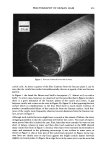
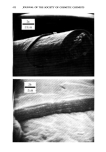
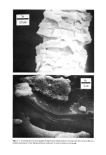
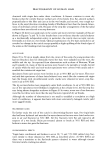
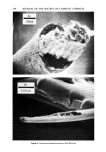
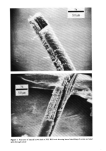
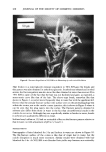
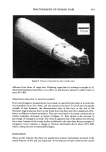
FRACTOGRAPHY OF HUMAN HAIR 465 A similar weakening might have been expected in the case of hair in view of its pronounced swelling in water, but from our data it would appear that the intercellular and interfibrillar material in both wet and dry hair is as strong as the keratinous matter in both the cortex and the cuticle. The cuticle-cortex boundary, however, is a zone of intercellular weakness in the wet state and this weakness is markedly aggravated by oxi- dative bleaching, as shown in Figure 10 cylindrical segments of the entire cuticle have been lost in the process of tensile fracture. This is the only evidence of bleach damage dry breaks of bleached hair appear to be quite similar to those of virgin hair. The weakness of this boundary is also revealed in virgin hair in sleeve fractures (Figure 2) and in the related flaring of the cuticle after its tensile failure, as seen in Figure 4. The multiplicity of the cuticle cracks on wet extension indicates that the junction with the cortex fails only locally, probably as a result of the combined forces of axial shear and radial tension generated by the elastic relaxation of torn cuticle to its unstressed length and radius. The flaring in Figure 4c is about 30% of the fiber diameter as would be expected for relaxation from 70% extension at constant volume (assuming a Poisson ratio of 0.5 throughout). The effect of age on hair fracture is quite different from that of bleach. Where cuticle is present its bond with the cortex seems unchanged, but the cortex in old hair splits and fibrillates much more than in young hair. With reference to virgin hair, we argued above that intact cuticle is involved in the generation of splitting forces on the same argument we would expect that loss of cuticle on old hair should lead to less, not more, splitting on tensile fracture. From the fact that the contrary is observed we conclude that the major effect of aging in the cortex as revealed in fractography is a significant decrease in the inherent cohesiveness of this tissue at the intercellular level. Loss of cuticle in vivo, however, leaves the cortex much more vulnerable to other modes of stress and we do not wish to imply that such loss is of no consequence cosmetically on the contrary, we propose that even in young hair cuticle rupture in the wet state may have significant cosmetic consequences. The evidence of multiple fracture of the cuticle on wet extension (Figures 3 and 4) suggests a mechanism for producing "friz- zies" in midshaft. If the detached cuticle were subsequently eroded away from such fracture sites the cortex would be locally exposed to mechanical and chemical attack. In extreme cases this might lead to a condition dermatologists would diagnose as acquired trichorrhexis nodosa (14). The spongy scales seen in hairs dried in the extended state after wet stretching to cuticle rupture (Figure 4b) are thought to be the remains of cells which have split through the endocuticle layer as proposed by Swift and Bews (15) in reference to similar features on hair which had been subjected to prolonged agitation in water in their cuticle isolation procedure. It seems plausible that if the hair shown in Figure 4 were even mildly scoured in the wet state the scales would slough off and the end result would be a normal-looking hair. This is supported by our observation that after a hair has been broken in water under the optical microscope a considerable amount of scaly, isotropic matter is seen in the bath. It seems reasonable to postulate that such cracking of the swollen endocuticle will occur in hairs under tension since the inclination of the stacked cuticle cells to the fiber axis should give rise to a component of force normal to their surfaces. This sloughing phenomenon should be studied further, especially with reference to the question of whether it occurs at the much lower extensions involved in ordinary grooming operations (such as setting wet hair on rollers) and also whether it occurs
Purchased for the exclusive use of nofirst nolast (unknown)
From: SCC Media Library & Resource Center (library.scconline.org)