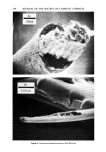
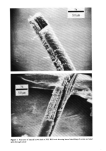
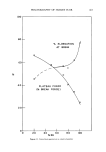
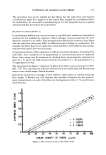
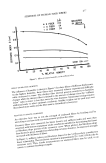
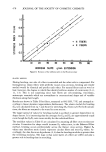
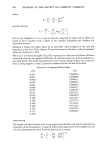
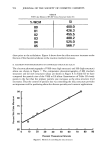
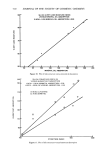
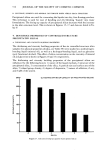
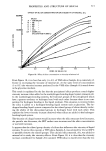
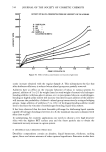
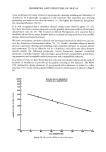
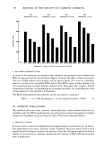
466 JOURNAL OF THE SOCIETY OF COSMETIC CHEMISTS when the entire cycle of extension and relaxation occurs in water. In either case it may make a significant contribution to the gradual loss of cuticle associated with aging. Hair fractures in dry solvents (glycerin, ethanol and ethyl acetate) look like wet frac- tures on cursory examination, but the absence of cuticle cracks and the location of sleeve fracture surfaces in the cortex rather than at the base of the cuticle suggest a se- quence of events different from those of both wet and dry breaks. The absence of noticeable response to pH variation and addition of surfactant indicates that the wet fracture dynamics are not very sensitive to either the charge state of the protein or to reduction of interfacial tension with the environment at the fracture site. Removal of accessible lipids with chloroform/methanol was also without noticeable ef- fect on dry or wet fractures. With reference to Figure 11, the shape of the curves shows that there is not a direct relationship between the plateau-force/break-force ratio and percentage of elongation at break. Nevertheless some interesting features are noted. Compared with the reported decrease in plateau force vs. relative humidity for keratin fibers (16), we find that the plateau-force/break-force ratio decreases more slowly, indicating that a decrease in the break force also occurs with increasing relative humidity. This provides a second, indirect confirmation that wet hair is weaker than dry hair. The percentage of elongation at break is almost constant at 55 to 60% in the 50 to 79% RH range in which jagged fractures are almost invariably obtained in air. We con- clude that, •-cept for highly hydrated hairs, this is the limiting extensibility of the cortex. It is interesting to note in connection with the difference in hair fracture at inter- mediate vs. very high humidities that over 60% of the observed radial swelling of wool by water occurs above 70% RH (17), indicating a change in the effect of water at high humidities. Based on our results, we propose that a similar change in hair properties occurs at high humidities. Over 60% of the change in relative rigidity of wool occurs above 65% relative humidity (18). From our data and that on wool it appears that hydration is the dominant variable affecting both the stress/strain behavior and the fracture mechanics, and that the two are interrelated. It seems appropriate to point out that our data on percentage of elongation at high relative humidities follows a trend very similar to the uptake of water by wool in the same range (19). Based on our own data, hair shows the same behavior up to 90% RH, the highest humidity at which water uptake was determined. SUMMARY Fracture pattern and stress/strain behavior of hair are interrelated through degree of hydration. The different fracture patterns obtained for wet and dry hair are attributed to an inversion in the relative extensibilities of the cuticle and cortex. The boundary of these two tissues is weak in the wet state and this weakness is aggravated by oxidative bleaching. Aging causes a reduction of cohesiveness in the cortex as well as a loss of cuticle a new mechanism, not necessarily involving abrasion, is proposed for cuticle loss. Finally, a new demonstration of the lower tensile strength of wet, relative to dry, hair is presented.

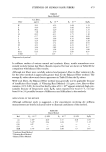
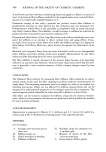
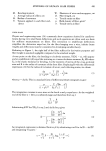
FRACTOGRAPHY OF HUMAN HAIR 467 ACKNOWLEDGEMENTS We wish to acknowledge several helpful discussions with Dr. Hans-Dietrich Weig- mann of Textile Research Institute. We also thank Avon Products, Inc., for encourag- ing this research. REFERENCES (1) (2) (3) (4) (5) (6) (7) (8) (9) (10) (11) (12) (13) (14) (15) (16) (17) (18) (19) R. Caputo and B. Ceccarelli, Study of normal hair and of some malformation with a scanning electron microscope,Arch. Klin. Exp. Derm., 234,242 (1969). A. Tosti, S. Villardita, M. L. Fazzini and R. Scalici, Contribution to the knowledge of dermatophytic in- vasion of hair, J. Invest. Dermatol., 55,123 (1970). E. Wyatt, E. Bottoms and S. Comaish, Abnormal hair shafts in psoriasis on scanning electron mi- croscopy, Brit. J. Dermatol., 87,368 (1972). E. Bottoms, E. Wyatt and S. Comaish, Progressive changes in cuticular pattern along the shafts of human hair as seen by scanning electron microscopy, Brit. J. Dermatol., 86, 379 (1972). R. P. Ayer and J. A. Thompson, Scanning electron microscopy and other new approaches to hair spray evaluation, J. Soc. Cosmet. Chem., 23,617 (1972). S. P. DiBianca, Innovative scanning electron microscopic techniques for evaluating hair care products, J. Soc. Cosmet. Chem., 24, 609 (1973). A. C. Brown and J. A. Swift, Hair breakage: the scanning electron microscope as a diagnostic tool, J. Soc. Cosmet. Chem., 26, 289 (1975). E. Bernstein, Dynamic Experiments on Hair in the Scanning Electron Microscope, in "The First Human Hair Symposium," A. C. Brown, Medcom Press, New York, New York, 1974, pp 317-331. N. A. Lange, "Handbook of Chemistry," 10th ed, McGraw-Hill Publishing Company, New York, New York, 1956, pp 1420-1421. J. W. S. Hearle and S.C. Simmens, Electron microscope studies of textile fibres and materials, Polymer, 14,273(1973). J. W. S. Hearle andJ. T. Sparrow, The fractography of cotton fibers, Text. Res. J., 41,736 (1971). E. Lehmann, Mikroskopische dntersuchungen •iber chemische und physikalische vorg•inge an Pelztierhaaren, Melliand Textilber., 22, 145 (1941). J. H. Bradbury and G. V. Chapman, An investigation by light microscopy of the swelling of wool fibers, Text. Res. J., 33,666 (1963). M. E. Chernosky, Acquired Trichorrhexis nodosa, in "The First Human Hair Symposium," A. C. Brown, Medcom Press, New York, New York, 1974, pp 36-49. J. A. Swift and B. Bews, The chemistry of human hair cuticle-I: a new method for the physical isolation ofcuticle,J. Soc. Cosmet. Chem., 25, 13 (1974). Encyclopedia of Polymer Science & Technology, Wiley, New York, New York, 8 (1968), p 22. Ibid., p 30. Ibid., p 28. Ibid., p 37.
Purchased for the exclusive use of nofirst nolast (unknown)
From: SCC Media Library & Resource Center (library.scconline.org)