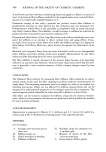
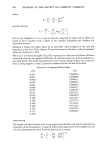
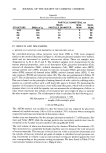
520 JOURNAL OF THE SOCIETY OF COSMETIC CHEMISTS G. ABRASIVE AND POLISHING AGENT Due to mild abrasivity and controlled structure, precipitated silicas are used as mild abrasives and polishing agents in toothpaste formulations. LS and VLS silicas are ideally used because of their low humectant demand and acceptable compatibility features with other toothpaste formula ingredients. H. ADSORBENT Controlled-structure precipitated silicas are used to purify polyols and to remove traces of impurities from many liquids and effluents. The choice of proper silica would depend upon the nature and concentration of the impurity present in the liquid. I. VISCOSITY CONTROL A relatively small amount of VHS silicas increases the viscosity of creams, lotions, oint- ments, ache preparations and other specialty products enabling the cosmetic chemist to control the viscosity characteristics of his finished product. J. GLOSS REDUCTION Synthetic silicas are widely used as de-lustering agents to reduce the gloss of varnishes, lacquers and other surface coatings. VII. CONCLUSIONS We have presented here the structure, chemistry and preparation of controlled-struc- ture precipitated silicas. We have correlated the properties and the end-use applica- tions of silicas to their structure. The variety of cosmetic applications in which synthetic silicas are currently being used is already phenomenal. Further insight into surface chemistry and silica structure is needed to further explore the future cosmetic properties of synthetic silicas. REFERENCES (8) (9) (10) (1) CTFA Cosmetic Ingredient Dictionary, Bulletin No. 3 (March 1974), published by the Cosmetic, Toiletry and Fragrance Association, Washington, D.C. (2) E. Wagner and H. Brunner, Angew. Chem., 72,744 (1960). (3) R. Bode, H. Ferch and H. Fratzscher, Kaut. Gummi Kunstst., 20, 578 (1967). (4) R. K. Iler, "The Colloid Chemistry of Silica and Silicates," The Cornell University Press, Ithaca, New York, 1955, Chapter VI. (5) A. V. Kiselev, "The Structure and Properties of Porous Materials," Butterworths Scientific Publica- tions, London, England, 1958, p 158. (6) J. A. Hockey and B. A. Pethica, Surface hydration of silicas, Trans. Faraday Soc., 57, 2247 (1961). (7) J. A. Hockey, "The Nature of the Silica Surface," Ph.D. Thesis, Manchester University, Manchester, England, 1960. F. Kindervater, Concerning the structure of silica fillers, Kaut. Gummi Kunstst., 26, 7 (1973). J. A. Hockey, The surface properties of the silica powder, Chem. Ind. (London), January, 57 (1965). M. L. Hair, "Infrared Spectroscopy in Surface Chemistry," Marcel Dekker, Inc., New York, New York, 1967, Chapter 4.

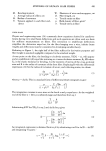
PROPERTIES AND STRUCTURE OF SILICAS 521 (11) (12) (13) (14) (15) (16) (17) (18) (19) (20) (21) (22) (23) (24) (25) (26) J. J. Fripiat, M. C. Gastucke and R. Brichard, Surface heterogeneity in silica gel from kinetics of isotopic exchange OH-OD,J. Phys. Chem., 66, 805 (1962). C. G. Armistead, A. H. Typer, F. H. Hambleton, S. A. Mitchell and J. A. Hockey, The surface hydroxylation ofsilica,J. Phys. Chem., 73, 3947 (1969). F. H. Van Cauwelaert, P. A. Jacobs and J. B. Uytterhoeven, Identification of the A-type hydroxyls on silica surfaces, J. Phys. Chem., 76, 1434 (1972). (a) S. K. Wason (toJ. M. Huber Corp.) U.S. Patent 3893840 (1975). (b) S. K. Wason (toJ. M. Huber Corp.) U.S. Patent 4040858 (1977). (c) S. K. Wason and R. K. Mays (toJ. M. Huber Corp.) U.S. Patent 4067746 (1978). (a) S. K. Wason (toJ. M. Huber Corp.) U.S. Patent 3988162 (1976). (b) S. K. Wason (toJ. M. Huber Corp.) U.S. Patent 4015966 (1977). Determination of Oil Absorption, Amer. Soc. Test. Mater. Stand., D, 281. S. Brunauer, P. H. Emmett and E. Teller, Adsorption of gases in multimolecular layers, J. Amer. Chem. Soc., 60, 309 (1938). Coulter Electronics, Inc., 590 West Twentieth Street, Hialeah, FL 33010. N.M. Winslow and J. J. Shapiro, An instrument for the measurement of pore size distribution by mercury penetration, A.S.T.M. Bulletin, February 1959, (Aminco Reprint No. 105). G. K. Stookey and J. C. Muhler, Laboratory studies concerning the enamel and dentin abrasion properties of common dentifrice polishing agents, J. of Dent. Res., 47, 524 (1968). P. C. Kitchin and H. B. G. Robinson, How abrasive need a dentifrice be?, J. of Dent. Res., 27, 501 (1948). N.J. Dudding, L. O. Dahl and J. C. Muhler, Patient reactions to brushing teeth with water, dentifrice, or salt and soda, J. Periodontol., 31,386 (1960). H. B. McCauley, M. J. Sheehey, D. B. Scott, P. H. Keyes, S. J. Fanale and P. P. Dale, Clinical efficacy of powder and paste dentifrices, J. Amer. Dent. Ass., 33,993 (1946). Council on Dental Therapeutics, Reports of Council and Bureaus: Abrasivity of current dentifrices, J. Amer. Dent. Ass., 81, 1177 (1970). P. C. Kitchin, The prevalence of toothroot exposure, and the relation of the extent of such exposure to the degrees of abrasion in different age classes, J. of Dent. Res., 20, 565 (1941). R. J. Grabenstetter, R. W. Broze, F. L. Jackson and A. W. Radike, The measurement of the abrasion of human teeth by dentifrice abrasives: a test utilizing radioactive teeth, J. of Dent. Res., 37, 1060 (1958).
Purchased for the exclusive use of nofirst nolast (unknown)
From: SCC Media Library & Resource Center (library.scconline.org)