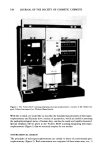
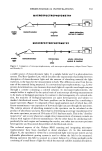
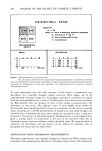
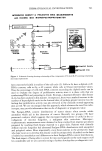
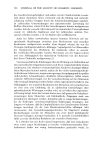
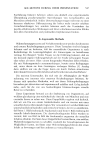
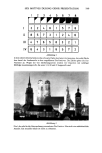
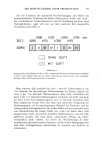
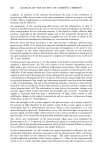
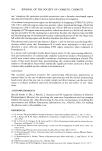
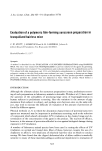
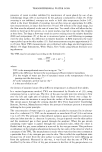
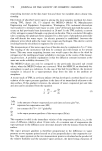
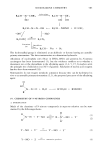
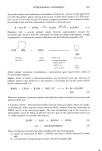
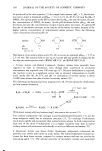
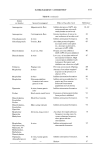
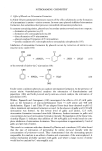
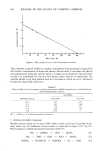
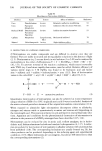
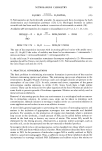
DERMATOLOGICAL INVESTIGATIONS 539 MACROSPECTROPHOTOM ETRY liable monochromator cuvette light • Iolutlon photo detection lyltem & readout MICROSPECTROPHOTOMETRY • o o liable monochromator microscope photo detection light • Syllem & readout illde Figure 2. Comparison of microspectrophotometry with macrospectrophotometry, adapted from Chayen and Bitensky (3) a stable source of monochromatic light, 2) a sample holder and 3) a photodetection system. The Beer-Lambert Law, which describes the exponential relationship between absorption of monochromatic light and the amount of absorbing material the light traverses, is the basis for the measurement in both. The differences arise from the na- ture of the material being measured. In conventional spectrophotometry, e.g., Lowry protein determinations, one measures how much light of a specific wavelength can pass through a cuvette containing a colored solution. In microspectrophotometry, the sample holder is replaced by the optical train of a microscope allowing measurements to be made on biological specimens. In contrast to the homogeneity of a colored solu- tion, the majority of biological specimens are quite heterogeneous and subject to marked distributional errors. This basic problem can be illustrated by considering a square specimen (Figure 3) composed of four equal segments each of which has a dif- ferent transmittance--an expression of how much light can pass through the specimen. The relative amount of absorbing material in the specimen can be calculated as the product of absorbance and area. Note that by determining an average transmittance for the entire specimen, an error of.054 units of 15% has been made. This is the "distribu- tional error" and occurs whenever a single direct measurement of intensity is made on objects with regions of diverse transmittance. On the other hand, by calculating inde- pendently for each region and summing the results, one takes into account specimen heterogeneity and thus avoids the problem of distributional errors. The technical aspects of the Vickers M-85 scanning and integrating microspec- trophotometer have been described in detail elsewhere (2). In this instrument (Figure 4), the specimen is viewed by a conventional light microscope system and an adjustable photoelectric grating system is used to define the field to be measured. During operation this field is scanned in a raster fashion by a flying spotlight probe consisting of a small beam of light for which the material exhibits maximal absorption.

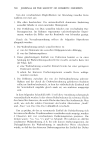
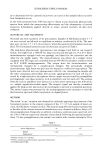
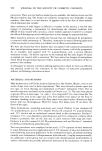
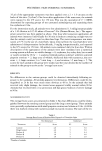
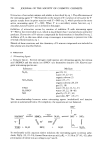
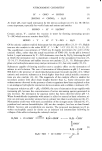
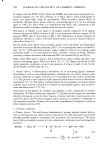
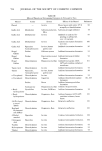
540 JOURNAL OF THE SOCIETY OF COSMETIC CHEMISTS DISTRIBUTIONAL ERROR 80% HETEROGENEOUS OBJECT Equations: m = AB where m,, ma•s of absorbing material in specimen A. absorbance (--log T) B. area of photometeric field T = transmittance MEAN INTEGRATED T A X B = M .301 X I = .301 units T A X B = M !4• .698 x ,25 • .175 .398 x .25 - .100 .222 x .25 = .056 .097 x .25 : .024 • .355 units Figure 3. Distributional error in a model system The specimen is divided into four equal areas of varying chromophore concentrations. The mean value was determined by measuring the transmittance of all areas simultaneously and the integrated value by measuring the transmittance of each area separately. The distributional error increases as specimen heterogeneity increases. At each measuring point the light intensity of the object is transformed into absorbance by a specially designed analog convertor which makes use of the logarithmically decaying voltage of a discharging condensor to transform the signals from the photomultiplier into a train of 10 kHz pulses. Since this circuitry simulates the Beer-Lambert Law, the duration of each of these pulses is proportional to the absorbance at the point. The digitized value of each sample point within the electronically gated measuring field is stored in a computer. At the end of a scanning raster involving over 120,000 measurements of sample area, each small enough to be relatively free of distributional error, these signals are integrated to give a value pro- portional to the amount of absorbing material. Simultaneously a second digital meter gives a reading which is proportional to the area of the specimen which has an absorbance greater than any arbitrary chosen threshold value. By using standards of reference, the absorbance and area meters can be calibrated in absolute units of picograms and square microns, respectively. APPLICATION USING ABSORBANCE MEASUREMENTS Microspectrophotometry was originally designed to estimate the DNA content of an individual cell by measuring the absorbance of Feulgen-stained nuclei. This method has
Purchased for the exclusive use of nofirst nolast (unknown)
From: SCC Media Library & Resource Center (library.scconline.org)