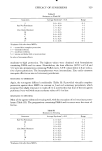
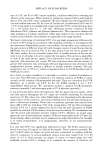
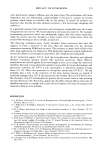
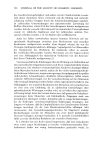
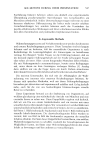
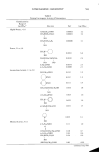
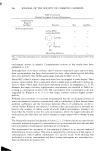
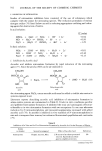
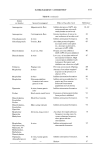
EFFICACY OF SUNSCREENS 529 Table II Resistance to Wash Off Sunscreen Average Erythema a + S.E. Range J 2.8 _+ 0.16 0-3 Red Vet Petrolatum 2.2 _+ 0.30 1-3 I 1.7 -+ 0.12 1-2 Zinc Oxide Ointment 1.2 _+ 0.27 0-3 H 1.2 _+ 0.16 2-3 D 0.4 -+ 0.20 0-1 C 0.4 + 0.15 0-1 M 0.3 -+ 0.25 0-2 F 0.1 m 0.06 0-1 aErythema 24 hr after three MED's: 0 = normalskin (complete protection) 1 + = minimal erythema 2 + = moderate erythema 3 + = intense erythema (little or no protection) In order of increasing efficacy. moderate-to-high protection. The highest values were obtained with formulations containing PABA and its esters. Nonetheless, the least effective (S.P.F.'s of 3.8 and 5.1) were also preparations containing PABA esters. S.P.F. values below 4.0 are indica- tive of poor protection. The benzophenones were intermediate. Zinc oxide ointment was quite effective as was red veterinary petrolatum. RESISTANCE TO IMMERSION Again, the test agents differed considerably (Table II). F provided virtually complete protection against three MED's in contrast to J and red veterinary petrolatum, which possessed but slight resistance to wash-off. It is noteworthy that four of the test agents penormeu very well with mean erythema values -c •, /. •,t t,.•, or less. RESISTANCE TO SWEATING Most of the agents withstood sweating well, with the exception of red veterinary petro- latum (Table III). The preparations containing PABA and its esters were the most ef- fective. Table III Resistance to Sweating Sunscreen Average Erythema a -+ S.E. Range Red Vet Petrolatum 2.3 -+ 0.25 1-3 H 1.3 -+ 0.45 0-3 J 1.1 _+ 0.14 1-2 C 1.0 -+ 0.21 0-2 Zinc Oxide Ointment 0.9 -+ 0.29 0-2 D 0.7 + 0.21 0-2 F 0.4 - 0.14 0-1 L 0.3 -+ 0.16 0-1 M 0.2 -+ 0.14 0-1 I 0.2 _+ 0.11 0-1 •Erythema 24 hr after three MED's.

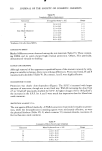
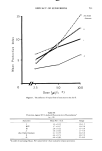
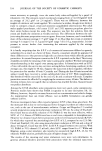
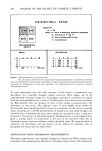
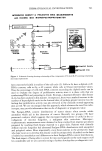
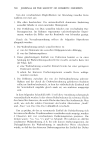
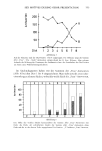
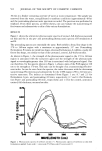
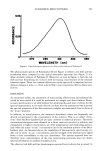
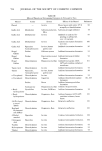
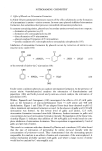
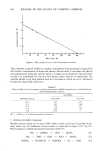
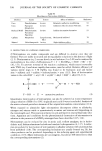
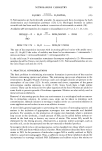
530 JOURNAL OF THE SOCIETY OF COSMETIC CHEMISTS Table IV Cumulative Effects (Immersion) Sunscreen Average Erythema a +- S.E. Range H 2.8 +- 0.16 2-3 D 2.3 +- 0.42 1-3 J 2.2 --- 0.30 1-3 Zinc Oxide Ointment 1.8 + 0.16 1-2 F 1.3 +- 0.36 0-3 L 1.0 + 0.37 0-3 M 0.8 +- 0.30 0-2 I 0.8 + 0.23 0-2 aErythema 24 hr after three MED's. CUMULATIVE EFFECT Marked differences were observed among the test materials (Table IV). Those contain- ing PABA and its esters showed high residual protection. Others, H in particular, demonstrated virtually no buildup. SCOTCH-TAPE STRIPPING Although removal of the uppermost superficial layers of the stratum corneum by strip- ping is a variable technique, there were striking differences. Protection from J, H and F was practically abolished (Table V). By contrast, I and L were highly effective. DOSE-RESPONSE STUDIES Protection was clearly dose-dependent (Figure). The $.P.F.'s increased with larger amounts of sunscreen, though not in any fixed way. With H increasing the dose from 2.5 to 5.0/•l/cm 2 practically doubled the S.P.F. At higher dosages (5.0 to 10.0/•l/cmZ), the increases in the S.P.F. for A and I were much less impressive than for H and zinc oxide ointment. PROTECTION AGAINST UV-A The test agents differed markedly. A PABA sunscreen (I) provided virtually no protec- tion, while the benzophenone-containing agents were moderately effective, as were the physical blockers (Table VI). E, which contains 5 % titanium dioxide, was more ef- fective than zinc oxide ointment. Table V Cumulative Effects (Scotch-tape stripping) Sunscreen Mean Erythema Score + S.E. Range F 2.63 + 0.18 2-3 J 2.62 +- 0.18 2-3 H 2.50 + 0.19 2-3 I 0.63 -+ 0.26 0-2 L 0.50 --- 0.27 0-2
Purchased for the exclusive use of nofirst nolast (unknown)
From: SCC Media Library & Resource Center (library.scconline.org)