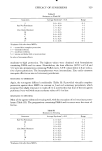
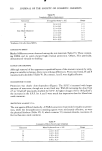
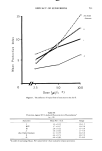
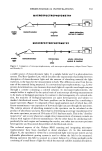
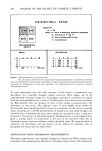
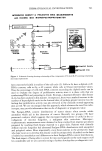
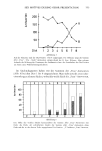
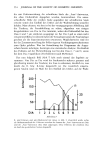
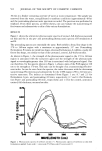
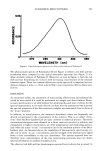
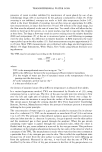
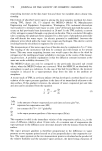
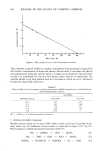
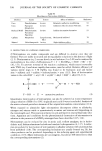
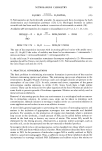
SUNSCREEN EFFECTIVENESS 563 O.5O b.I Z m n., 025 0 I & I , I I 270 i90 $$0 $50 VAVE/ENGTH (nm) Figure 2. Optical absorption spectrum of a dilute alcohol solution of Padimate-O The photoacoustic spectra of Formulation B (see Figure 1) exhibit a red shift and line broadening when compared to the optical absorption spectrum (see Figure 2) of a dilute alcoholic solution of Padimate-O. Moreover, as seen in Figure 1, both the red shift and line broadening are reduced with decreasing concentration of the retained sunscreen agent. These are common effects seen in the spectra of a compound as it un- dergoes changes in state, i.e., from solid to film to less concentrated film to dilute solu- tion (6). DISCUSSION As mentioned earlier, the assessment of sunscreening effectiveness and substantivity would be most useful if it could be performed in a simple and direct fashion. Photo- acoustic spectroscopy is an ideal method for achieving this goal since it allows for the spectral measurement to be made directly on skin thus the parameters which govern the spectral properties of the skin-sunscreen complex are maintained close to those of the "in use" situation. In addition, in actual practice, the measured absorbance values are frequently not directly proportional to the concentration of the solution. That is, so called "devia- tions" from the Beer-Lambert Law are quite common in analytical practice. Therefore conventional absorption data obtained on a dilute sunscreen product in solution, and extrapolated to higher concentration, are often inappropriate and misleading, particu- larly when the actual "in use" concentration lies in the nonlinear portion of the Beer- Lambert plot. As discussed above, the capabilities of photoacoustic spectroscopy en- ß able one to study "in use" concentration, and the strength of the photoacoustic signal bears a close resemblance to the true absorbance. The spectra reported here are therefore more representative of the true sunscreening potentials since we obtain spectral information on undiluted samples in situ. The observed red shift and line broadening as reported here indicate that in actual "in

564 JOURNAL OF THE SOCIETY OF COSMETIC CHEMISTS use" situations the sunscreen provides protection over a broader wavelength region than that determined by dilute solution optical absorption investigation. A broadened sun-protective region can be beneficial in designing a UVB-UVA (290 to 320, 320 to 400 nm) regions sunscreen product, where maximum blockage of both the burning rays (290 to 320 nm) and tanning rays (320 to 400 nm) is desired. However in designing a UVB region sunscreen product, where the desire is to block only the burn- ing rays and allow for the tanning rays to penetrate the skin, the observed spectral shift and broadening may be detrimental because a substantial portion of the line shape may fall within the tanning region and thereby minimize the desired effect. The photoacoustic spectral data shown in Figure 1 and the derived sunscreening effec- tiveness indices show that Formulation B is much more substantive to skin and is therefore a more effective postsoaking UVB region sunscreen when compared to Formulation A. In a recent well controlled double-blind clinical study (9) the sunscreening effective- ness and substantivity of commercially a,Jailable sunscreens similar to Formulations A and B were tested under controlled conditions of saltwater swimming at a beach. The result of this study showed that, postswimming, the commercially available product similar to Formulation B provided statistically significant better protection than the commercially available product similar to Formulation A. CONCLUSION The excellent agreement between the sunscreening effectiveness assessments as reported here by the use of photoacoustic spectroscopy and the clinical sunscreening beach study show that one can, in a rapid, simple and direct manner, use the new tech- nique to evaluate undiluted sunscreen formulations in situ and under "in use" situa- tions. ACKNOWLEDGMENTS Special thanks to Drs. J. Mezick, J. Sequeira and M. Augustine (Johnson & Johnson Dermatological Division) for providing the sunscreen formulations and encouraging helpful discussions, Dr. Allan Rosencwaig for his advice and assistance in building the spectrometer and Gilford Instruments Laboratories, Inc., Oberlin, Ohio, for making the photoacoustic cells available to us. REFERENCES (1) N. S. Lucas, The permeability of human epidermis to ultraviolet irradiation, Biochem. J., 25, 57 (1931). (2) W.J. Runge and R. M. Fusaro, Biophysical considerations of light protection, J. Invest. Dermatol., 39, 431 (1962). (3) M. A. Everett, E. Yeargers, R. M. Sayre and R. L. Olson, Penetration of epidermis by ultraviolet rays, Photochem. and Photobid., 5, 535 (1966). (4) A. Rosencwaig, Photoacoustic spectroscopy--a new tool for investigations of solids, Anal' Chem., 47, 592A (1975). (5) A. Rosencwaig, Photoacoustic spectroscopy of solids, Physics Today, 28, 23 (1975). (6) A. Rosencwaig and E. Pines, A photoacoustic study of newborn rat stratum comeurn, B•ochim. Biophys. Acta, 493, 10 (1977). (7) A. Rosencwaig and A. Gersho, Theory of the photoacoustic effect with solids, J. Appl. Physiol., 47, 64 (1976). (8) Gilford Instruments Laboratories, Inc., Oberlin, Ohio. (9) P.M. Catalano and D. D. Fulghum, A water-resistant sunscreen, Clin. Experm. Dermatol., 2, 127 (1977).
Purchased for the exclusive use of nofirst nolast (unknown)
From: SCC Media Library & Resource Center (library.scconline.org)