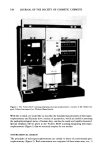
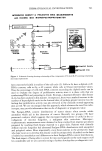
DERMATOLOGICAL INVESTIGATIONS 543 represents the average of 25 to 100 readings at random spots using eyepiece graticule (10). This is not only time consuming and tedious but is subject to considerable errors in specimens with prominent fete-ridge patterns. We are not the first to recognize this problem, as a method based on the Quantiment microdensitometer has been pre- viously reported (11). The key word here is "microdensitometer," because this ap- proach monitors only differences in grey levels--not color intensities. This presents problems when two or more colors are present in the same photometric field and re- quires that the sections be overstained with hematoxylen, which produces a dark blue color, enabling the Quantiment to detect these regions from fainter pink dermal components. With the Vickers M-86 microspectrophotometer these colors can be re- solved and projected area measurements obtained for each colored component. Thus, by measuring the area occupied by the epidermis in a standard size field, one can obtain a global assessment of the dimensions of the viable epidermal compartment with little difficulty. Much of our current research ac.tivity is concerned with developing noninvasive testing procedures for monitoring the physiological status of skin. One extremely promising area is exfoliative cytology, which analyzes cells shed from the body surfaces. Ken McGinley, in our laboratory, has devised a simple detergent-scrub method for quanti- tative sampling and cytomorphological visualization of the cells making up the desqua- mating portion of the horny layer (12). This approach has proved to be very valuable in our studies of psoriasis (13, 14), aging (15), dandruff (16, 17), contact dermatitis (18) and steriod atrophy (19). Many of these studies indicate that changes in corneocyte size permit a sensitive evaluation of altered skin physiology, especially epidermpoieses. Unfortunately, since these cells tend to be quite irregular in shape the techniques that have been employed to date to measure this parameter (axial filar micrometry and polar planimetry) are subject to considerable error. We can, however, rapidly and precisely measure changes in corneocyte size by using the projected area feature of Vickers microspectrophotometry. CONCLUSION The range of applications for both absorbance and projected area measurements covered by this brief survey hopefully has provided some idea of how valuable the microspectrophotometric approach can be. By measuring light absorbance characteris- tics we can analyze dimensions of structure and amounts of material in any biological structure that can be identified at the visible light microscopic level and in which an ap- propriate change in color intensity can be realized. The powerful combination of fast and accuarate geometric and absorbance measurements greatly expands the amount of information which can be obtained from dermatological specimens, viz., scrubs, biopsies, tissue slices, cultures, etc. In fact, the large number of measurements avail- able and the rapidity with which they can be performed means that restraint must be exercised to avoid the unfortunate circumstance of being surrounded by reams of data which have little relevance to the question at hand. REFERENCES (1) R. Barer and F. Smith, Microscope for weighing bits of cells, New Sci., 24, 380 (1972). (2) C. Venderly, Cytophotometry and Histochemistry of the Cell Cycle, in "Cell Cycle and Cancer," R. Baserga, Ed., Marcel-Dekker, New York, New York, 1971, pp 227-268.

544 JOURNAL OF THE SOCIETY OF COSMETIC CHEMISTS (3) (4) (5) (6) (7) (8) (9) (10) (11) (12) (13) (14) (15) (16) (17) (18) J. Chayen and L. Bitensky, Cell Injury, in "Cell Biology in Medicine," E. Bittar, Ed., John Wiley and Sons, New York, New York, 1973, pp 595-678. W. Wonlrab, Uber den DNS-gehalt von epidermiszellen unbeffalener psoriatikerhaut, Derma- tologica, 140, 28 (1970). G. Grove, R. Anderton and J. G. Smith, Jr., Cytophotometric studies of epidermal proliferation in psoriatic and normal skin, J. Invest. Dermatol., 66, 236 ( 1976). G. Grove and J. G. Smith, Jr., In vivo examination of cell proliferation in normal and psoriatic epi- dermis by Feulgen-DNA cytophotometry, in "Psoriasis, Proceedings of the Second International Sym- posium," E. M. Farbet and A.J. Cox, Eds.,Yorke, New York, New York, 1977, pp 365-368. W. Van Vloten, P. van Dujim and A. S. Schaberg, Cytodiagnostic use of Feulgen-DNA measurements in cell imprints from skin of patients with mycosis fungoides, Brit. J. Dermatol., 91,365 (1974). M. Hagedom and G. Kiefer, DNA content of mycosis fungoides cells, Arch. Derm. Res., 258, 127 (1977). R. Cowden, A review of application for users of the Vickers M-85/M-86, scanning microdensitometer, Vickers Technical Bulletin, York, England, 1976. D. J. Dykes and R. Marks, Measurement of skin thickness: a comparison of two in vivo techniques with a conventional histome tric method, J. Invest. Dermatol., 69, 275 ( 1977). W. Picton, H. Devitt and M. A. Forgie, Practical applications of the Quantimet 720, an image analyzing computer, in the field of investigative dermatology, Brit. J. Dermatol., 95,341 (1976). K.J. McGinley, R. R. Marpies and G. Piewig, A method for visualizing and quantitating the desquamat- ingportion of the human stratum comeurn, J. Invest. Dermatol., 53, 107 (1969). H. W. Goldschmidt, J.J. Leyden and J. Decherd, Exfoliative cytology in the diagnosis of psoriasis of the nail, Cutis, 10, 107 (1972). H. W. Goldschmidt and A.M. Kligman, Exfoliative cytology of human horny layer, Arch. Dermatol., 96, 572 (1967). G. Piewig, Regional differences in cell sizes in the human stratum comeurn II: effects of sex and age, J. Invest. Dermatol., 54, 19 (1970). J. J. Leyden, K. J. McGinley and A.M. Kligman, Shorter methods for evaluating antidandruff agents, J. Soc. Cosmet, Chem., 26, 573 (1975). A.M. Kligman, K. H. McGinley andJ. J. Leyden, The nature of dandruff, J. Soc. Cosmet. Chem., 27, 111 (1976). E. Hoelzle and G. Plewig, Effects of dermatitis, stripping and steroids on the morphology of cor- neocytes. A new bioassay,J. Invest. Dermatol., 66, 259 (1976).
Purchased for the exclusive use of nofirst nolast (unknown)
From: SCC Media Library & Resource Center (library.scconline.org)