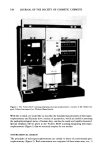
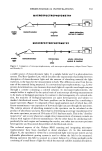
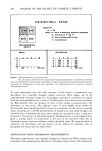
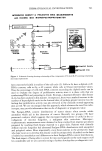
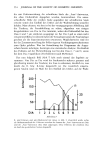
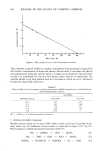
576 JOURNAL OF THE SOCIETY OF COSMETIC CHEMISTS heat radiation from the skin surface. The temperature of the crystal is kept constant by means of a cooling system connected with a circulation themostat. The sensing ele- ment is a thermal conductivity cell comprising two compartments. The air passes through the first compartment before it reaches the skin. After the air has been humidified by passing over the skin, the air is led through the second compartment of the cell. A thermistor is mounted in each of the two compartments which are then in- corporated into the arms of a Wheatstone bridge circuit. Any difference in the com- position of the air between the two compartments causes an imbalance in the bridge, which is recorded directly (29). The measurement of the thermal conductivity of the air allows the measurement of the insensible perspiration of 1 cm 2 of forearm skin (30). It is possible to quantitatively de- tect 0.1 to 30/ag/cm2/min evaporating from the skin. Simultaneously, the water vapor pressure at the skin surface can be recorded. From this vapor pressure can be calcu- lated the relative humidity of the skin surface which is a measure of the moisture content of the outermost skin layers. Quattrone and Laden (31) have adapted the thermal conductivity method to use a car- rier gas, in a method which they call transpirometry. The investigators employ an ap- paratus wherein a stream of dry nitrogen, passing in a flow-through chamber on the skin, and a stream of identical pressure flowing independently of the skin are compared for their thermal conductivity in a gas chromatograph. Two of these systems, each equipped with integrators, allow for simultaneous measurement of the rate of moisture loss at two separate sites (i.e., a control and a test). In the actual method, for each unit, streams of dry nitrogen are split into two equal components--one passing directly into the chromatography unit, while the other streams into a flow-through probe on the skin before entering this thermal conductivity analyzer. The difference in the conductance between the split streams is measured and a signal from each chromatograph is sent to a dual pen recorder. The latter is equipped with two repeat- ing potentiometers, allowing for integration of each signal. Standard curves are ob- tained for each system before use each day by application of known quantities of water to filter paper sealed within each chamber. The previous static-conductance method can be replaced with a dynamic electrohy- grometer technique (20, 21, 29) wherein ambient humidity air is swept through a skin chamber over a plate coated with a sensor chemical whose electrical conductivity is a function of the ambient humidity. Sulzberger and Herrmann (32) were the first to at- tempt to monitor humidity changes by means of electrohygrometry. They passed air through a skin chamber and over a plate coated with lithium sulfate. A group of inor- ganic sensor salts, of which lithium bromide is the most commonly used, has sub- sequently been refined and made commercially available. It should be noted that the "humidity sensor" devices are limited by the fact that they operate within an enclosed area. Therefore the measurements have to be accomplished very quickly in order to avoid saturation of the air contained within the chamber. Electrohygrometry has lowered the skin conditioning time, as opposed to gravimetric methods. In electrohygrometric TWL measurements, a current of air is either predried by pass- ing through a freezing mixture (8) or is passed across a pre-sensor to record the hu- midity of the inflowing air (11) and is then conducted into a sampling chamber. The chambers have extended from 15 cm 2 area of skin (21) to 60 cm 2 (8). The apparatus usually incorporates a humidity transducer which provides continuous monitoring and a thermistor for measuring skin temperature (8, 9). As previously discussed, the

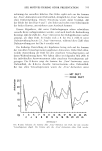
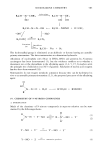
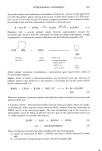
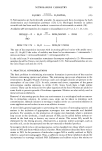
TRANSEPIDERMAL WATER LOSS 577 presence of sweat is either inhibited by inactivation of sweat glands by use of an- ticholinergic drugs (20) or ascertained by the galvanic conductivity of skin (9). If the sweating is not inhibited, attempts are made •,, hold •bin t,=•,,,,o•t,,• b•l(•,, 34øC_ which is the lower threshold of sweating. Low air-flow rates are appropriate for diffu- sion measurements in intact skin between 50 and 300 ml/min is the usual range, but the flow must be adjusted to the rate of water loss. Too small a flow will allow the hu- midity to build up in the system, or, in sweat studies, may fail to vaporize the droplets as they form. Too large a flow may result in uneven mixing since the relative humidity (RH) and temperature (T) of the air is monitored prior to and following its passage over the skin surface, the difference in relative humidity (& RH) represents the water vapor picked up at the skin surface (21). Each measurement requires approximately 15 to 20 min. Most •L measurements are performed with a Sage electric hygrometer, Model 154 (Sage Instruments, White Plains, New York) using lithium bromide sens- ing elements. The •L may be calculated according to the formula (21): &RH 1 TWL - x D • AF • -- (1) 100 A where: TWL is the transepidermal water loss in mg cm-'- 2 hr--• ARH is the difference between the incoming and effluent relative humidities D is the weight of water per liter of saturated steam at the temperature of the air passing over the skin in mg 1 -• AF is the volumetric air flow rate in 1 hr -• A is the area of skin in cm 2 the density of saturated steam (D) at different temperatures is obtained from tables. In a variant hygrometer method, TWL was determined by Berube et al. (33), using compressed air as a carrier gas. The flow of the gas was split into two streams to flow over the left and right arm of subjects. Each stream then flowed over a Sage hy- grometer where the moisture is swept from the surface of the skin into the gas stream. The stream passes through the sensing chamber Dew Point hygrometer (Cambridge Systems, Newton, Massachusetts) where the amount of moisture present is measured utilizing the dew point principle. The concentration of water vapor in a gas stream can also be measured by its absorp- tion of i.r. radiation (15). TWL can be measured on areas from 20 cm 2 (34) to as low as 1 to 4 cm • (35). The principle is that infrared radiation passes through two conduction tubes and then into the i.r. detector. In practice, dry gas is passed over the skin surface and the moistened gas is then passed through the analyzer. When the gas stream containing water vapor is passed through the conduction tube, while the other is flushed with dry gas, some radiation is removed by the wet gas stream. This produces an imbalance in the radiation absorption between the two sides of the detector which is a measure of the TWL. The measurement is made when water loss becomes constant at a particular flow of dry nitrogen gas over the skin. This is called the equilibrium state because loss of water from the skin surface is exactly matched by water diffusing up from the epidermis. Measured in this way, it was found that the rate of TWL was modified by the rate of flow of dry gas increases in the flow of dry gas produces cor-
Purchased for the exclusive use of nofirst nolast (unknown)
From: SCC Media Library & Resource Center (library.scconline.org)