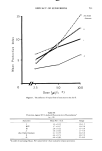
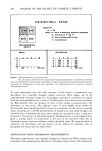
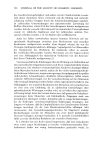
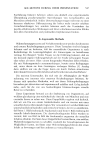
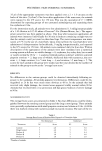
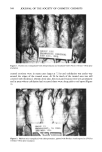
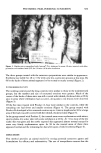
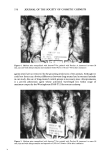
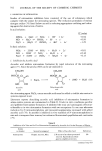
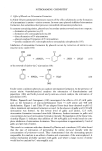
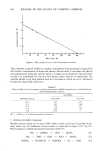
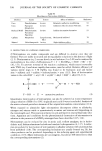
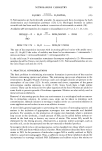
EFFICACY OF SUNSCREENS 527 RESISTANCE TO WASH-OFF Treated forearm sites were covered by perforated plastic cups for 2 hr to enable diffu- sion into the horny layer. The forearm was then immersed in a tub of tap water at room temperature for 10 min, followed by air drying for 10 to 15 min. The challenge ex- posure was three MED's with reading of the degree oferythema on a 0 to 3 scale 24 hr later, as follows: 0, normal skin 1 +, minimal redness equivalent to one MED 2 +, more intense erythema 3 +, intense erythema and edema. This was found suitably dis- criminating and entailed considerably less effort than giving a series of exposures to de- termine the postimmersion S.P.F. RESISTANCE TO SWEATING The test agents were applied to the mid-back and the sites protected with perforated cups for 2 hr while the subjects remained inactive in an air-conditioned room. Sweating was then induced in an environmental chamber at 110øF and 65% R.H. for 30 min while the subjects sat upright. After leaving the chamber, the skin was air dried for 10 to 15 min and the sites challenged with three MED's. CUMULATIVE EFFECT This test measures the capacity of the material to form a horny layer reservoir. The agents were applied once daily each morning to the same forearm site for three consecutive days. The sites were not protected during this time the subjects engaged in their usual activities. On the morning of the fourth day the arms were immersed in a tub of tap water at room temperature for 10 min, allowed to air dry and challenged with three MED's. SCOTCH-TAPE STRIPPING This test establishes whether the sunscreen is of the external type (on the surface) or internal (within the coherent portion of the stratum corneum). Practically speaking, this test corresponds to abrasion resistance and is preferred because of greater con- trollability. The test agents were applied as above to the same site once daily each morning for three consecutive days. On the fourth day the forearms were washed with soap and water and lightly dried with a towel. Each site was then stripped five times with scotch tape and challenged with three MED's. DOSE-RESPONSE S.P.F. values were determined immediately after application at three dosage levels: 2.5 /zl/cm2 5.0/zl/cm 2 and 10.0/zl/cm •. PROTECTION AGAINST UV-A This was assessed by determining the protective factor in skin pretreated with fluoranthrene, a polycyclic hydrocarbon photosensitizer. A solution of 20/zl of 0.5% fluoranthrene in 95% ethanol was applied to 2 cm squares of skin outlined by white ad- hesive tape, providing a dose of 5.0/zl/cm •. After drying, the sites were covered with equal square patches of nonwoven cotton cloth (Webril, Curity) and fastened to the

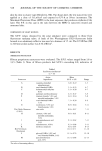
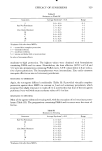
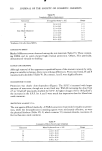
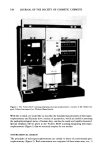
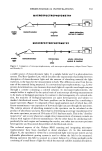
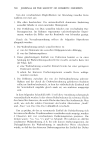
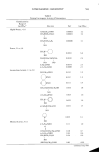
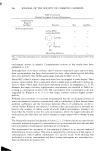
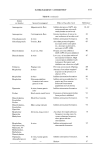
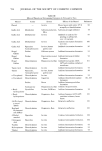
528 JOURNAL OF THE SOCIETY OF COSMETIC CHEMISTS skin by clear occlusive tape (Blenderm, 3M). Two hours later, the test sunscreens were applied at a dose of 5.0/xl/cm 2 and exposed to UV-A at 30-sec increments. The Minimum Phototoxic Dose (MPD) is the least exposure that produces erythema 24 hr later. The P.F. in this case is the ratio between the MPD in sunscreen treated and untreated skin. COMPARISON OF LIGHT SOURCES The S.P.F. values obtained by the solar simulator were compared to those from fluorescent suniamp tubes. A bank of five Westinghouse FS20 fluorescent bulbs housed in an aluminum reflector was used at a distance of 15 cm. The UV-B flux (280 to 320 nm) at skin surface was 0.54 mW/cm 2. RESULTS IMMEDIATE PROTECTION Fifteen proprietory sunscreens were evaluated. The S.P.F. values ranged from 3.8 to 13.5 (Table I). Nine of fifteen products had S.P.F.'s exceeding 8.0, indicative of Table I Sun Protection Factors a (n = 10) Active Mean Sunscreen Ingredients S.P.F. - S.E. Range A isoamyl-p-dimethyl 3.8 --- 0.22 3-5 aminobenzoate B amyl dimethyl PABA 5.1 ___ 0.35 4-7 C homomenthyl salicylate 5.3 + 0.28 4-7 8.0% D padimate and dioxybenzone 6.3 + 0.47 5-9 E titanium dioxide, 5.0% and 6.6 + 0.34 5-8 menthyl anthranilate, 5.0% F octyl dimethyl PABA 7.3 + 0.30 6-9 3.3% G oxybenzone, 3.0% and 8.8 + 0.64 5-11 dioxybenzone, 3.0% Zinc Oxide Ointment zinc oxide 8.8 + 0.67 7-11 (U.S.P.) H cinoxate, 4.0% and 9.0 + 0.61 8-11 menthyl anthranilate, 5.0% I para aminobenzoic acid 9.1 + 0.62 7-11 5.0% J sulisobenzone, 10.0% 9.2 + 0.68 5-11 K methoxy cinnamate 9.8 --- 0.93 8-15 Red Veterinary 12.6 + 0.71 11-16 Petrolatum L 13.1 --- 0.76 12-18 13.5 -+ 0.48 12-15 glyceryl PABA, 3.0% and octyl dimethyl PABA, 3.0% para aminobenzoic acid, 5.0% aIn order of increasing efficacy.
Purchased for the exclusive use of nofirst nolast (unknown)
From: SCC Media Library & Resource Center (library.scconline.org)