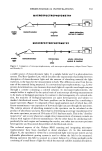
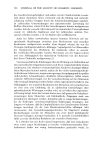
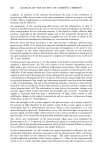
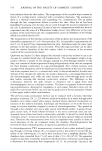
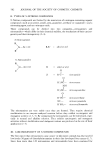
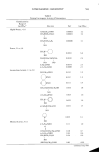
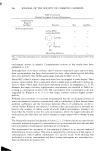
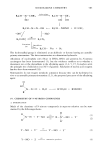
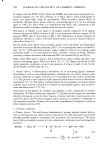
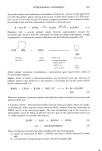
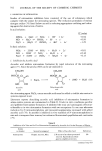
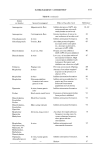
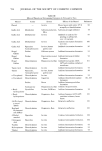
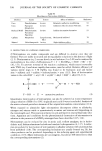
586 JOURNAL OF THE SOCIETY OF COSMETIC CHEMISTS Nitrosation of secondary amines and amides is described by eq 1. The effectiveness of the nitrosating agent Y--NO depends on the nature of Y. Catalysis ofnitrosation by Y' species results from its prior reaction with Y--NO (eq 3), which produces the more active nitrosating agent Y'--NO. When Y is a secondary amine function, eq 1 describes transnitrosation as it is defined in this paper. Inhibition of nitrosation occurs by reaction of inhibitor Z with nitrosating agent Y--NO in the irreversible eq 4, which is much faster than 1 and produces unreactive products. Destruction of N-nitroso compounds by denitrosation is described by eq 2. Addition of Z, in this case called a trap or scavenger, is necessary to prevent via 4 the reversal of denitrosation, eq 1. Details of these reactions and the chemistry of N-nitroso compounds not included in this scheme are described below. B. FORMATION 1. Nitrosating Agents a. Inorganic Species. Several nitrogen oxide species are nitrosating agents, but nitrous acid (HONO) and the nitrite ion (ONO-) are themselves inactive (19). Known inor- ganic nitrosating species are: Substance Medium N2Oa gas (20, 21) water (19, 22-27) organic solvent (2) NO2/N204 water (25-27) organic solvent (28, 29) gas (21, 30) YNO water ( 19, 22, 23, 31- 37) H2ONO + water (19, 22, 38-40) NO plus O2 (25, 27, 36) anaerobic, M n+ (19, 27) The interrelationship between active nitrosating agents (underlined) and inactive species is summarized below. For simplicity, the equations are not balanced. --H + --H•O H•ONO + • HNO• - ' N•Oa YNO + H20 NO•- + H20 NO + Mn+ ß NO + NO• Io_ In moderately acidic aqueous nitrite solutions the nitrosating agent is nitrous anhy- dride, N2Oa (19, 22-24), formed from nitrous acid, pK• = 3.138 at 25 ø (41, 42), after protonation of nitrite ion according to eqs 5 and 6.

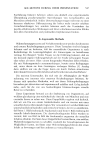
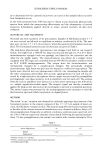
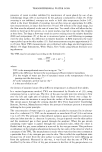
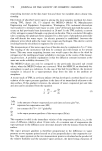
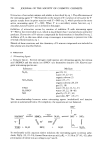
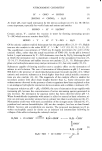
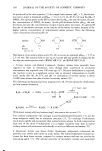
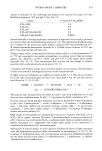
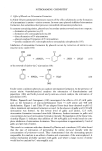
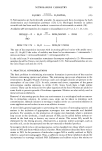
NITROSAMINE CHEMISTRY 587 H + + ONO- • HONO (5) 2HONO --' ONNO2 + H20 (6) At lower pH, more rapid nitrosation by the nitrous acidium ion (19, 22, 38-40) be- comes important, especially for weakly basic aryl arnines and amides. HONO + H + -'-' H2ONO + (7) Certain anions, Y-, catalyse the reaction in water by forming nitrosating species Y--NO which are more reactive than NzOa. HONO + Y- + H + •- Y--NO + H•O (8) Of the anionic catalysts studied thiocyanate has the greatest effect (23, 31-37). Halide ions are also catalytic in the order SCN-, 1- Br- Ci- (19, 22, 23, 31, 33, 35). The equilibrium concentration of YNO (eq 8) mainly determines the order of the catalytic effect, rather than the actual reactivities of YNO (36). As the pH is lowered below 2, rapid nitrosation by Y--NO dominates over that by NzOa, lowering the pH at which the nitrosation rate is maximum compared to the uncatalysed reaction (23, 32-34, 37). Perchlorate and sulfate ions are not catalytic (22, 31, 33). Hydrogen phos- phate and carboxylate anio ns may catalys e nitros atio n (31), but only weakly ( 19, 33). Substances capable of forming micelies exert a catalytic effect on the nitrosation of amines in acid solution. The rate of nitrosation of dihexylamine at pH 3.5 increases 800-fold in the presence of decyltrimethylammonium bromide micelies (43). Other cationic and nonionic substances at levels higher than their critical micelie concentra- tions are also catalytic (43, 44). The magnitude of the catalytic effect is smaller for secondary amines with alkyl chain lengths shorter than C6. Some nitrosation rate enhancements observed in the presence of microorganisms have been explained as due to an analogous hydrophobic interaction between amine and a cellular constituent (45). In aqueous solution at pH pKa of HNO2 the rate of nitrosation drops rapidly with increasing pH, because the concentrations of active nitrosating species generated in situ decrease. No nitrosation by aqueous nitrite has been observed above pH 7.5. When formaldehyde (equimolar with amine) is added to neutral or basic solutions, ni- trite can nitrosate secondary amines, but at a slower rate than in acid solutions (46, 47). Nitrosamine yields vary with steric accessibility of the nitrogen atom. Chloral (46, 47), pyridoxal and various benzaldehydes (48) are also catalytic, but less so than formal- dehyde. Acetone and acetaldehyde are inactive. The proposed mechanism (eq 9) in- volves nucleophilic attack by nitrite on an iminium ion intermediate following by collapse of the adduct releasing the carbonyl catalyst. --OH- + + - ' R•N•CHR' ( ) R•N--CHR' .. RzN-- CHR' " I R=N--NO + O•---CHR' * N--O ReNH + O-•-CHR' (9)
Purchased for the exclusive use of nofirst nolast (unknown)
From: SCC Media Library & Resource Center (library.scconline.org)