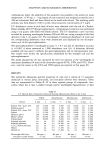
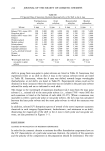
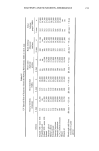
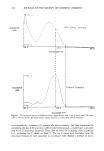
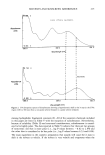
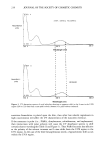
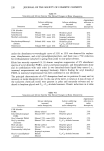
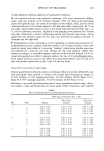
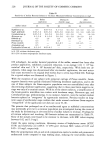
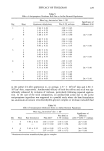
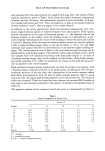
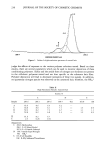
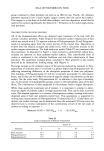
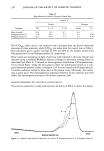
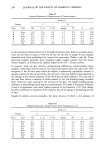
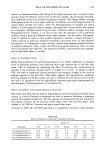
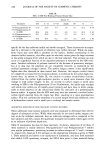
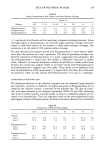
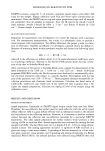
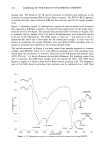
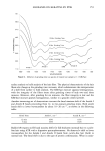
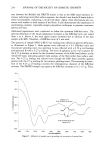
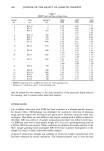
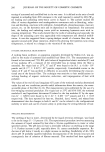
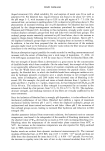
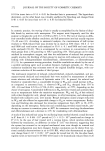
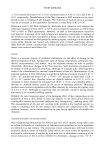
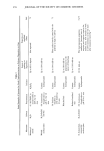
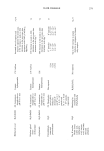
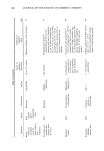
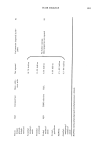
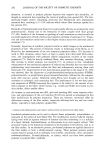
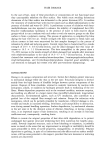
220 JOURNAL OF THE SOCIETY OF COSMETIC CHEMISTS Table VI Sunscreens and Solvent Systems That Showed Changes in Molar Absorptivity Sunscreen Approximate Solvent exhibiting Solvent exhibiting reduction in increased decreased molar molar absorptivity molar absorptivity absorptivity UVA Absorbers Dioxybenzone Sulisobenzone Menthyl anthranilate Butylmethoxydibenzoyl- methane Oxybenzone Hexane Ethanol 90%-water 10% Ethanol 70%-water 30% Ethanol 90%-water 10% Ethanol 90%-water 10% Hexylene glycol 40% Methyl carbitol 37% Isopropyl palmitate 25% Isopropyl myristate 25% Hexylene glycol 24% C12-C15 alcohols benzoate 24% Mineral oil 18% under the absorbance-vs-wavelength curve of 32% to 35% was observed for oxyben- zone, dioxybenzone, and octyl cyanodiphenylacrylate, and there was a 75% reduction for triethanolamine salicylate in going from polar to non-polar solvents. Klein has recently reported (4, 13) almost complete suppression of UV absorbance spectra of octyl dimethyl PABA, octyl p-methoxycinnamate, and benzophenones alone and in combination with each other in two branched-chain liquid fatty esters (i.e., isostearyl neopentanoate and isopropyl linoleate). Klein's finding for octyl dimethyl PABA in isostearyl neopentanoate has been confirmed in our laboratory. The principal characteristics of a UV absorption band are its position (k max) and its intensity or molar absorptivity (½). In the case of the latter, ½ values at k max of most of the sunscreen chemicals tested were greatest in polar and non-polar solvents and re- duced in hexylene glycol and C•2-C•5 alcohols benzoate. Drastic reductions in ½ value Table VII Sunscreens and Solvent Systems That Showed Changes in Molar Absorptivity Sunscreen Approximate Solvent exhibiting Solvent exhibiting reduction in increased decreased molar molar absorptivity molar absorptivity absorptivity UVB Absorbers PABA Ethyl dihydroxypropyl PABA Octyl dimethyl PABA Octyl p-methoxy cinnamate TEA salicylate Octyl salicylate Homomenthyl salicylate Octyl-2-cyanodiphenyl- acrylate Ethoxy ethanol Ethanol 33% Ethanol 90%-water 30% Hexylene glycol 23% Ethanol 70%-water 30% Ethanol 70%-water 30% Hexylene glycol 21% C12-C 15 alcohols benzoate 25 % Methyl carbitol Hexylene glycol Ethanol 70%-water 30% Hexylene glycol Hexane Hexylene glycol Isopropyl myristate Hexane C12-C15 alcohols Ethanol benzoate 29% 20% 55% 28%

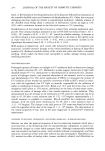
SOLVENTS AND SUNSCREEN ABSORBANCE 221 in such semi-polar solvents would require increasing the concentration of required sun- screen for maximum protection or, in the case of branched-chain liquid fatty esters, replacement with a more appropriate solvent. In conclusion, the wavelength of maximum absorbance (h. max) in the UVA and UVB regions of the spectrum and the resultant molar absorptivity (E) of a sunscreen chemical often will be affected by the solvent in which it is dissolved. The changes observed in these two important parameters appear to be strongly influenced by the polarity and chemical structure of both the sunscreen and the solvent. The results of the present study of the interaction between sunscreens and solvents provide practical information that cosmetic chemists may find useful in formulating sunscreen preparations. REFERENCES (1) S. Riegelman and R. P. Penna, Effect of vehicle components on the absorption characteristics of sunscreen compounds, J. Soc. Cosmet. Chem. 11, 280-291 (1960). (2) G. A. Groves, Factors influencing the formulation of sunscreens, Amer. Cosm. Perf., 87, 54-58 (July 1972). (3) B. M. Cumpelik, Sunscreens at skin application levels: Direct spectrophotometric evaluation, J. Soc. Cosmet. Chem., 31, 361-366 (1980). (4) K. Klein and I. Doshi, Sunscreen/solvent interactions: An in-vitro evaluation, 14th International IFSCC Congress, September 16-19, 1986, Barcelona, Spain. (5) For a more detailed explanation of the experimental procedure and results, refer to: L. E. Agrapidis- Paloympis, The Influence of Solvent on the UV Absorbance of Sunscreens, M.S. Thesis, St. John's University (1987). (6) Department of Health, Education and Welfare, US FDA, Sunscreen drug products for over-the- counter human use, Fed. Reg., 43(166), 36206-38269 (1978). (7) C. Vaughan, Using solubility parameters in cosmetic formulations, J. Soc. Cosmet. Chem. 36, 319-333 (1985). (8) Spectrometry nomenclature, Anal. Chem. 56, 125 (1984). (9) R. F. Rekker, The Hydrophobic Fragment Constant (Elsevier Scientific Publishing Company, New York), 1977. (10) N. A. Shaath, The chemistry of sunscreens, Cosmetics and Toiletries, 101, 55 (March 1986). (11) N. A. Shaath, On the Theory of Ultraviolet Absorption of Sunscreen Chemicals, Annual Meeting of the Society Cosmetic Chemists, New York, December 1986, J. Soc. Cosmet. Chem., 82, 193-207 (May/ June 1987). (12) J. Vogelman, E. Nieves, J. Brind, R. Nash, and N. Orentreich, A spectrophotometric method for determining relative SPF values of sunscreen preparations, J. Applied Cosmetol., 1, 1-11 (1985). (13) K. Klein, Van Dyk Division, Mallinckrodt, Inc., Belleville, NJ 07109, private communication.
Purchased for the exclusive use of nofirst nolast (unknown)
From: SCC Media Library & Resource Center (library.scconline.org)