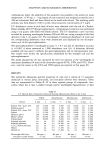
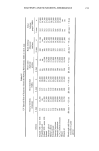
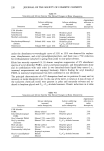
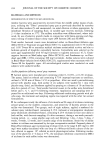
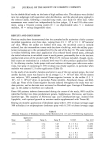
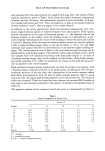
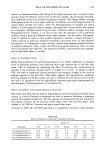
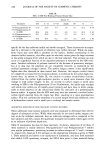
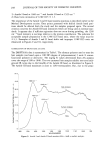
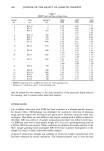
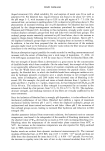
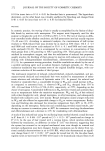
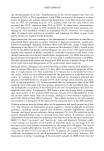
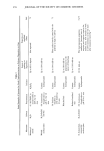
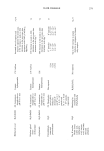
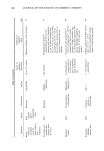
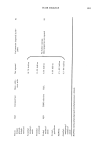
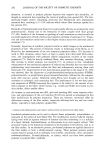
244 JOURNAL OF THE SOCIETY OF COSMETIC CHEMISTS Table IX Effect of SDS Post-Washing Polymer-Treated Hair Atomic % Treatment CH C - O C = O Amide N + O S .1% Polyquaternium- 10 51.6 22.6 5.4 1.9 0.7 16.2 0.79 .1% Polyquaternium- 10 + 1% SDS 48.4 14.4 6.1 6.8 0.3 18.3 3.20 ß 1% Polyquaternium-24 42.7 26.9 3.4 2.2 0.6 21.1 1.30 ß 1% Polyquaternium-24 q- 1% SDS 44.0 18.4 6.2 6.4 0.3 20.3 2.40 specific for the hair substrate (sulfur and amide nitrogen). These increases are accompa- nied by a decrease in the amount of cellulosic-type carbon detected. While the possi- bility exists that some SDS is adsorbed on the surface, thereby contributing to the observed sulfur intensity, this effect must be relatively minor given the large increases in the amide nitrogen levels which are due to the hair substrate. This increase can only occur if a significant fraction of the deposited polymers is removed by the SDS treat- ment. Another indication of polymer removal is the decrease of quaternary nitrogen, but it is clear that the polymers are not completely removed, as evidenced by the residual quaternary nitrogen content. The surface oxygen content is also significantly higher than that observed on clean control hair. However, this oxygen content cannot be completely accounted for by retained polymer, as evidenced by the carbon high-reso- lution data. As shown in Table IX, the decline in surface alcohol/ether content, derived from the carbon high-resolution spectra, is much more dramatic than the change in total surface oxygen. In fact, an increase in surface oxygen is noted upon washing in SDS in the Polyquaternium-10 set! Furthermore, the amide-type nitrogen and amide-type carbon are of roughly equal intensity and have risen to levels compa- rable to those observed on the control hair (Table II), indicative of a predominantly keratin surface. It appears that the SDS wash may have also removed a residual hydro- carbon (lipid) material from the virgin hair fiber, resulting in a more proteinaceous surface. This was confirmed by treatment of a control sample which also exhibited a loss of hydrocarbon content with a small rise in carbonyl and amide content. ADSORPTION BEHAVIOR OF NON-CELLULOSIC CATIONIC POLYMERS Three additional vinyl cationic polymers were also examined to determine their relative degrees of adsorption on hair. While these materials do not enrich surface oxygen con- tent as do the cellulosic materials, they are relatively nitrogen-rich as compared to the hair substrate and they contain the quaternary nitrogen functionality which again serves as an indicator of polymer deposition. Table X summarizes the data for these materials. As shown, deposition of all three of these materials is readily detected. Polyquaternium-5 and Polyquaternium-7 exhibit very similar performance, producing increases in surface nitrogen of 1.7 and 1.4 atomic %, respectively, based on 6.4% nitrogen on the original hair substrate as given in Table I. These materials are known to be copolymers of acrylamide, and since both materials also exhibit 0.8% quaternary nitrogen, the ESCA data point to these materials being

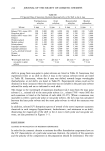
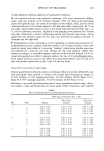
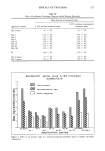
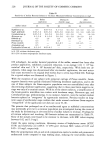
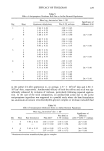
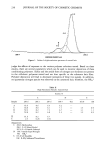
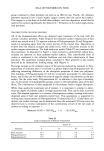
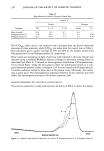
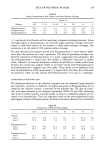
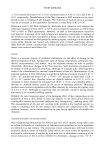
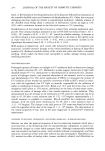
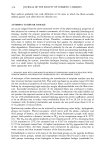
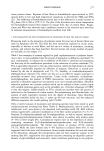
ESCA OF POLYMERS ON HAIR 245 Table X Surface Composition of Hair Treated with Non-Cellulosic Polymers Atomic % Polymer CH C - O C = O N N + O S Polyquaternium-5 52.0 11.8 11.7 7.3 0.8 13.8 2.4 Polyquaternium-7 58.2 12.4 6.9 7.0 0.8 12.3 2.4 Polyquaternium- 11 54.5 15.1 7.8 6.6 0.6 12.8 1.6 1:1 copolymers of acrylamide and the quaternary nitrogen-containing monomer. Given this high degree of quaternization, the relatively large quaternary nitrogen levels ob- served on these fiber surfaces do not translate to high surface polymer coverages. Our estimation is on the order of 10% polymer surface coverage. The data obtained from samples treated with Polyquaternium-11 show distinct differ- ences from the previous two vinyl copolymers. The level of quaternary nitrogen con- ferred by adsorption of Polyquaternium-11 is lower, suggesting lower adsorption. But the Polyquaternium-ll treated hair does exhibit a substantial reduction in surface sulfur, indicative of increased adsorption, whereas the similarity in surface sulfur levels between the control hair samples (Table I) and those treated with Polyquaternium-5 and Polyquaternium-7 suggests very little upake. These results can be explained if the level of quaternization of Polyquaternium-11 is appreciably lower than that of the other two polymers. Thus, the data indicate that Polyquaternium-11 is not a 1:1 copolymer. ADSORPTION ON BLEACHED HAIR The adsorption behavior of the cellulosic polymers was also examined using bleached hair substrates. As shown in Table XI, the higher adsorption of Polyquaternium-24, as judged by the cellulosic content, is observed on this substrate also. The data are consis- tent with those obtained in the designed experiment (Tables VI and VII), indicating that levels of surface polymer coverage similar to those on unbleached samples are ob- tained on the bleached hair. This is an important result in that prior experiments using radiotagged versions of Polyquaternium-10 showed increased substantivity on bleached Table XI Compositions of Bleached Hair Samples CH C-O C=O N N + O S Controls Area 1 53.0 12.8 9.1 8.3 -- 12.2 2.9 Area 2 51.6 13.6 9.6 7.2 -- 14.8 2.5 Polyquaternium- 10 Area i 45.6 16.9 12.2 6.8 0.6 14.5 2.7 Area 2 43.3 18.7 8.1 6.5 0.7 18.8 2.4 Polyquaternium- 24 Area 1 27.1 29.5 11.3 3.3 0.7 23.9 1.6 Area 2 31.7 33.9 6.7 1.4 0.4 23.6 0.9
Purchased for the exclusive use of nofirst nolast (unknown)
From: SCC Media Library & Resource Center (library.scconline.org)