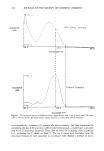
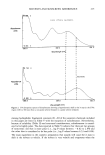
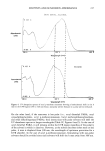
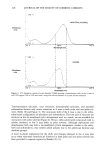
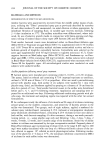
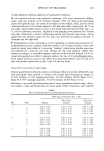
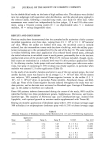
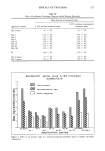
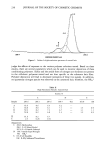
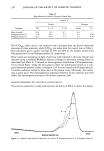
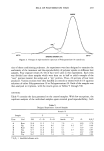
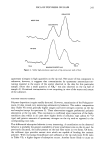
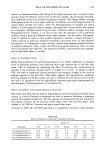
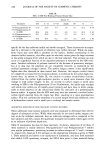
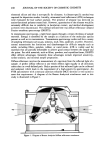
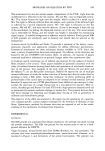
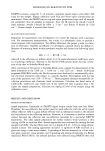
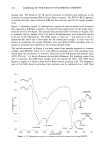
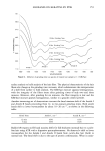
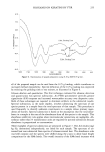
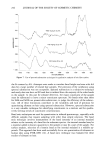
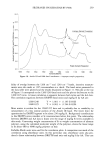
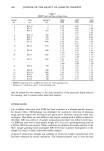
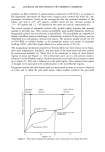
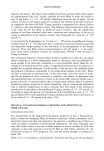
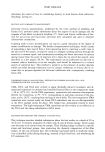
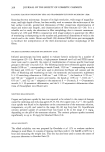
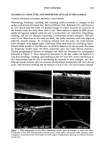
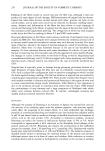
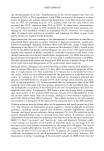
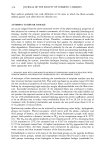
252 JOURNAL OF THE SOCIETY OF COSMETIC CHEMISTS mixing trial. The bands in the IR spectra increased in intensity and definition as the intimacy of mixing between KBr and hair fibers increased. The WIG-L-BUG appeared to provide the best contact between KBr and hair and was used for all sample prepara- tions. Figure 3 illustrates typical % transmittance spectra of silicone-treated and untreated hair prepared as KBr/hair mixtures. The general band assignments for the major inten- sities are noted in the figure. The primary hair protein bands of interest are Amide I due to carbonyl stretch, Amide II for C-N and N-H deformations, and Amide III also for C-N and N-H deformations. The SiMe band at 1260 cm -x was selected as the si- 1oxane-specific band and is detectable for the treated hair sample. A study was con- ducted to determine the proper KBr/hair ratio and WIG-L-BUG grinding time re- quired to maximize the intensity of the siloxane-specific band. The spectra presented in Figure 4 are from treated hair samples prepared at constant weight using KBr/hair ratios of 1:1 and different grinding times. The grinding times varied from two minutes to 12 minutes. Only part of the full spectra was plotted, from 1850-950 cm-x, to better illustrate the spectral differences. For grinding times of six and 12 minutes, the SiMe band merges with the Amide III band. The SiMe band begins to appear as a distinct band with a three-minute grinding time. The disappear- ance of the SiMe band as grinding time increases can be interpreted as a shift from 64.6 58.9 53.5 uJ 48.1 z • 42.7 z 37.3 31.9 26.5 Treated Hair • / / J •u Untreate N_H Slre•tch C-H Stretch Am,d e I -•-•-•J' •'% A rn•ime': alII 4300 3900 3500 3100 2700 2300 1900 1500 1100 700 WAVENUMBERS Figure 3. % Transmittance spectra of siloxane-treated and untreated hair using DRIFTS.

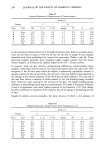
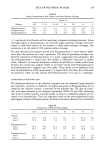
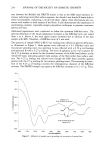
SILOXANES ON KERATINS BY FTIR 253 76.1 66.8 57.5 48.2 38.9 29.6 12 M•n. Grinding %me 6 M•n. Gnnd•ng T•me 20.3 11.0 3 Min. Gnndlng %me Amide I 2 Mm, Grinding Twn• 1850 1750 1650 1550 1450 1350 1250 1150 1050 950 WAVENUMBERS Figure 4. Influence of grinding time on spectra of treated hair sample at 1:1 KBr/hair. surface analysis to bulk analysis of the hair fiber. The physical characteristics of the hair fibers also change as the grinding time increases, which substantiates the interpretation of a shift from surface to bulk analysis. The KBr/hair mixture appears heterogeneous, with the integrity of the fibers intact after grinding times of only two and three minutes. However, after grinding for six minutes, the fiber integrity is lost and the KBr/hair mixture appears homogeneous, similar to a grayish colored powder. Another interesting set of observations concerns the band maxima shift of the Amide ! and Amide II bands proceeding from 12- to two-minute grinding times. Both amide bands shift to lower wavenumbers by about 10-20 cm-•, as shown in the following table: Grind Time Amide I, cm-• Amide II, cm-• 12 min 1670 1533 3 min 1654 1524 Baddiel (8) reports on IR band maxima shifts for full-thickness (normal) hair vs cuticle- free hair using ATR with a dispersive spectrophotometer. He observed a shift to lower wavenumbers for the Amide ! and Amide I! bands from cuticle-free hair (bulk) to normal hair. The band shift is due to the type of protein conformation. What is consis-
Purchased for the exclusive use of nofirst nolast (unknown)
From: SCC Media Library & Resource Center (library.scconline.org)