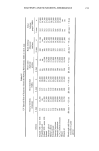
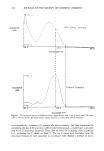
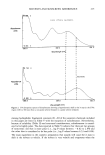
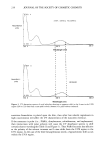
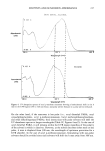
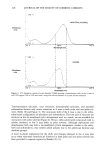
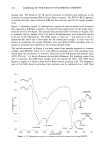
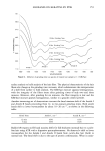
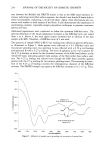
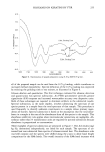
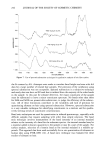
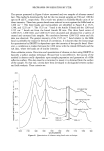
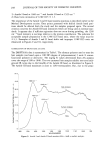
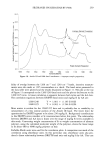
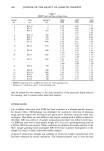
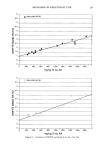
262 JOURNAL OF THE SOCIETY OF COSMETIC CHEMISTS was based upon a 100 DP 2 mole % amine-functional siloxane polymer (trimethylsilyl- amodimethicone) or derivative. Both treated and untreated hair samples were analyzed using DRIFTS and the band ratios of 1260/1240 and 1260/1225 measured for each sample. The band ratios correlate with the weight concentration of Si in the hair, and the result is a linear relationship. The lower detection limit for quantitation is about 250 mg/kg Si or 680 mg/kg siloxane polymer. The correlation is linear to 1840 mg/kg Si, which converts to 6800 mg/kg siloxane polymer. Detection and quantitation of siloxane on hair using DRIFTS is essentially a surface analysis technique. Criteria have been developed to distinguish between surface and bulk analysis. These criteria are: 1) Amide I band at 1660 cm-• and Amide II at 1520 cm-•, and 2) band ratio intensities of 1240/1225 • 1.3. The potential use of DRIFTS in further keratin fiber studies, as well as with other materials, is exciting. In fact, this technique has been successfully applied in our labora- tories to cloth fibers. The deposition of any material that has a distinctive IR band could be assayed by this method. DRIFTS should also be applicable to the study of hair surfaces for both chemical and environmental damage. REFERENCES (1) S. R. Wendel and A. J. DiSapio, Organofunctional silicones for personal care applications, Cow•etzcs & Toiletries, 98(5), 103-106 (1983). (2) M. S. Starch, Silicones in hair care products, Drug and Cosmetic Industry, 134(6), 38-44, (1984). (3) M. S. Starch, Silicones for conditioning damaged hair, Soap/Cosmetics/Chemical Specialties. 62(4), 34-39, (1986). (4) G. Kohl and E. Gooch, J. Soc. Cosmet. Chem., submitted for publication. (5) P. R. Griffiths and M.P. Fuller, "Mid-Infrared Spectrometry of Powdered Samples," in Advances in Infrared and Raman Spectroscopy, R. J. H. Clark and R. E. Hester, Eds. (Heyden, London, 1981), Vol. 9, Chap. 2. (6) G. J. Weston, The infra-red spectrum of peracetic acid-treated wool, Blochim. Biophys. Acta., 47, 462-464 (1955). (7) H. Alter and M. Bit-Alkhas, Infrared analysis of oxidized keratins, Text. Res. J., 39, 479-481 (1969). (8) C. B. Baddiel, Structure and reactions of human hair keratin: An analysis by infrared spectroscopy, J. Mol. Biol., 38 181-199 (1968). (9) M. J. D. Low and A. G. Severalia, Infrared spectra of a single human hair, Spectrosc. Lett., 16(11), 871-877 (1983). (10) J. Strassburger and M. M. Breuer, Quantitative Fourier transform infrared spectroscopy of oxidized hair, J. Soc. Cosmet. Chem., 36, 61-74 (1985). (11) P. Kubelka and F. Munk, Ein betrag zur optik der farbanstriche. Z. Tech. Phys., 12, 593 (1931). (12) H. M. Klimisch and G. Chandra, Use of Fourier transform infrared spectroscopy with attenuated total reflectance for in vivo quantitation of polydimethylsiloxanes on human skin, J. Soc. Cosmet. Chem., 37, 73-87 (1986).

j. Soc. Cosmet. Chem., 38, 263-286 (July/August 1987) Hair damage and attempts to its repair j. JACHOWICZ, Clairol, Inc., 2 Blachley Road, Stamford, CT 06922. Received February I0, I987. INTRODUCTION The changes to the physical properties of hair fibers incurred as a result of weather, handling, and cosmetic treatments such as bleaching, waving, dyeing, or relaxing can be significant. In many instances they may lead to premature fracture of the hair, longitudinal fibrillation or separation of the hair cortex, loss of gloss, or increased absorption of moisture. The present paper is concerned with the identification of phys- ical and physicochemical alterations in fiber structure and properties caused by a variety of degradative processes, reviewing the methods used to assess the extent of damage and identifying the treatments capable of stabilizing or enhancing the properties of hair fibers. CRITICAL ELEMENTS OF FIBER STRUCTURE AND THE PHYSICAL PROPERTIES OF UNDAMAGED HAIR Hair fibers have two major morphological components, the cuticle and the cortex. The cuticle covers the whole fiber and is composed of layers of overlapping scales each about half a micron thick (1). In a newly formed fiber there may be as many as ten overlap- ping scales in a crossection. The outermost layer of a cuticle cell is made up of a very thin membrane (3 nm) called the epicuticle. The next layer, exocuticle, consists of cystine-rich, highly crosslinked protein and represents about two-thirds of the cuticle structure (1,2). Beneath this, there is an endocuticle which has a low cysteine content and is mechanically the weakest part of the cuticle (2). Lastly, there is a thin layer of cell membrane complex. Both X-ray analysis and optical birefringence measurements have demonstrated the lack of molecular orientation in the cuticle (3,4). Some data exist which point to solvent-induced ordering during swelling (5). The main function of the cuticle is to provide mechanical protection for the cortex. The role of the cuticle seems to be minor (2) in terms of contribution to the bulk longitu- dinal mechanical properties of the fiber as a whole. On the other hand, the cuticle has been shown to be an important factor in torsional mechanical properties of hair (6). While both the torsional modulus and logarithmic decrement exhibit no apparent de- 263
Purchased for the exclusive use of nofirst nolast (unknown)
From: SCC Media Library & Resource Center (library.scconline.org)