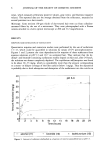
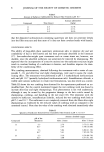
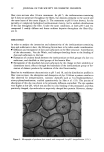
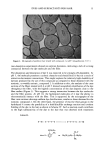
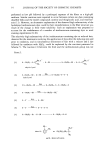
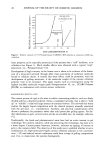
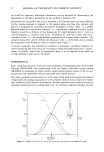
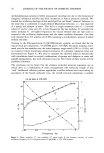
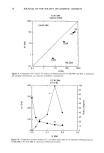
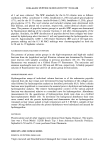
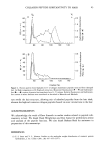
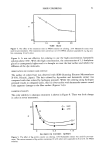
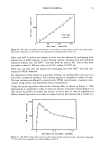
24 JOURNAL OF THE SOCIETY OF COSMETIC CHEMISTS methylammonium salicylate exhibit pronounced viscoelasticity due to the formation of elongated cylindrical micelles and their interaction to form a pervasive network. We studied the oscillatory rheology of this model gel first and found "classical" behavior, in the sense that it conformed to single-element Maxwellian behavior, i.e., that expected of a spring and dashpot in series. This led to a single relaxation time of--2 seconds where G" and G' cross over (8): at low frequencies the loss modulus G" exceeded the elastic modulus G'. At higher frequencies the viscous element does not have time to respond to the oscillatory displacement and the elastic modulus dominates. Our data were obtained for a 5 % solution of CTAB containing a stoichiometric amount of added sodium salicylate. Turning to the Polyquaternium-10 (JR30M)/anionic systems, we found that for the typical thick gel composition, i% JR30M plus 0. i5% SDS, the elastic modulus domi- nated over the loss modulus over the entire frequency range tested (0.001 to i0 Hz), and no crossover (which would have allowed estimation of a dynamic relaxation time) was encountered (see Figure 4). We tried to simulate the observed behavior theoretically with simulations based on several combinations of springs and dashpots in series and parallel arrangements, but with only partial success. The results of these studies will be published elsewhere. The conclusion can be drawn that the ultimate molecular structure represents one in which there is a combination of chain entanglement (the molecular weight of this "stiff" backboned cellulose polymer approaches a million daltons) and cross-linking by association of the bound surfactant ions, the overall structure presenting a complex 1% JR 30M, 0.15% SDS 500 G * G' 200 S ,• t00. 0.00! 0.0t 0.! Frequency Hz ! io 0.01 Figure 4. Elastic modulus, G', loss modulus, G", phase angle, 6, and dynamic viscosity, x]' versus oscillation frequency for 1% Polyquaternium-10 (JR30M), 0.15% SDS mixture.

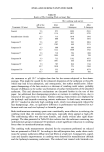
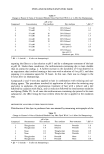
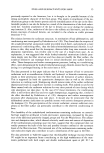
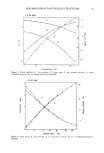
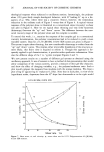
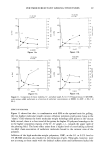
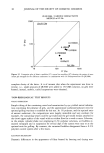
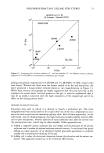
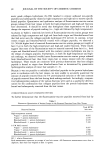
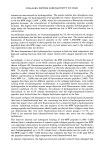
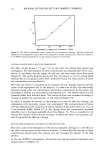
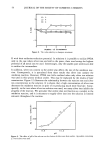
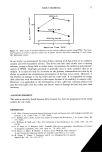
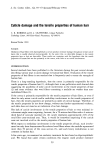
POLYMER/SURFACTANT GELLING STRUCTURES 25 1% JR 30M •5 10 50 5 , 2 Q- i 0.5 0.2 o.i 0.1 i ....... Frequency Hz Figure 5. Elastic modulus, G', loss modulus, G", phase angle, 8, and dynamic viscosity, qr I' versus oscillation frequency for 1% Polyquaternium-10 (JR30M). 1% JR 30M 4. 50 3 • 20 '• 2 0 o i0 5, i 5 '•i '2 '5 .... i0 •0 •0 ' ' ' Shear rate 1/s Figure 6. Shear stress, (y, and viscosity, qrl, as a function of shear rate for 1% Polyquaternium-10 (JR30M).
Purchased for the exclusive use of nofirst nolast (unknown)
From: SCC Media Library & Resource Center (library.scconline.org)