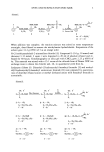
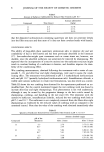
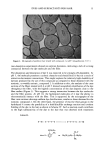
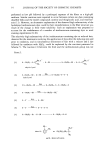
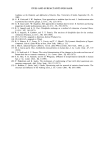
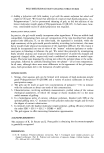
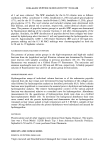
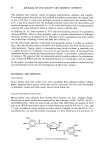
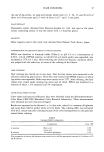
DYES AND SURFACTANTS FOR HAIR 3 Scheme I. 0 F HNCH• CH•OH HNCH• CH•O--S-•CHa H•NCH•CH•I]H • CHsSõ •CI , s 1. H•N•NH• 2. Dowex 50W + _ HNCH•CH•__S•C• NH•X •NH• 4a : X-= CHaSOa- 4b : X-= C1- When addition was complete, the reaction mixture was stirred at room temperature overnight, then filtered to remove the triethylamine hydrochloride. Evaporation of the solvent gave 14.2 g (99%) of 3 as an orange solid. N-(2-isothiuranylethyl)-2-nitroaniline chloride [4]. Compound 3 (2.6 g 10 mmol) and thiourea (1.12 mmol 2 equiv.) were dispersed in 20 ml of absolute ethanol and re- fluxed for 48 hours. Chromatography on silica gel with CHCI 3 gave 2.25 g (69%) of 4a. This material was stirred with a 15:1 excess of the chloride form of Dowex 50W ion exchange resin to obtain the chloride salt, 4b, in quantitative yield from 4a. Surfactants (Scheme II). Dimethyl-(2-hydroxyethyl) hexadecyl bromide [5] and methyl- di[(2-hydroxyethyl)]-hexadecyl ammonium bromide [8] were prepared by quaterniza- tion of dimethyl ethanol amine or methyl diethanoi amine with hexadecyl bromide in acetonitrile. Scheme II. CHa X- CHa X- S CHa X- +l --NH• Br +1 PBr3/Benzene +1 II - H2NCNH2 R•N•CH•CH•0H , R•N--CH•CH•Br , R•--N--CH•CH•S• I I

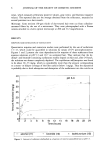
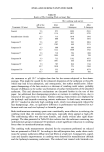
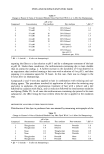
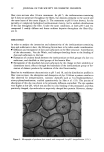
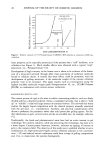
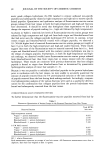
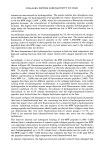
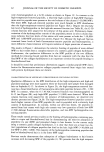
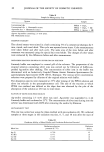
4 JOURNAL OF THE SOCIETY OF COSMETIC CHEMISTS Dimethyl-(2-bromoethyl) hexadecyl ammonium bromide [6]. Surfactant 5 (3.95 g, 0.010 mole) was combined with 0.991 g (0.00366 mole) of phosphorous tribromide in 20 ml of benzene. The mixture was allowed to react with stirring, under nitrogen, for 24 hours at room temperature. The solvent was removed in vacuo and the residue washed several times with anhydrous ether. The resulting amorphous solid was recrys- tallized from ethyl acetate to yield 3.57 g (77%) of the product: mp 185-190 (d). Calculated: %C 52.51 %H 9.49 %N 3.06 %Br 34.93. Found: %C 51.80 %H 10.06 %N 3.06 %Br 34.18. •H NMR (CDCI3) 80.880 (t, 3H), 1.25-1.37 (broad s, 26H), 1.75 (m, 2H), 3.94 (s, 6H), 3.63 (t, 2H), 3.90 (t, 2H), 4.06 (t, 2H). Dimethyl-(2-isothiuranyl)ethyl hexadecyl ammonium dibromide [7]. Compound 6 (9.14 g, 0.020 mole) and thiourea (1.52 g, 0.020 mole) were dissolved in pure ethanol and allowed to reflux for 4-6 h. Upon cooling a precipitate formed which was filtered and recrystallized from ethanol [yield 7.54 g (71%)]. Calculated: %C 47.27 %H 8.89 %N 7.88 %S 6.04 %Br 29.95. Found: %C 47.09 %H 8.85 %N 7.87 %S 6.14 %Br 29.73. •H NMR (D202) 80.878 (t, 3H), 1.27 (broad s, 26H), 1.75 (m, 2H), 3.18 (s, 6H), 3.40 (m, 2H), 3.66 (broad s, 4H). Compounds 9-13 were prepared in a similar manner as 5-7 described above. Hydrolysis of isothiouronium-containing dyes and surfactants. The hydrolysis of the isothi- uronium groups proceeds with the formation of a thiol and urea (9) according to Scheme III. The isothiuronium-containing surfactants and dyes reported in this work were hy- drolized at pH 10.7 for about 60 min prior to use in hair treatment experiments. The presence of mercaptans was confirmed by the formation of the sulfides with lead acetate (15). Only partial hydrolysis (4.8% for compound 7) occurs under these conditions. The pKa of the thiol groups is approximately 10-11 (16). Thus hydrolyzed quaternary ammonium surfactants 7, 10, and 13 are cationic below 10, and zwitterionic at pH above 10. METHODS Adsorption and extraction. The adsorption experiments were conducted in 20-ml vials using 0.5 g of hair fibers and 5.0 ml of surfactant solutions at a concentration of 4 mg/ml and pH 5.3 or 10.7. The pH was adjusted with 1 N solutions of HCl or NaOH. The vials were tumbled continuously at a rate of 8 rpm at ambient temperatures for specified amounts of time. At completion of the adsorption process, 1.5-ml aliquots Scheme III. + 0 (1) R---CH2CH2•S• + -OH , R---CH2CHz•SH + H2N --NH2 •NH2 CHa CHa I•-----C 2C 2SH I•---2-'N--CIt2CH2S - •H.a pH -- 10- 11 [16]
Purchased for the exclusive use of nofirst nolast (unknown)
From: SCC Media Library & Resource Center (library.scconline.org)